Clear Sky Science · en
Atmospheric water vapor contribution to interannual variability of Northern Hemisphere summer heatwaves
Why sticky air can make heatwaves worse
Summer heatwaves are becoming stronger and more frequent across the Northern Hemisphere, from record-breaking events in Europe and North America to searing temperatures in China and India. We know that hotter air can hold more moisture, and that this water vapor acts like an extra blanket, trapping heat near the surface. But in real heatwaves the air is not always muggy—sometimes it is strikingly dry. This study asks a simple but crucial question: when summers swing from milder years to summers packed with extreme hot days, how much of that change is due to the moisture in the air, and how much comes from other factors like clouds, winds, and soil conditions?
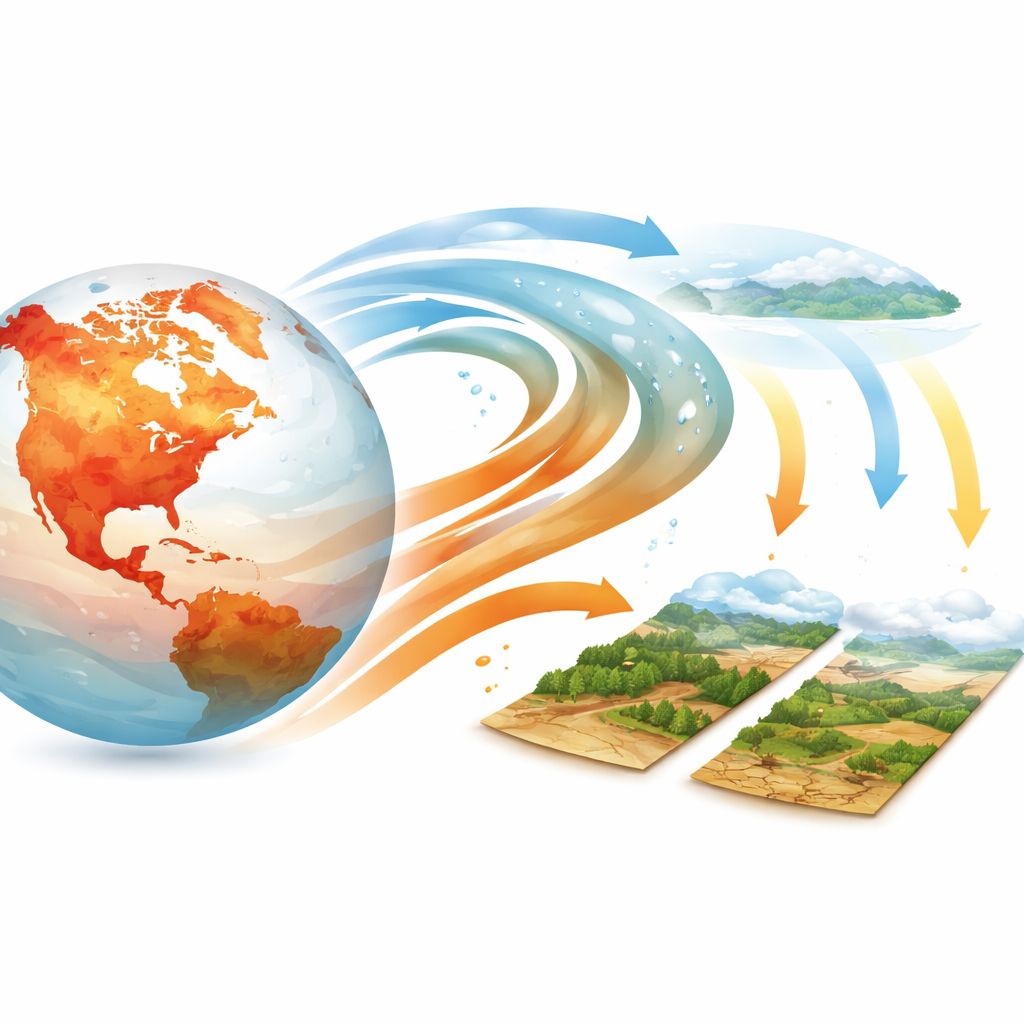
Different flavors of dangerous heat
The authors examine forty years of weather data to track how often summer days cross a local "very hot" threshold across the Northern Hemisphere. They then look at how the amount of water vapor in the entire air column above each location changes in summers with more of these extreme heat days. A clear pattern emerges: in mid‑ to high‑latitude regions such as northern Europe, Siberia, and northeastern Canada, heatwaves tend to come with moister air, while in places like India and western North America, heatwaves are typically drier. Some areas, including the southeastern United States, fall in between, showing little overall change in atmospheric moisture during hot summers.
How temperature and supply fight over moisture
Warmer air can hold more water, but that potential only matters if moisture is actually available. To untangle these effects, the researchers split the moisture changes into two parts. One part reflects the simple fact that hotter air can contain more water vapor. The other represents how much moisture is really supplied, through evaporation from the land and transport by winds. Over much of the land, the supply term is negative during heatwave summers: the atmosphere is drier than it could be at that temperature. In high‑latitude regions, however, ample soil water and cooler background temperatures let evaporation ramp up, so the temperature effect wins and the air gets moister. Over India and western North America, the opposite happens: weakened monsoon winds or parched soils limit moisture supply so strongly that, despite the heat, the atmosphere actually dries out.
Monsoons, ridges, and thirsty soils
The study zooms in on India and western North America to see how large‑scale weather patterns drive these dry heatwaves. In India, strong summer monsoon winds usually funnel moist air from the ocean onto the land, bringing rain and relief from pre‑monsoon heat. During summers with more extreme hot days, the monsoon circulation weakens: winds that normally carry moisture inland are disrupted, and a broad pattern of air flow promotes drying over the subcontinent. In western North America, by contrast, the air is dry to begin with and soils hold little water. Persistent high‑pressure ridges, fed by wave patterns arching across Eurasia and the Pacific, promote clear skies and intense sunshine. As the land bakes, remaining soil moisture is depleted, evaporation stalls, and the air above becomes even drier, locking in the heat.
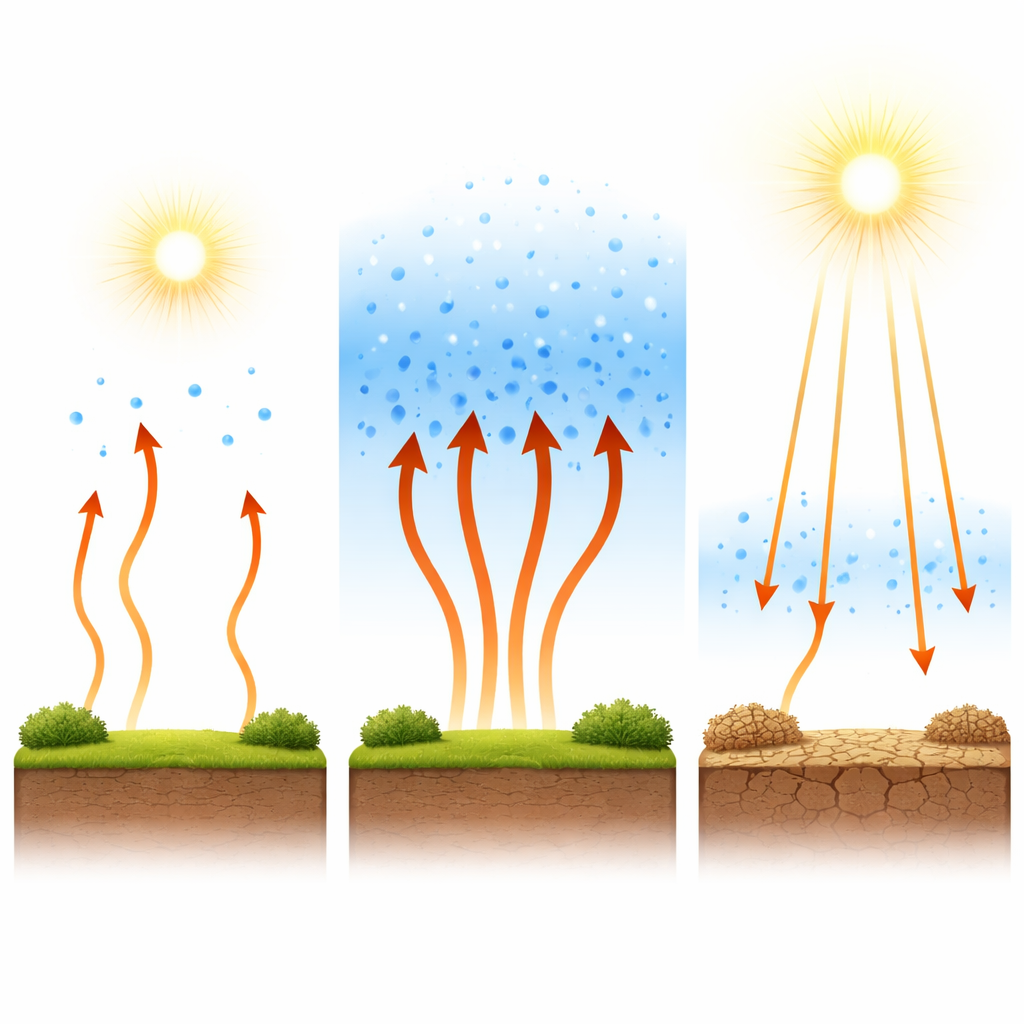
What water vapor does to invisible radiation
Beyond tracking moisture itself, the authors ask how water vapor changes the invisible flows of energy between the atmosphere and the surface. They separate the downward infrared "heat" radiation into parts caused by air temperature, water vapor, and clouds. Across the hemisphere, warmer air consistently boosts this downward radiation, while fewer clouds tend to reduce it. Water vapor adds a more nuanced layer. In moist high‑latitude and desert‑interior heatwaves, extra water vapor strengthens the greenhouse effect and raises the amount of infrared energy reaching the surface. In India and western North America, however, the drier air slightly weakens this greenhouse contribution, offsetting part of the warming that would otherwise come from hotter air alone. For incoming sunlight at the surface, changes in cloud cover dominate; water vapor has only a minor influence there.
What this means for future hot summers
Taken together, the findings show that the air's moisture is not a simple passenger during heatwaves; it is an active player whose role shifts from place to place. In many northern regions, moisture and temperature work together to intensify heat by strengthening the greenhouse blanket near the surface. In dry‑heatwave regions like India and western North America, the lack of moisture reduces this blanket but does nothing to stop the sun from beating down harder through clearer skies, while dry soils remove the natural cooling supplied by evaporation. Understanding which type of heatwave a region tends to experience—humid, dry, or neutral—can help planners better anticipate health risks, wildfire danger, and pressure on water and energy systems in a warming world.
Citation: Cao, D., Lin, H. & Huang, Y. Atmospheric water vapor contribution to interannual variability of Northern Hemisphere summer heatwaves. npj Clim Atmos Sci 9, 88 (2026). https://doi.org/10.1038/s41612-026-01361-4
Keywords: heatwaves, water vapor, radiation, monsoon, soil moisture