Clear Sky Science · en
Relative roles of different tropical oceans on the weakening of the stratospheric equatorial quasi-biennial oscillation
Shifting Winds High Above Our Heads
The winds in the layer of air above the jets we fly in may seem distant from everyday life, yet they quietly shape weather and climate around the globe. This study looks at a key wind pattern there, the quasi-biennial oscillation (QBO), and asks a deceptively simple question: as different tropical oceans warm at different rates, how does that change this high-altitude wind rhythm—and what might that mean for future climate forecasts? 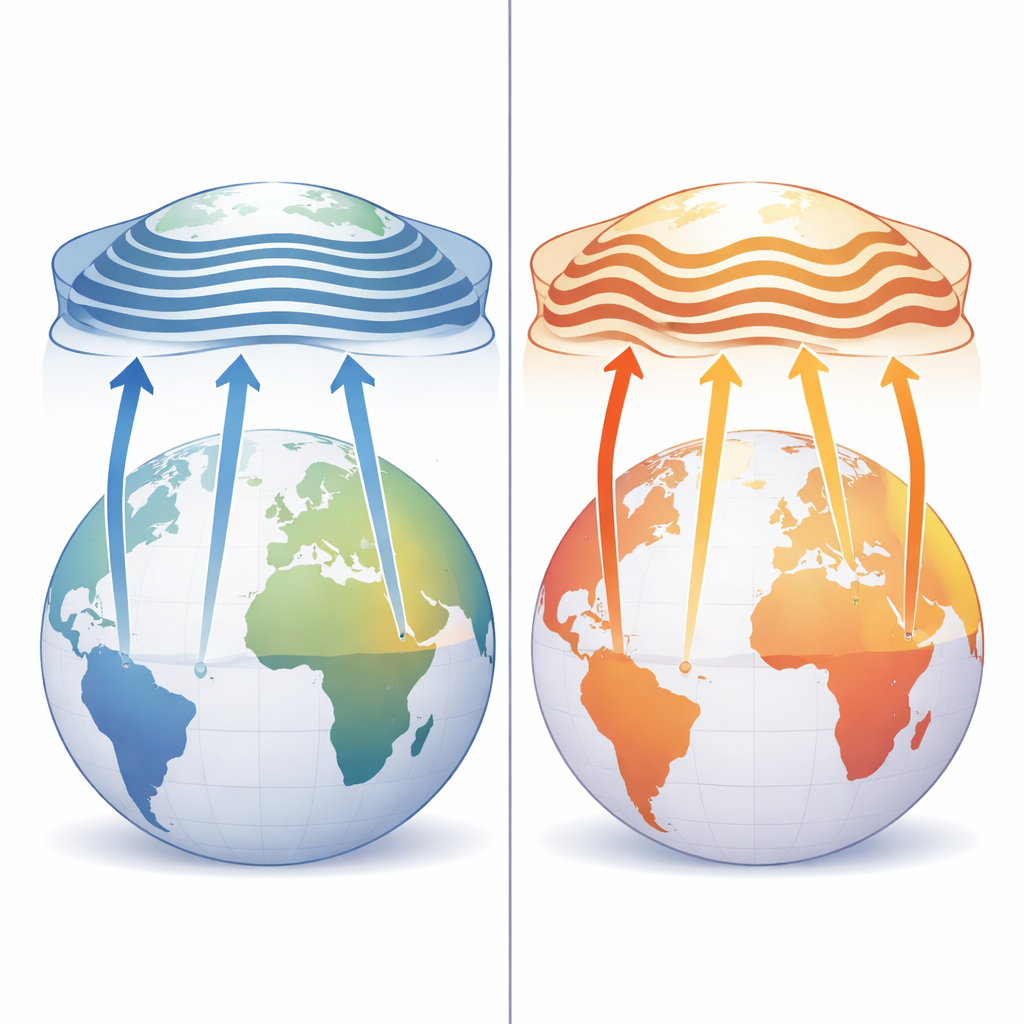
A Gentle Wind With Global Reach
The QBO is a regular flip-flop of winds that circle the Earth above the equator, about 15–30 kilometers up. Every couple of years these winds switch from blowing eastward to westward and back again, slowly sliding downward as they go. Even though this happens far above our heads, it affects how ozone, water vapor, and other gases move through the atmosphere, and it influences winter storms, the jet stream, and even seasonal prediction skill. Observations have shown that in recent decades this oscillation has weakened in its lower reaches and changed shape higher up, raising concerns about how global warming might be altering this important “clock” in the sky.
Probing the Role of the Tropical Oceans
When the planet warms, two big things happen together: carbon dioxide rises in the air, and tropical seas heat up. Earlier work suggested that warmer tropical seas play a leading role in weakening the QBO, but most studies treated the tropics as if all oceans warmed the same way. In reality, the Pacific, Atlantic, and Indian Oceans are warming at different speeds and in different patterns. Using a high-top climate model that can realistically reproduce the observed QBO, the authors ran a set of experiments: one where all tropical oceans warmed together, and three where only one basin at a time—Pacific, Atlantic, or Indian—was warmed while the others were held at mid‑20th‑century conditions. This design let them tease apart what each ocean contributes.
Different Seas, Different Signatures
The model reveals that not all oceans pull the QBO in the same direction. Warming in the tropical Pacific produces the most dramatic change: the alternating wind bands become much weaker and fail to reach as far down, and the time between complete cycles lengthens by nearly a year. In other words, the QBO becomes sluggish and shallow. Warming in the Indian Ocean slightly weakens the QBO but allows the wind bands to descend more quickly, shortening the cycle. The Atlantic stands out: its warming modestly strengthens the QBO winds and speeds up the oscillation. When all three oceans are warmed together, the QBO ends up with weaker winds and a somewhat faster descent—consistent with the combined influence of the individual basins—but the overall effect is smaller because the temperature contrasts between basins are reduced. 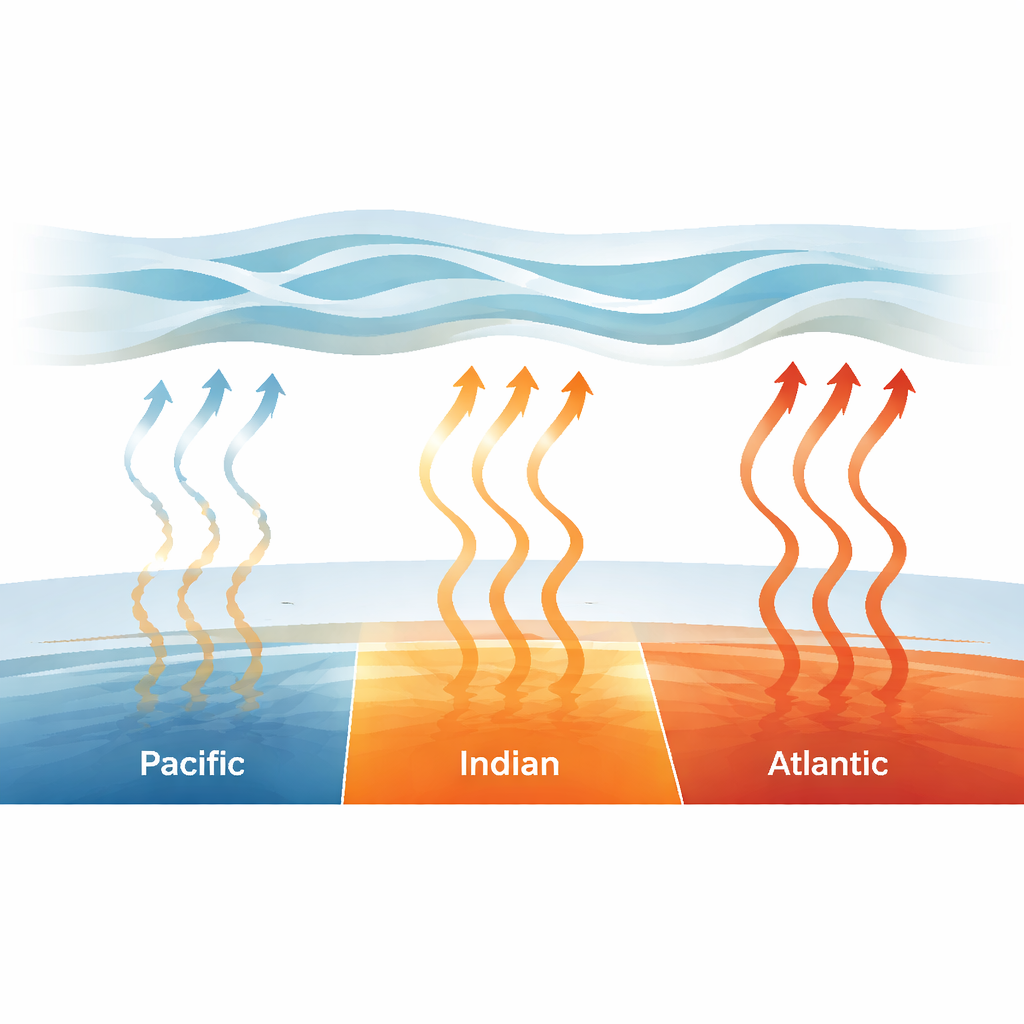
How Tropical Heating Tugs on High Winds
Why do the basins behave so differently? The answer lies in waves and rising air that connect the ocean surface to the stratosphere. Tropical thunderstorms generate a zoo of atmospheric waves that carry momentum upward and help drive the QBO’s alternating winds. At the same time, a slow upwelling of air from below tends to resist the downward slide of the wind bands. Pacific warming in the model shifts heavy rain off the equator and strengthens an east–west overturning circulation across the Pacific. This makes it harder for key waves to reach the stratosphere and pushes the height where they break higher up, starving the lower levels of the momentum needed to sustain strong, deep QBO phases. Over the Atlantic, by contrast, near‑equatorial rainfall and a weaker overturning pattern allow more wave energy to reach and penetrate the stratosphere, reinforcing the oscillation and helping it descend more efficiently. The Indian Ocean and the combined warming case fall in between, with weaker wave forcing but also changes in upwelling that let the wind bands slide downward more quickly despite their smaller strength.
Why These Hidden Winds Matter
By showing that each tropical ocean basin leaves its own fingerprint on the QBO, this work explains why many climate models agree that the QBO will weaken as the planet warms, yet disagree on how its period will change. Most warming patterns reduce the overall wave “push” that powers the oscillation, but the exact balance between that push and the opposing rise of air depends on where and how the oceans heat up. For non‑experts, the takeaway is that the detailed pattern of sea‑surface warming—not just the global average—can reshape a key high‑altitude wind system that influences seasonal forecasts and extreme events. Better tracking and modeling of basin‑by‑basin ocean warming should therefore help improve predictions of the QBO and, by extension, the climate patterns it helps to steer.
Citation: Wang, Y., Rao, J., Garfinkel, C.I. et al. Relative roles of different tropical oceans on the weakening of the stratospheric equatorial quasi-biennial oscillation. npj Clim Atmos Sci 9, 83 (2026). https://doi.org/10.1038/s41612-026-01359-y
Keywords: quasi-biennial oscillation, tropical ocean warming, stratospheric winds, equatorial waves, climate prediction