Clear Sky Science · en
Remote modulation of European blocking on 2022 Pakistan summer extreme rainfall: the bridge role of Tibetan Plateau
Why a distant weather pattern matters
In late summer 2022, southern Pakistan was hit by astonishingly heavy rains that flooded vast areas, displaced tens of millions of people, and caused enormous economic losses. At first glance, these floods might seem to be a local monsoon disaster. This study shows instead that they were the end point of a chain reaction stretching from Europe, across the Tibetan Plateau, to South Asia—a story of how distant weather systems can team up to produce a catastrophe.
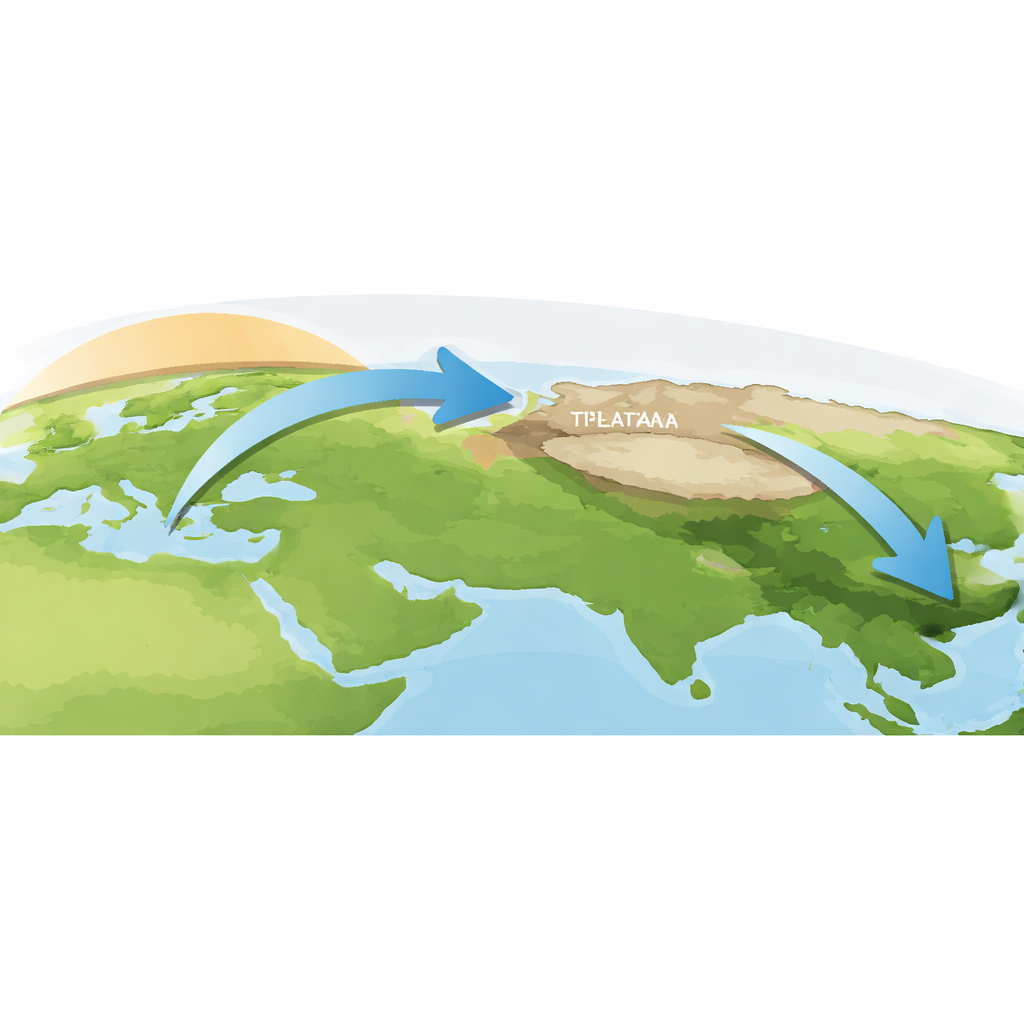
From usual monsoon to upside‑down rainfall
In a typical August, Pakistan sits on the weakened fringe of the South Asian monsoon. Moist winds blow mainly from the southwest, bringing far more rain to India than to Pakistan, which usually remains relatively dry. In 2022 this pattern flipped. Winds near the ground over northern India turned unusually strong from the east, pushing huge amounts of moisture westward along the base of the Himalayas into southern Pakistan. Measurements of water vapor show that the biggest change came through Pakistan’s eastern boundary: instead of exporting moisture, the region suddenly began importing it, supplying the fuel for record‑breaking rainfall.
The hidden role of the Tibetan highlands
The researchers found that this abnormal easterly wind did not primarily arise from well‑known tropical influences such as El Niño or the Indian Ocean Dipole, which were relatively weak and poorly linked to Pakistan in 2022. Instead, the key intermediary was the Tibetan Plateau—the vast elevated "roof of the world" just to Pakistan’s northeast. In normal summers, the southeastern flank of the Plateau acts as a strong atmospheric heat source because of heavy rain and the release of latent heat as water vapor condenses. In August 2022, however, this region was unusually dry. The lack of rain meant strong cooling of the local atmosphere, which altered air pressure patterns and helped spin up stronger easterly winds along the southern edge of the Plateau. These winds acted like a conveyor belt, channeling moist air from the Bay of Bengal straight into southern Pakistan.
How Europe’s heatwave set the chain in motion
Why did the southeastern Tibetan slopes dry out so dramatically just when Pakistan was drowning? The answer, the authors show, lies thousands of kilometers away in Europe. During August 2022, an exceptionally strong and long‑lived "blocking" high‑pressure system sat over northeastern Europe, contributing to severe heat there. This atmospheric block launched a stationary wave pattern high in the atmosphere that rippled eastward across Asia. As the wave train propagated, it strengthened a high‑pressure system over subtropical East Asia. On the southern side of this high, air aloft flowed more strongly from east to west over the Tibetan Plateau. Because of the Plateau’s unique thermal structure—warmer air aloft over its western side and cooler air to the east—these stronger easterly winds encouraged air to sink over the southeastern Plateau, suppressing clouds and rainfall there. The resulting cooling over Tibet then fed back to the lower atmosphere, reinforcing the easterly conveyor belt that drove moisture toward Pakistan.
Testing the atmospheric domino effect
To check whether this picture was more than coincidence, the authors combined long‑term observations from 1979 to 2022 with a simplified numerical model of the atmosphere. Statistically, years with strong European blocking tended to coincide with less rain over the southeastern Tibetan Plateau, stronger easterly winds over northern India, and more rain over southern Pakistan. Model experiments that artificially cooled the southeastern Plateau reproduced the observed easterly winds and moisture pathway into Pakistan. Separate experiments that mimicked the European blocking pattern created the eastward‑spreading wave train and changes aloft, but only when Tibetan heating effects were also included did the model generate the full chain of surface‑level responses leading to Pakistan‑like rainfall increases.
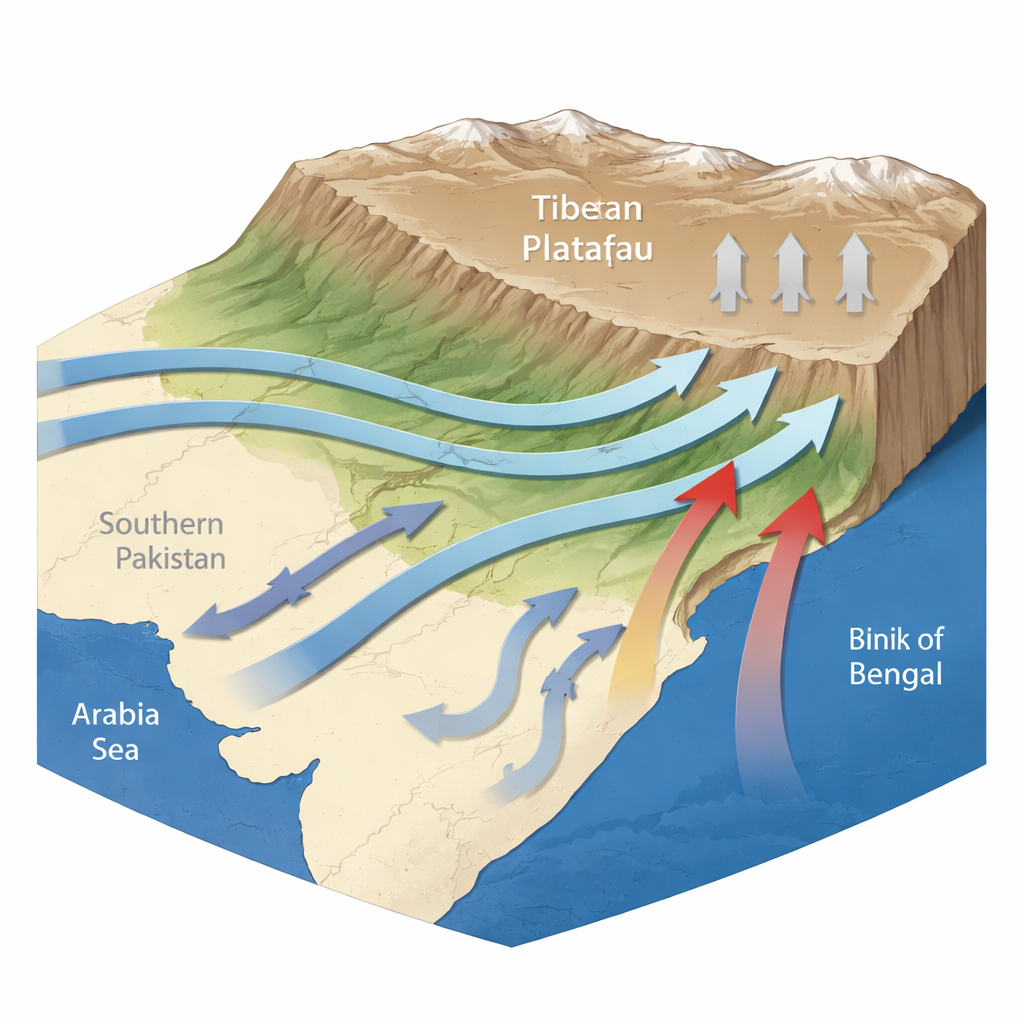
What this means for future floods
This work concludes that the 2022 Pakistan deluge cannot be explained simply by local monsoon quirks or modest tropical ocean anomalies. Instead, it arose from a three‑step linkage: an extraordinary European blocking high altered winds high above Eurasia; those winds dried and cooled the southeastern Tibetan Plateau; and the cooled Plateau strengthened low‑level easterly winds that funneled moisture into southern Pakistan. In plain terms, Europe’s heatwave, Tibet’s dryness, and Pakistan’s floods were all connected parts of the same atmospheric story. Recognizing the Plateau’s "bridge" role between distant weather systems and South Asian rainfall could help forecasters spot similar dangerous configurations earlier, improving warnings for millions of people living in flood‑prone regions.
Citation: Ye, J., Jiang, X., Zhang, T. et al. Remote modulation of European blocking on 2022 Pakistan summer extreme rainfall: the bridge role of Tibetan Plateau. npj Clim Atmos Sci 9, 93 (2026). https://doi.org/10.1038/s41612-026-01358-z
Keywords: Pakistan floods, Tibetan Plateau, European blocking, monsoon rainfall, atmospheric teleconnection