Clear Sky Science · en
Climate warming could weaken aerosol-cloud interactions in subtropical marine stratocumulus
Why brighter ocean clouds matter for our future
Much of Earth’s sunlight first meets a blanket of low clouds over the oceans. These clouds help cool the planet by reflecting sunlight back to space. Tiny airborne particles, called aerosols, help form the droplets inside those clouds. This study asks a timely question: as the climate warms and carbon dioxide rises, will these particle–cloud partnerships keep working the same way, or will their cooling power fade? The answer matters not only for natural climate change, but also for controversial ideas to artificially brighten clouds in order to offset warming.

Tiny particles, big influence on clouds
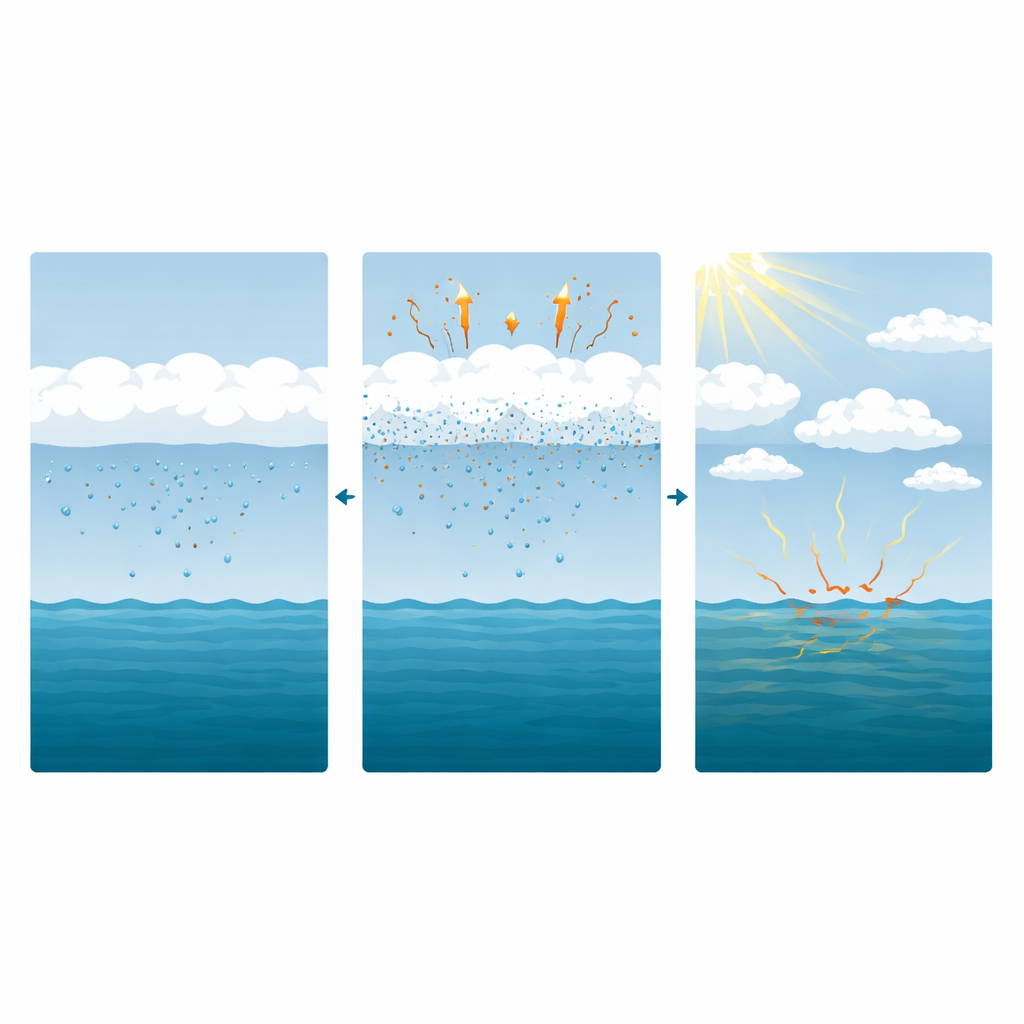
The authors use a high‑resolution computer model to follow a block of air moving over the northeastern Pacific Ocean. At first, this air sits over relatively cool water and carries a sheet of bright, low clouds called stratocumulus. As the air drifts over warmer water, those clouds gradually thin and give way to puffier cumulus clouds. Into this evolving scene, the researchers add or remove aerosols, which act as seeds for cloud droplets. With few particles, clouds form larger droplets that collide, form drizzle, and quickly rain out, leaving behind patchy skies and less reflected sunlight. With more particles, clouds hold many smaller droplets, drizzle is suppressed, cloud cover lasts longer, and the ocean surface stays more shaded.
How a warmer world changes cloud responses
The team compares present‑day conditions with futures where carbon dioxide is doubled or quadrupled and the ocean surface is several degrees warmer. Warming alone tends to thin and break up the low cloud layer by altering how heat and moisture move between the surface, the clouds, and the air above. When aerosols are added in these warmer climates, they still increase the number of droplets and make them smaller—an effect long known to brighten clouds. But the model shows that the follow‑on changes that really boost cooling, such as thicker clouds and greater cloud coverage, become noticeably weaker. In the doubled‑carbon‑dioxide world, the extra cooling from added particles drops by more than 30 percent along the simulated path.
Background air pollution sets the stage
The study also explores how the starting level of aerosols in the marine boundary layer—the lowest part of the atmosphere over the ocean—shapes what happens next. When background aerosol levels are very low, adding particles has a dramatic effect: drizzle is shut down, the cloud sheet becomes more continuous, and the surface cools strongly. When background levels are already high, the same particle boost produces only small changes. In some cases it can even thin the clouds slightly, because changes in droplet behavior enhance mixing with the dry air above and promote evaporation at cloud top. This means the cooling power of aerosol‑cloud changes depends not just on future warming, but also on how clean or polluted the starting environment is.
Lessons for ideas to brighten clouds on purpose
One proposed climate intervention, known as marine cloud brightening, would spray additional tiny particles into low marine clouds to make them whiter and longer‑lived. The simulations suggest two important limits on this idea. First, warming itself makes it harder for extra particles to thicken and spread these clouds, especially over already‑warming oceans, so the maximum cooling that brightening could deliver shrinks in hotter futures. Second, regions with already high aerosol levels respond weakly, or even in the opposite direction, to additional particles. The most promising targets would be cleaner regions where low clouds tend to drizzle and break apart today.
What this means for the planet
Put simply, the study finds that as the climate warms, the ability of tiny particles to strengthen cooling low clouds is likely to weaken, especially for the cloud‑cover changes that matter most for temperature. Cloud brightening, whether accidental from pollution or deliberate as a climate strategy, has a built‑in ceiling that gets lower in a warmer world and in hazier air. Understanding these limits helps scientists better estimate future warming and informs debates over whether deliberately tinkering with marine clouds could ever be a reliable tool in the climate toolbox.
Citation: Sun, H., Blossey, P.N., Wood, R. et al. Climate warming could weaken aerosol-cloud interactions in subtropical marine stratocumulus. npj Clim Atmos Sci 9, 86 (2026). https://doi.org/10.1038/s41612-026-01357-0
Keywords: aerosol-cloud interactions, marine stratocumulus, climate warming, marine cloud brightening, low cloud feedback