Clear Sky Science · en
Large discrepancies in dominant microphysical processes governing mixed-phase clouds across climate models
Why the mix of cloud ice and water matters
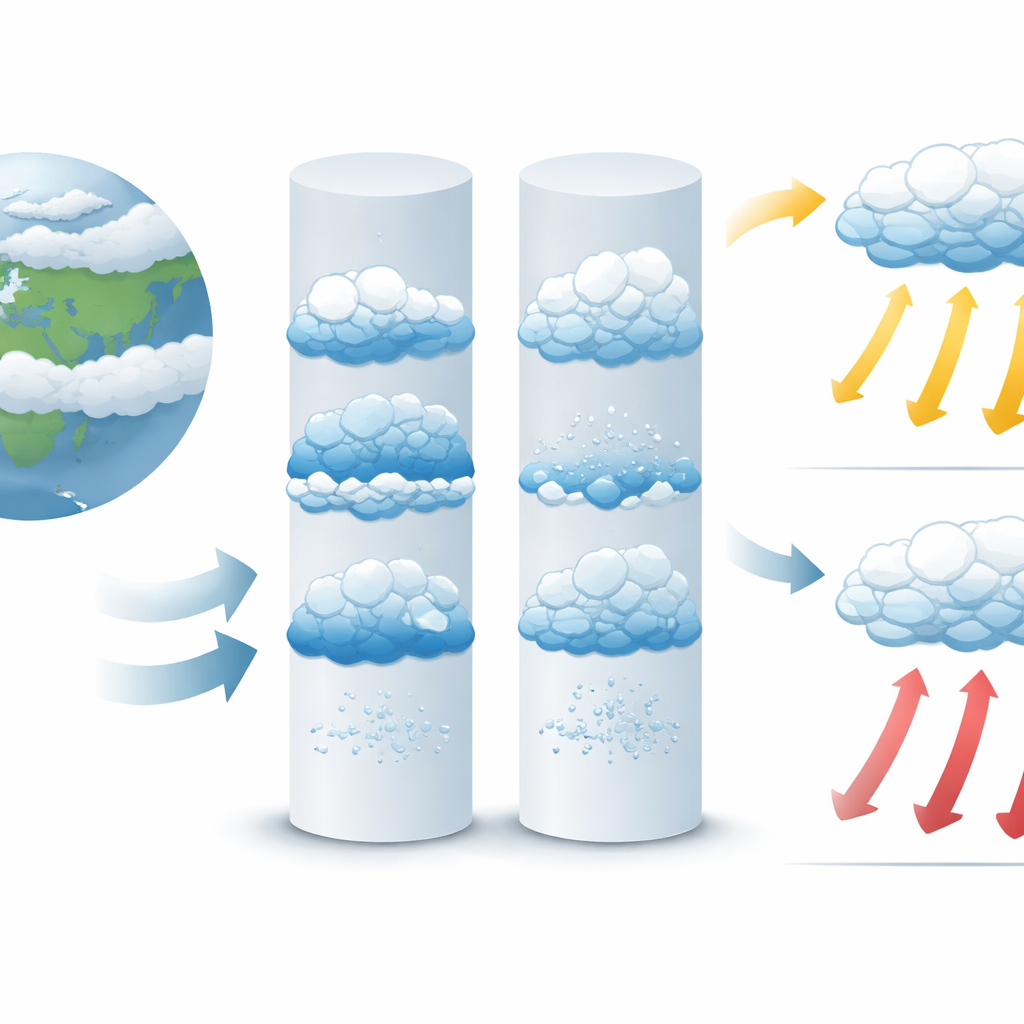
Clouds that contain both liquid droplets and ice crystals play an outsized role in how fast the planet warms, because they control how much sunlight is reflected back to space and how much heat is trapped below. Yet today’s climate models disagree sharply about how much of these “mixed-phase” clouds is liquid versus ice, especially in cold regions. This study digs into the tiny processes inside clouds that create and transform ice, asking whether different climate models at least agree on which processes matter most. The answer has big implications for how much confidence we can place in climate projections.
Balancing liquid and ice in cold clouds
The authors focus on the supercooled liquid fraction, a measure of how much of a mixed cloud’s water is still liquid even at temperatures below freezing. Many global climate models underestimate this liquid portion, which can make clouds appear more icy and less reflective than they really are, ultimately biasing estimates of Earth’s climate sensitivity on the low side. To understand why, the team examines three state-of-the-art climate models and compares their simulated cloud phase against satellite data, which infer cloud ice and liquid from a spaceborne laser instrument.
Four tiny processes with big consequences
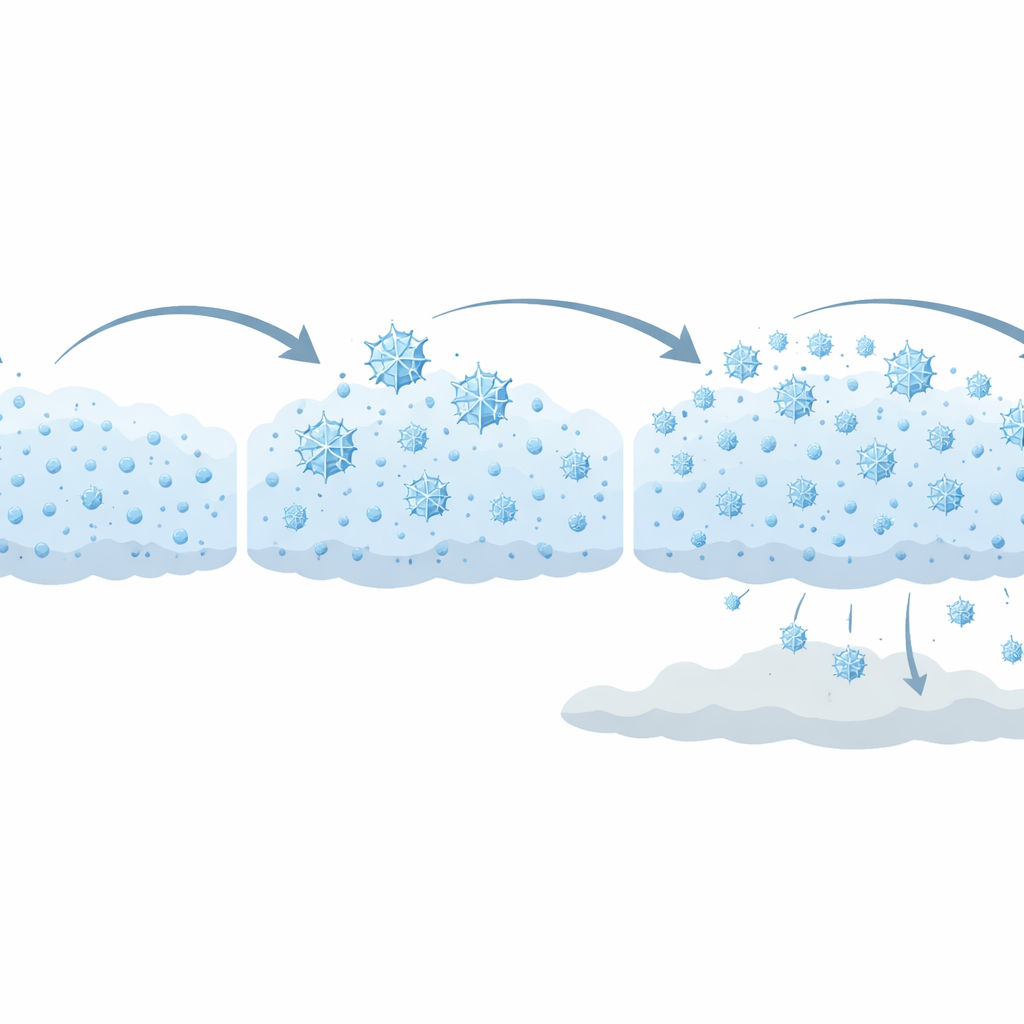
The study zooms in on four key ice-related processes: primary ice nucleation, where special particles in the air trigger the first ice crystals; secondary ice production, where existing ice generates more crystals through splintering and shattering; sedimentation, the slow fall of ice crystals through the atmosphere; and transport, which moves ice around via winds and mixing. Using a statistical “factorial” design, the researchers systematically turn each process on and off in the models and measure how much the liquid–ice balance responds. This allows them to rank which process has the strongest influence, at different altitudes, temperatures, and latitudes.
How the models see the same clouds differently
When the team compares the three models to each other and to satellite observations, they find no single, shared picture of how mixed-phase clouds are structured. In some regions and temperature ranges, individual models happen to line up with the satellite record, but they do so for different underlying reasons. One model tends to make ice crystals fall out unusually quickly, so sedimentation dominates its cloud behavior. Another model is highly sensitive to how new ice crystals form, making primary ice nucleation the main driver at cold temperatures. A third model gives transport, especially the outflow from convective clouds, an outsized role in setting the cloud phase, which helps explain its strong biases in the tropics.
Testing a shared recipe for making ice
To see whether at least one piece of physics could be standardized, the authors implement the same machine-learning-based recipe for secondary ice production in all three models. This unified scheme is designed to mimic how real clouds multiply ice crystals as they collide, freeze, and break apart. Even with this identical ingredient, the models respond very differently: in two of them, secondary ice production substantially reduces the amount of liquid in mixed-phase clouds in the temperature band where it is active, while in the third model it barely changes the result. In none of the models does this improvement in the physics automatically bring cloud phase into better agreement with satellite data across the board.
What this means for climate predictions
The study’s most robust point of agreement is that, in very cold mixed-phase clouds over the high northern latitudes, primary ice nucleation is the dominant control on how much liquid survives. Outside that niche, however, the three models disagree on which microphysical process matters most, and even on which ones can be safely ignored. This lack of consensus means that conclusions drawn from any single climate model about the real atmosphere’s cloud physics should be treated with caution. For practical climate prediction, the results argue for two parallel strategies: better, more targeted observations that constrain entire suites of cloud processes at once; and new modeling approaches that represent the net, statistical effect of many intertwined microphysical processes, rather than relying only on deterministic formulas for each one in isolation.
Citation: Frostenberg, H.C., Costa-Surós, M., Georgakaki, P. et al. Large discrepancies in dominant microphysical processes governing mixed-phase clouds across climate models. npj Clim Atmos Sci 9, 75 (2026). https://doi.org/10.1038/s41612-026-01342-7
Keywords: mixed-phase clouds, climate models, ice microphysics, cloud phase, climate sensitivity