Clear Sky Science · en
Deep learning model for enhancing decadal prediction of Eurasian surface air temperature
Why looking a decade ahead matters
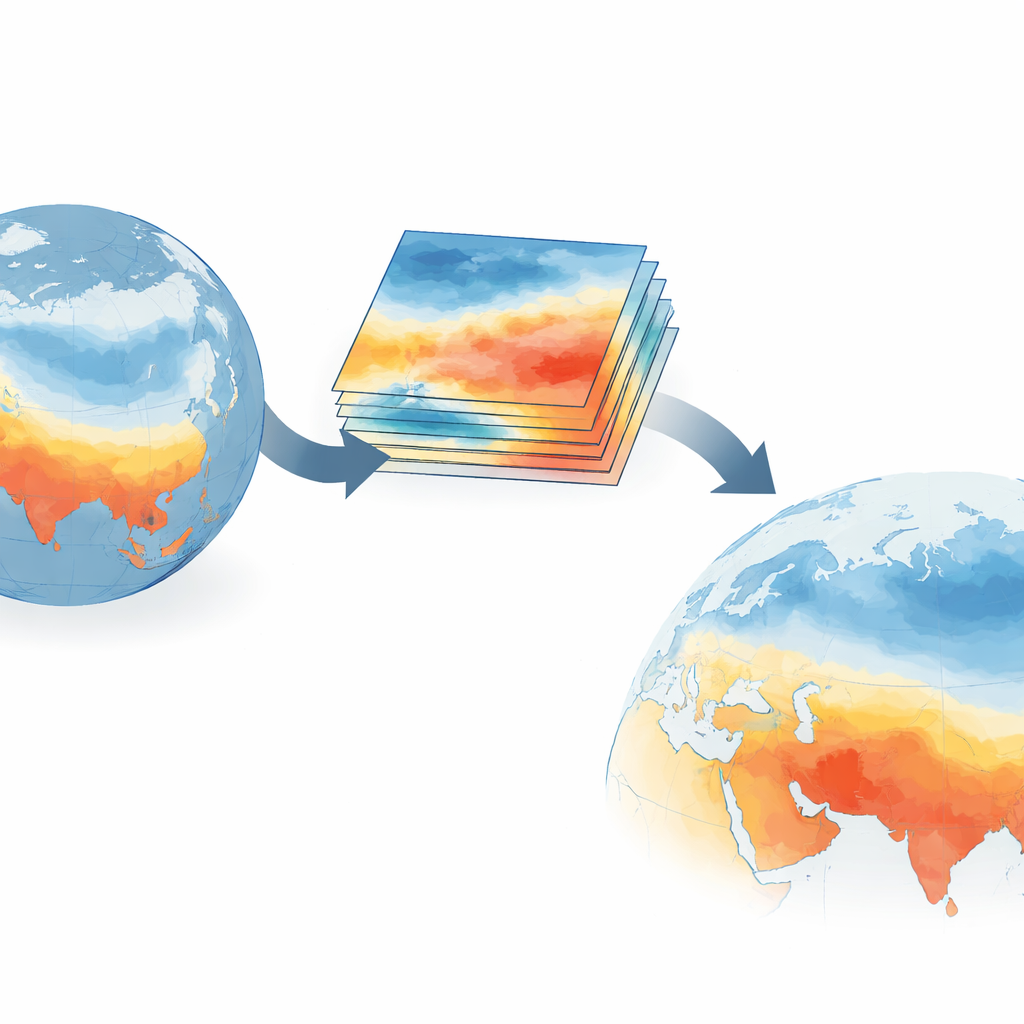
For people and governments across Eurasia, knowing how temperatures are likely to change over the coming 5 to 10 years can inform everything from energy planning to crop choices and infrastructure design. Yet today’s best climate models still struggle to predict these medium‑range swings in surface air temperature over such a vast and varied region. This study introduces a new way to boost those predictions by using deep learning to sharpen and combine existing climate model forecasts, offering a clearer view of Eurasia’s climate future.
The challenge of decadal temperature shifts
Eurasia stretches from the deserts of Central Asia to the Arctic coast, and more than half of the world’s population lives there. Over recent decades the region has not simply warmed smoothly; instead, it has experienced complex decade‑to‑decade swings, including a puzzling cooling across many northern areas from the 1990s to the 2000s. These ups and downs are shaped by slow‑moving ocean patterns in the Atlantic and Pacific and by changes in Arctic sea ice. Standard climate prediction systems can anticipate some sea surface temperature patterns several years ahead, but they still do poorly at capturing Eurasia’s multi‑year temperature variations, especially at mid‑to‑high latitudes where the need for reliable guidance is greatest.
Breaking Eurasia into climate neighborhoods
To make sense of this complexity, the authors first divide Eurasia into 20 "climate neighborhoods" using a technique called temporal clustering. Instead of drawing boundaries by geography alone, they group grid cells that share similar decade‑scale temperature behavior between 1968 and 2001. Southern regions show relatively small fluctuations once long‑term warming is removed, while northern and high‑mountain areas display much larger and more intricate swings. Treating each neighborhood separately helps reduce noise and focuses the problem on predicting distinct regional patterns of slow temperature change, rather than one enormous and inconsistent field.
A deep learning assistant for climate models
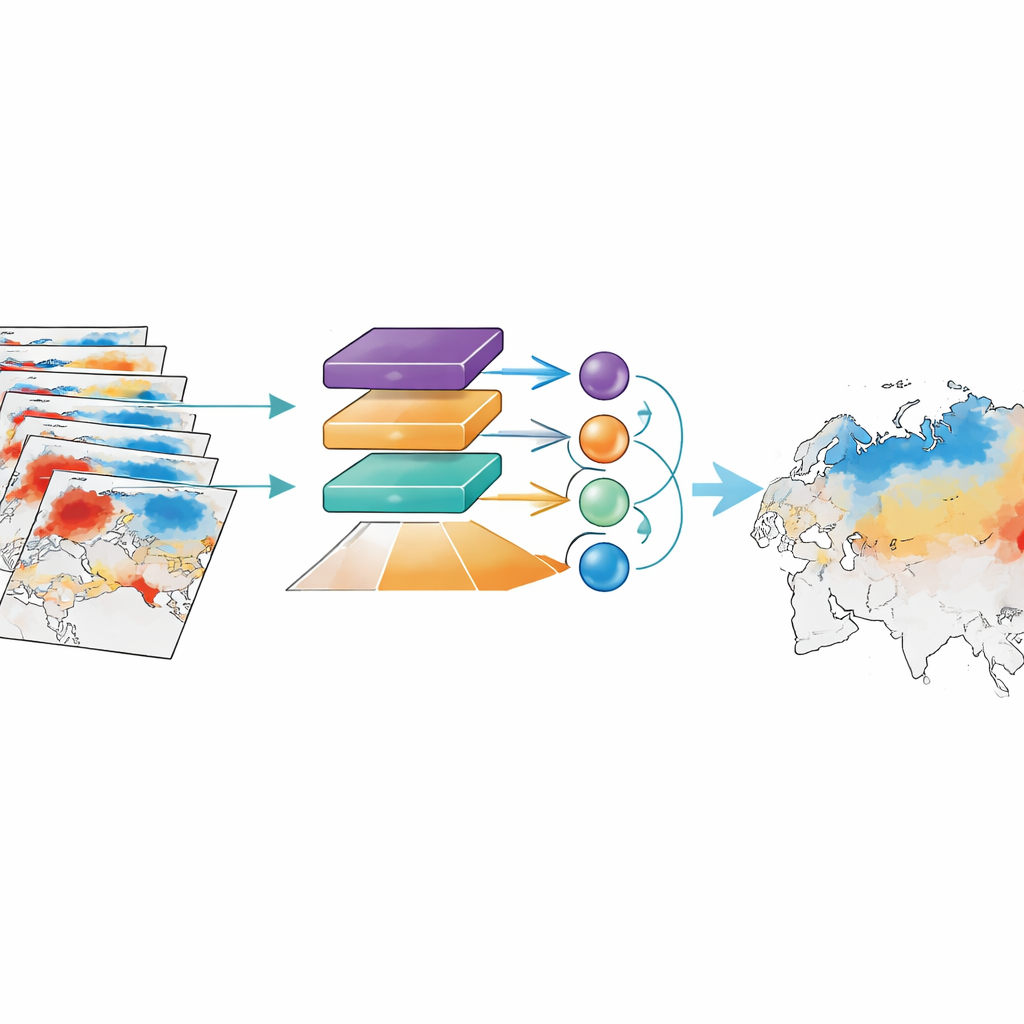
The heart of the study is a seven‑layer deep learning model called GRUBA, based on a type of recurrent neural network that is well suited to time‑series data. GRUBA does not replace physical climate models; instead, it learns to post‑process their outputs. For each neighborhood, it ingests predictions from 80 different model runs that look 6–10 years into the future. As the data pass through stacked processing layers, GRUBA compresses information from the many ensemble members, stabilizes it, and then applies an "attention" step that focuses on the time slices that matter most for predicting the final outcome. A final layer performs a subtle adjustment of the predicted amplitudes to better match observed temperatures.
Sharper forecasts and why they improve
When tested on the period 2004–2021—years the model did not see during training—GRUBA dramatically improves decadal predictions. Simple averaging of the climate models yields weak or even misleading skill over most northern regions. After GRUBA’s correction, the average correlation between predicted and observed decade‑scale swings across the 20 neighborhoods jumps from near zero to strongly positive, and measures of amplitude accuracy also improve from negative to clearly positive values. The system captures both the early‑2000s cooling and the renewed rapid warming at high latitudes, which the raw models largely miss. By analyzing the deep learning model with a technique called SHAP, the authors show that GRUBA effectively learns to give higher weight to those individual model runs that historically tracked reality better, particularly for challenging northern regions, and to downplay less reliable ones.
A glimpse of the coming years
Armed with this improved tool, the researchers generate real‑time predictions for 2022–2025. GRUBA suggests continued strong warming at high latitudes, paired with pockets of relative cooling in some mid‑latitude areas—a pattern that contrasts with the raw multi‑model average. For 2022, this refined forecast aligns much more closely with observed conditions, though it still underestimates warming over the Tibetan Plateau and exaggerates some cooler zones. The authors also show that GRUBA’s advantage depends on having many ensemble members to learn from, and that its architecture outperforms several alternative machine‑learning designs on a particularly difficult high‑latitude region.
What this means for climate planning
In everyday terms, this work demonstrates that smart use of artificial intelligence can squeeze far more usable information out of the climate forecasts we already produce. By learning from past successes and failures of many individual simulations, GRUBA converts a scattered bundle of decadal predictions into a much clearer picture of likely temperature swings across Eurasia. While the method still needs broader testing and refinement, it points to a practical path for giving decision‑makers more trustworthy guidance about how regional climates will evolve over the next decade, bridging the gap between short‑term weather outlooks and long‑term climate projections.
Citation: Chen, Y., Huang, Y., Qian, D. et al. Deep learning model for enhancing decadal prediction of Eurasian surface air temperature. npj Clim Atmos Sci 9, 77 (2026). https://doi.org/10.1038/s41612-026-01337-4
Keywords: decadal climate prediction, Eurasian temperature, deep learning, climate ensembles, surface air temperature