Clear Sky Science · en
A deep learning-based land-atmosphere coupled model for heatwave prediction
Why predicting deadly heat matters
Dangerous heatwaves are becoming more frequent and intense as the climate warms, threatening health, food production, and power systems. Yet even with powerful supercomputers, forecasts often miss how extreme a heatwave will become, or how long it will last. This study introduces a new artificial intelligence (AI) approach that looks not just at the air above us, but also at the moisture and temperature stored in the ground, to sharpen short‑term heatwave predictions over the Northern Hemisphere.
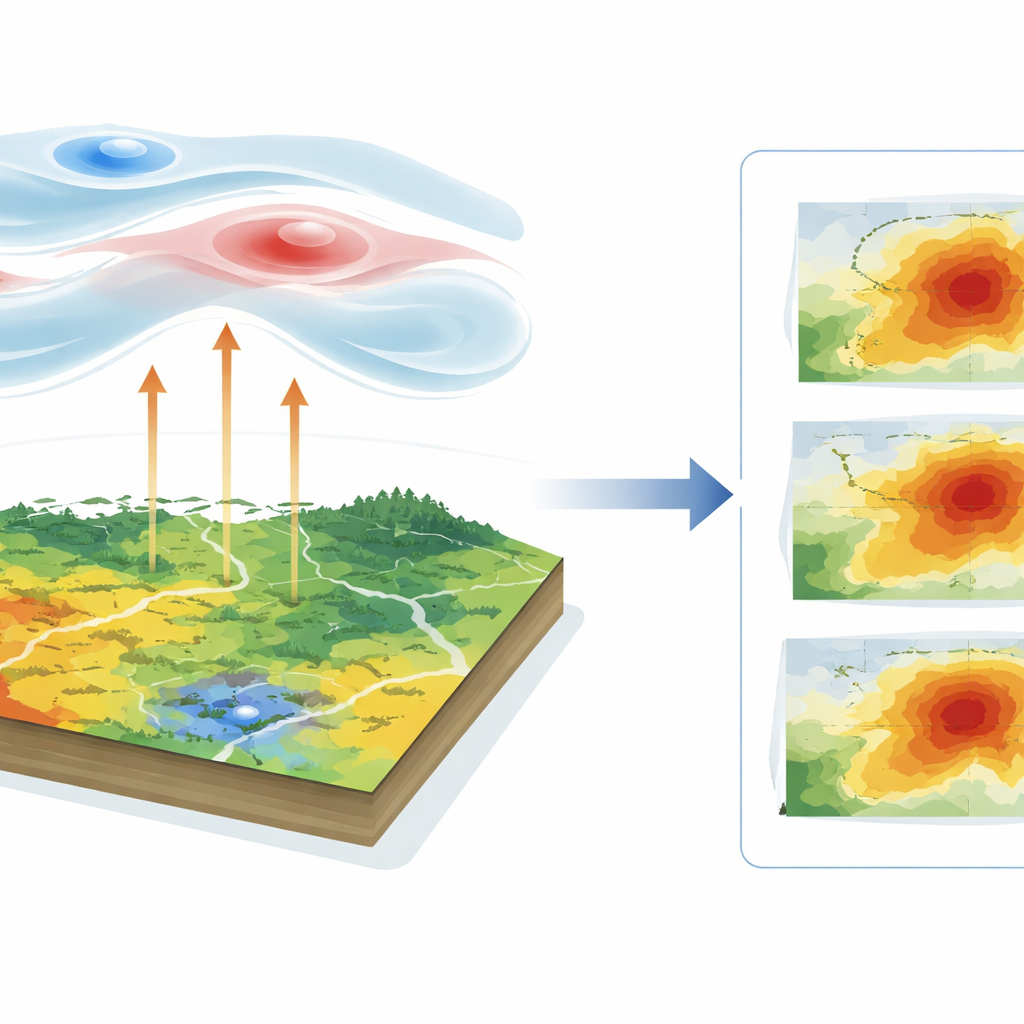
How the ground talks to the sky
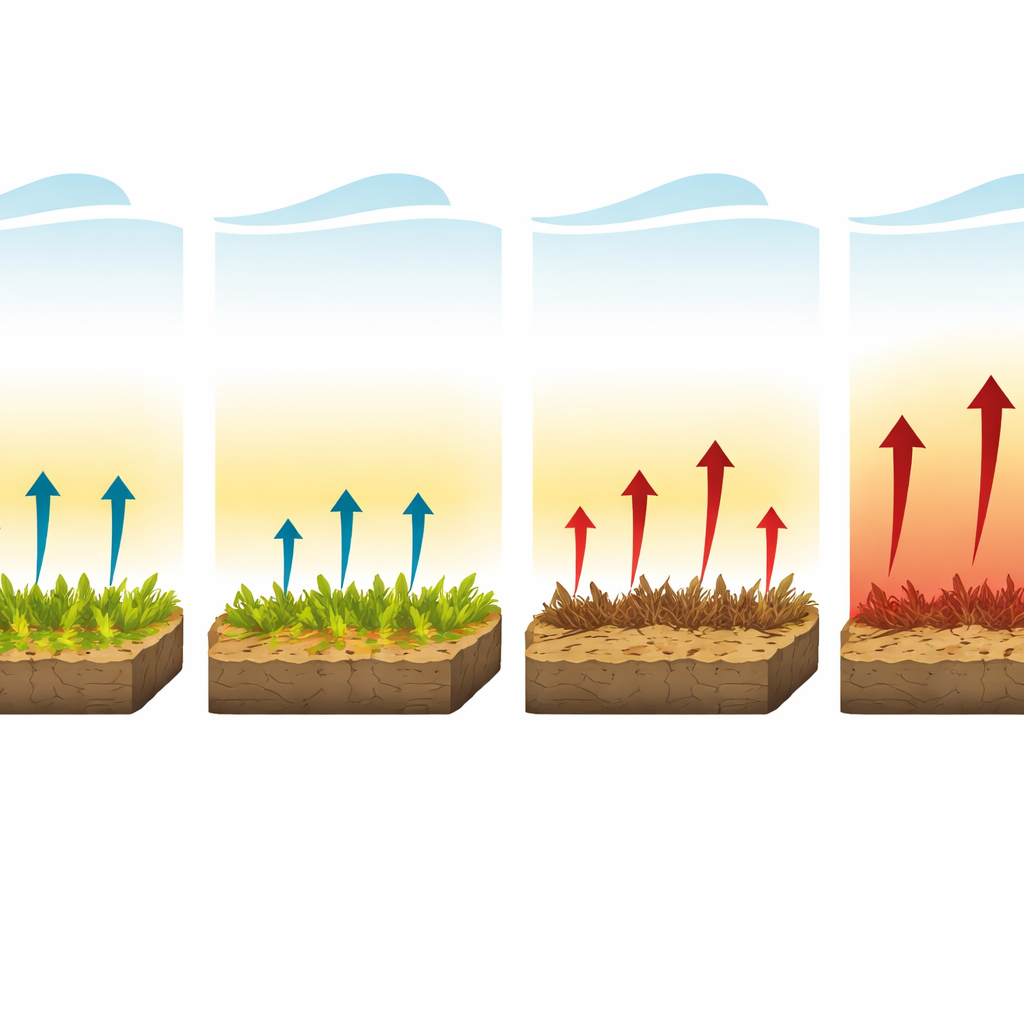
When soils are moist, much of the Sun’s energy goes into evaporating water, which cools the surface. As soils dry out, less energy is spent on evaporation and more is converted into direct heating of the air just above the ground. This shift can trigger a self‑reinforcing loop: drier ground leads to hotter air, which increases the demand for evaporation and dries the soil even more, further intensifying the heat. Observations and past modeling work have shown that this land–atmosphere feedback is a major driver of severe heatwaves in regions such as central North America and Europe, but most AI weather models so far have largely ignored the land side of this story.
Teaching AI to follow land and air together
The authors built a land–atmosphere "coupled" model that ingests both atmospheric variables (like air temperature, pressure, and winds) and land variables (soil moisture and soil temperature in several layers) from the ERA5 reanalysis dataset. Using a convolutional neural network that compresses and then reconstructs global weather maps, the system is trained to predict daily conditions up to a week ahead. Crucially, instead of optimizing the model only for the very next day, the team used a “multi‑step” training method: the AI is penalized based on errors across all lead times from one to seven days, with slightly more weight on the near term. This encourages the model to learn how land conditions and the atmosphere evolve together over several days, rather than making disconnected one‑day jumps.
Stronger links between dry soils and extreme heat
To test whether the AI was really capturing land–atmosphere coupling, the researchers examined the correlation between top‑layer soil moisture and two key quantities: daily maximum temperature and latent heat flux (the energy tied up in evaporation). In observations, dry soils tend to coincide with hotter days and reduced latent heat across many mid‑latitude land regions. The coupled AI model trained with multi‑step loss reproduced these patterns much more faithfully than the same architecture trained with a simple one‑step loss. The single‑step version consistently underestimated how strongly soil dryness is connected to both surface heating and evaporation, especially for the evaporative flux, indicating it was missing the delayed impact of soil conditions on the overlying air.
Sharper heatwave forecasts and where the skill comes from
Under heatwave conditions—defined as days when local maximum temperatures exceed the 90th percentile—the coupled model showed clear benefits. Across one‑ to seven‑day forecasts, it achieved 5.9–11.2% reductions in temperature error compared with an atmosphere‑only AI model when trained with multi‑step loss, while the same comparison with single‑step training yielded only 0.4–2.4% improvement. The largest gains appeared around three days ahead, when both soil moisture and large‑scale circulation remain reasonably predictable and reinforce each other. As the forecast horizon extends, atmospheric patterns become harder to predict, but soil moisture retains memory for longer; the coupled model continues to draw skill from this slowly evolving land state, particularly in regions where dry soils and hot extremes are tightly linked.
Real‑world heatwaves as proving grounds
The team also examined two recent severe heatwaves: the land‑driven 2018 Western European event and the more atmosphere‑driven 2022 East Asian heatwave. In Europe, observations showed unusually dry soils, enhanced sensible heat, suppressed evaporation, and prolonged extreme temperatures. The coupled model captured this chain of events far better than the atmosphere‑only version, realistically tracking soil drying, energy flux changes, and the rise and fall of daily maximum and minimum temperatures. In East Asia, where an amplified high‑pressure ridge in the mid‑troposphere played the leading role, the coupled model still improved temperature evolution and reasonably reproduced the development of drought, even though the soil drying there was more a consequence than a cause of the heatwave.
What this means for future heat warnings
The study shows that combining land information with a training strategy that looks several days ahead can meaningfully improve AI‑based heatwave forecasts. By explicitly learning how slowly changing soil moisture and temperature interact with faster atmospheric shifts, the coupled model better anticipates both the buildup and persistence of extreme heat. Although challenges remain—especially for humidity and rainfall—this approach offers a promising path toward earlier and more reliable warnings of dangerous heat and compound heat‑drought events, giving societies extra time to protect people, ecosystems, and infrastructure.
Citation: Cho, D., Ham, YG., Jeong, S. et al. A deep learning-based land-atmosphere coupled model for heatwave prediction. npj Clim Atmos Sci 9, 85 (2026). https://doi.org/10.1038/s41612-025-01311-6
Keywords: heatwave prediction, land–atmosphere coupling, soil moisture, deep learning weather, climate extremes