Clear Sky Science · en
Local expansion mechanisms for quantum-scale wormholes
From tiny tunnels to cosmic shortcuts
Imagine that space and time are not smooth, but seethe with tiny bubbles and tunnels far smaller than an atom. Physicists call these hypothetical features quantum foam, and among them could lurk minuscule wormholes, shortcuts connecting distant regions of the universe. This paper explores whether a controlled burst of local expansion could take such a quantum scale wormhole and briefly swell it to human size, turning a wild science fiction idea into a precise thought experiment grounded in general relativity.
Why wormholes need strange stuff
Classic wormhole models describe a tunnel joining two distant, nearly flat regions of space through a narrow throat. To keep that tunnel open, the equations of general relativity demand matter with properties unlike anything in everyday experience: it must have negative energy density, at least in some regions, violating standard energy conditions that normally guarantee sensible gravitational behavior. Quantum fields, however, are known to produce small, temporary pockets of negative energy. Earlier work suggested that microscopic wormholes might form at the Planck scale, the realm where quantum gravity becomes important, and that cosmic inflation in the early universe or artificial bubbles could in principle inflate them to macroscopic size.
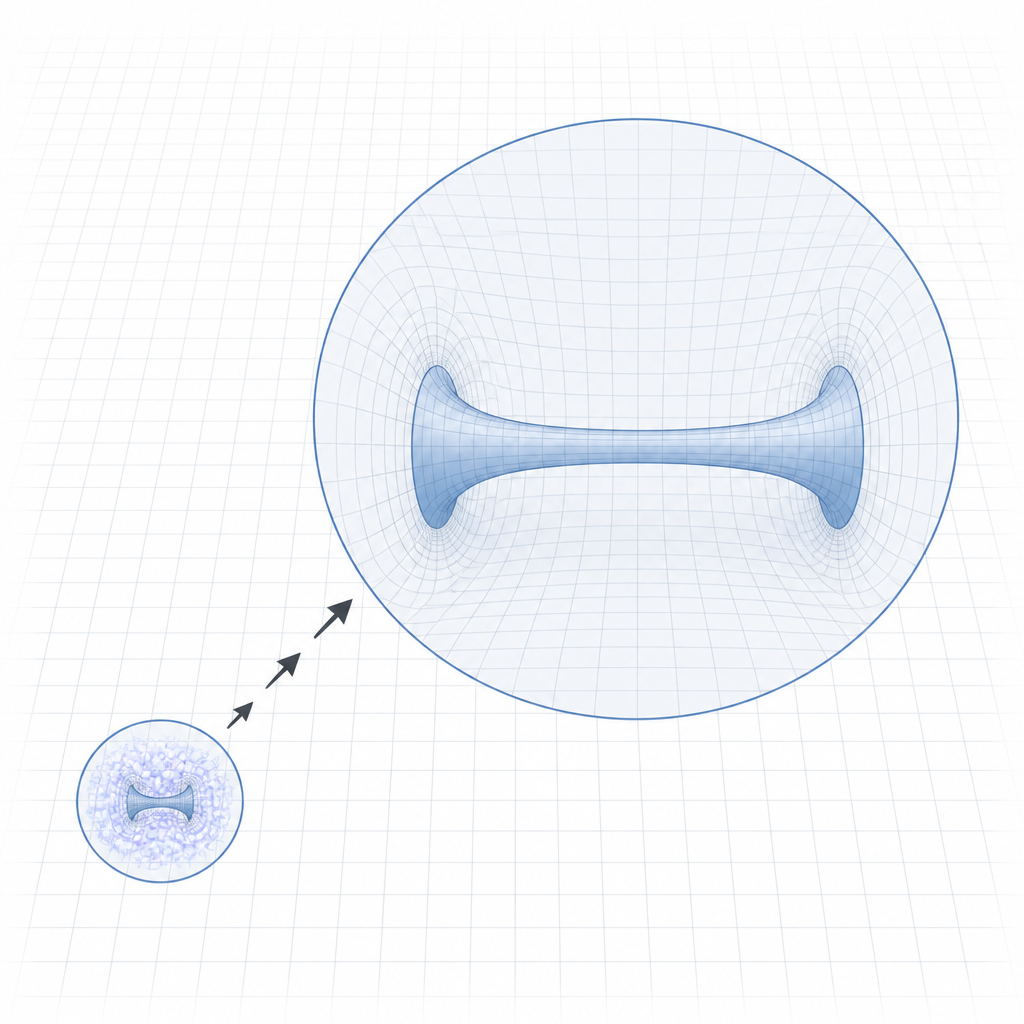
A gentle bubble in spacetime
The authors introduce a new toy model they call a local inflation bubble. Instead of reworking the entire universe, this construction inflates only a compact, carefully bounded region of otherwise flat spacetime. Mathematically, the bubble is described by a smooth function that switches the expansion on and off in both space and time without sharp edges. Outside the bubble everything looks like ordinary Minkowski space: there is no net mass added at infinity, no gravitational waves radiated away, and no singularities. Inside, distances temporarily stretch, light cones tilt, and light rays and particles trying to cross the center are strongly slowed, producing surfaces where light is almost frozen in place for a short time.
What it costs to grow a tiny region
Using this controlled setup, the authors compute the effective stress energy needed to produce such a bubble. Locally, the required matter is still exotic: the usual energy conditions are violated, and negative pressures play a central role. Yet the total energy measured on a constant time slice by static observers remains nonnegative, and all energy densities are bounded from below, echoing the way quantum theory limits how negative energy can become. The team then plugs in numbers to see what it would take to expand a patch of space, initially only about a hundred Planck lengths across, up to meter scales. Even under optimistic assumptions, the energy involved rivals that of a supernova or far exceeds current global energy production, suggesting only a civilization far beyond ours could hope to engineer such a bubble.
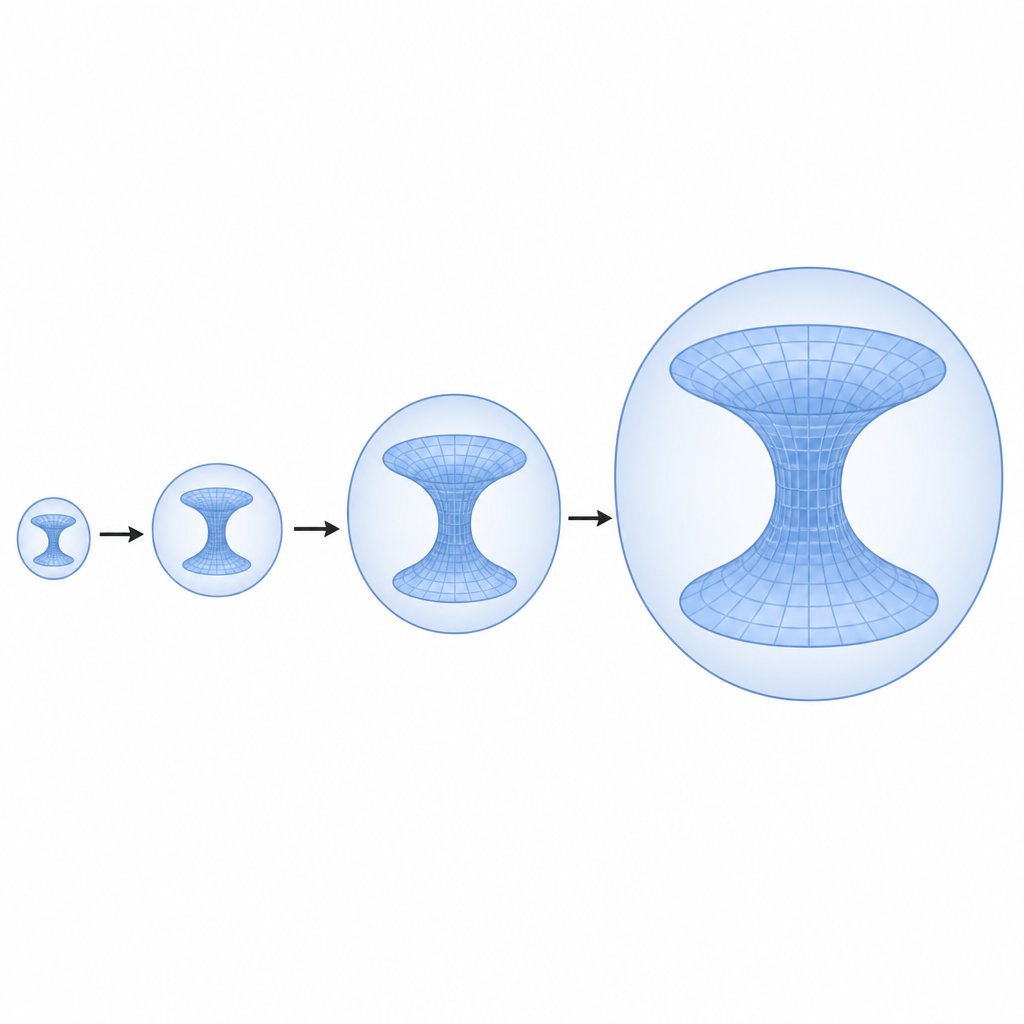
Putting a wormhole inside the bubble
The next step is to place a standard traversable wormhole model entirely inside the inflating region. In this combined picture, the wormhole throat swells along with the surrounding space, potentially carrying a Planck scale tunnel up to macroscopic size during the bubble’s lifetime. The authors show that the total energy of this configuration can become negative in some regimes, and the usual pointwise energy conditions remain violated. However, because the inflation bubble profile can be shaped, they identify special choices where the energy density right at the wormhole throat becomes positive while the bubble is active. They also analyze how the wormhole’s negative energy contribution stays finite and how its interaction with the bubble modifies the overall energy budget without introducing divergences.
What this means for future wormhole dreams
In the end, the local inflation bubble is presented not as a blueprint for building time machines, but as a theoretical laboratory. It shows that one can, at least on paper, design a compact, smooth spacetime deformation that amplifies quantum scale wormholes and other tiny structures without disturbing the universe at large. The price is steep: exotic forms of stress energy and enormous total power are required, and important open questions remain about stability and compatibility with quantum energy constraints. For now, the work clarifies what the rules of general relativity allow and what a future, far more capable civilization would have to overcome to turn microscopic spacetime tunnels into usable passages.
Citation: Dorau, P., Much, A. Local expansion mechanisms for quantum-scale wormholes. Sci Rep 16, 16424 (2026). https://doi.org/10.1038/s41598-026-54990-3
Keywords: wormholes, quantum foam, spacetime geometry, exotic matter, cosmic inflation