Clear Sky Science · en
Characterization of cast Ti30Cr20Mo15Zr10Ta5Nb20-xFex compositionally complex alloys
Stronger, Safer Metals for Implants
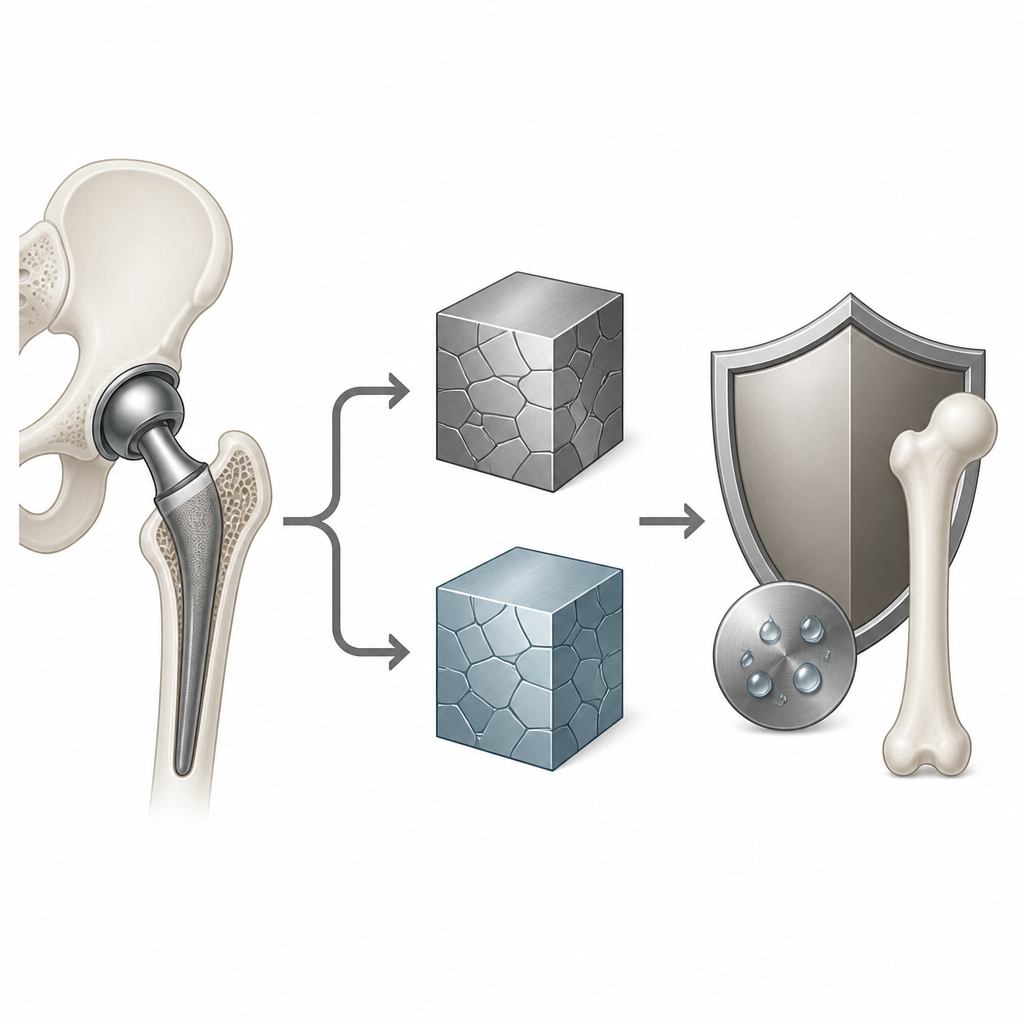
When surgeons replace a worn-out joint or repair a broken bone, they rely on metal implants that must endure years of rubbing, bending, and contact with salty body fluids. Conventional titanium alloys can slowly wear and corrode, releasing tiny particles into the body. This study explores two new titanium-based metals designed to be tougher, more resistant to attack in salty environments, and potentially cheaper, while still being suitable for future medical implants.
Why New Implant Metals Are Needed
Modern implants made from titanium, stainless steel, or cobalt-chromium alloys have transformed medicine, but they are not perfect. In the body, mechanical wear and chemical corrosion act together, gradually stripping material from the implant surface. This combined damage can shorten implant life and scatter debris that may irritate surrounding tissue. Researchers have turned to complex metal mixes containing several elements in almost equal amounts to overcome these limits. Such "compositionally complex alloys" can form simple internal structures that give them high strength, hardness, and corrosion resistance, making them promising candidates for next-generation implants.
Designing Two Advanced Titanium Alloys
The team focused on titanium-based alloys that also contain chromium, molybdenum, zirconium, and tantalum, all known for their good behavior in the body. They created two versions by adjusting the balance of niobium and iron. One alloy used more niobium, while the second replaced half of that niobium with iron to cut cost. Both were produced by arc melting, a process that fuses high-purity metals into a uniform ingot. Careful polishing and chemical etching revealed a dendritic, or tree-like, pattern inside each alloy, where different elements gather in slightly distinct regions. X-ray and electron microscope studies showed that both alloys are mostly built from a single type of crystal framework, mixed with smaller amounts of harder intermetallic particles.
Balancing Hardness, Toughness, and Flexibility
The researchers then tested how these inner structures affect mechanical performance. The iron-containing alloy turned out to be harder and stiffer, with a higher Young’s modulus, meaning it resists elastic stretching more strongly. Its fine mixture of phases boosted hardness but also introduced more brittle regions. The niobium-rich alloy was a bit softer and had a lower stiffness closer to that of natural bone, which can help reduce stress on the surrounding skeleton. Wear tests, where metal pins slid against a steel disk, showed that the niobium-rich alloy actually lost less material, likely because its stable internal framework resisted removal under friction despite its lower hardness.
How Salty Fluids and Protective Powders Affect Corrosion
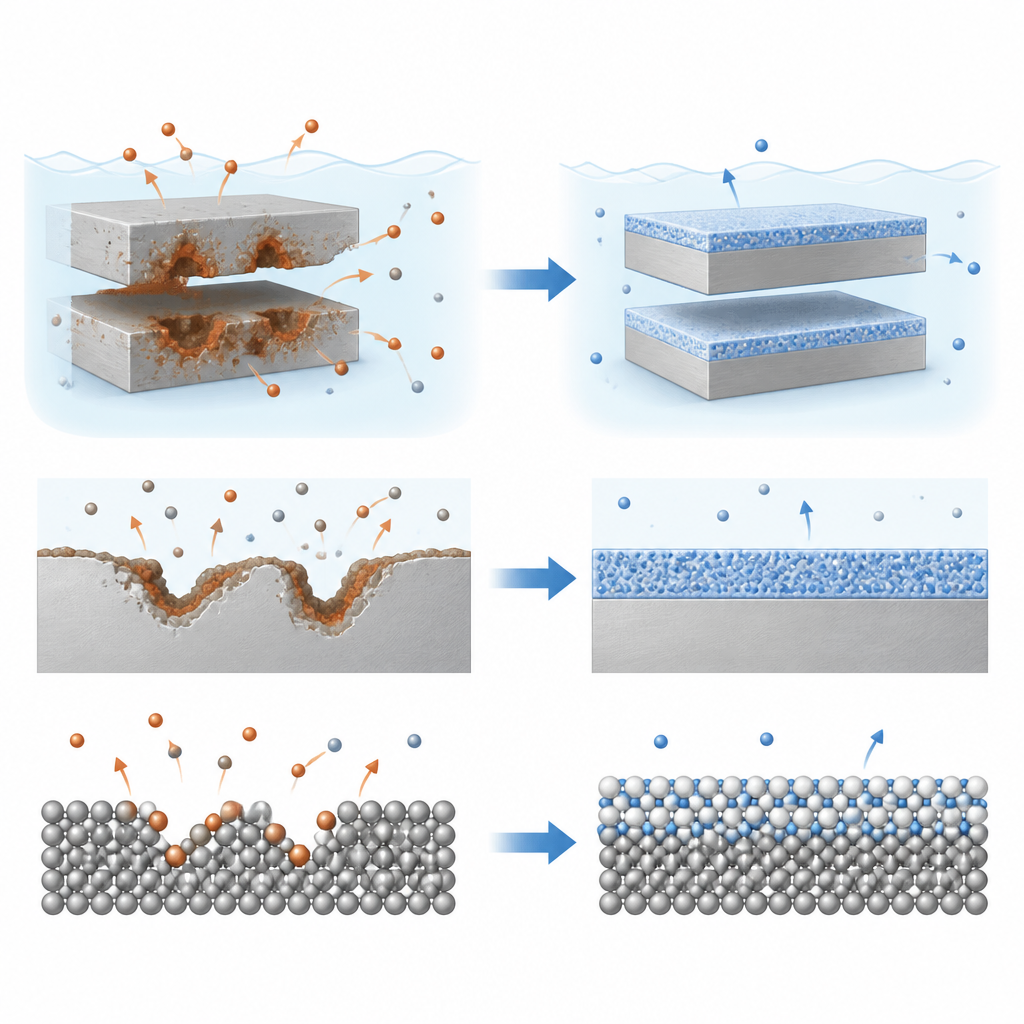
Because implants must survive in a salty, slightly acidic body environment, the team immersed the alloys in saline solution and tracked how quickly they corroded. On their own, both alloys formed protective oxide layers, but the niobium-rich version fared better, corroding more slowly than the iron-containing alloy. The real improvement came when the researchers added increasing amounts of hydroxyapatite powder, a calcium phosphate mineral similar to the mineral in bone. With 3 grams of this powder in the solution, the corrosion rates of both alloys plummeted by more than an order of magnitude. Microscopy and chemical analysis revealed that hydroxyapatite particles and metal oxides built up into a compact surface film that blocked aggressive chloride ions in the salt solution and limited metal dissolution.
What This Means for Future Implants
In simple terms, this work shows that by carefully tuning the recipe of titanium-based complex alloys, scientists can trade off hardness, wear resistance, stiffness, and cost. A niobium-rich version offers lower stiffness, better wear behavior, and strong corrosion resistance, while a partially iron-substituted version is harder and cheaper but needs extra protection. When both are combined with hydroxyapatite, they form robust protective layers in salty fluids. Although further studies on long-term behavior and biological response are still required, these materials demonstrate a pathway toward implant metals that last longer, shed fewer particles, and better match the mechanical and chemical demands inside the human body.
Citation: Ibrahim, A.A., Mohamed, L.Z., El-shazly, M. et al. Characterization of cast Ti30Cr20Mo15Zr10Ta5Nb20-xFex compositionally complex alloys. Sci Rep 16, 16287 (2026). https://doi.org/10.1038/s41598-026-54590-1
Keywords: titanium alloys, biomaterials, corrosion resistance, hydroxyapatite coating, orthopedic implants