Clear Sky Science · en
DFT study on tunable electronic and adsorption properties of poly(vinyl alcohol)/copper oxide/graphene oxide hybrid nanostructures
Smarter plastics for a changing environment
From checking air quality to tracking building moisture, society increasingly relies on small sensors that can “feel” gases and humidity. This study explores how a common, safe plastic can be combined with tiny particles of copper oxide and sheets of graphene oxide to create a new hybrid material whose response to water and carbon dioxide can be finely controlled. The work is theoretical, but it maps out how to design future plastic-based films that are more sensitive, selective, and energy-efficient for environmental monitoring.
Building a flexible hybrid material
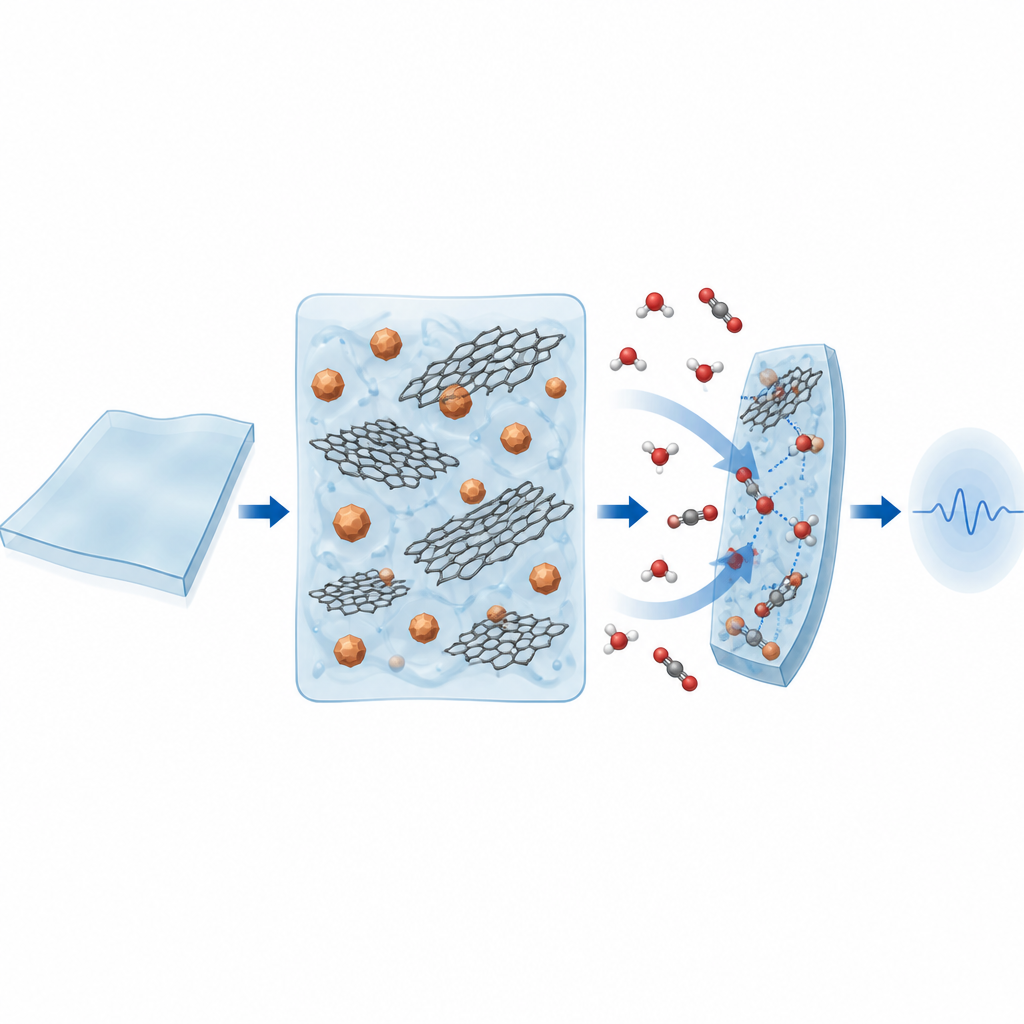
The base of the material is poly(vinyl alcohol), or PVA, a widely used polymer known for its stability, film-forming ability, and many hydroxyl (OH) groups that easily interact with other substances. On its own, however, PVA behaves like an electrical insulator, which limits its usefulness in electronic and sensing devices. The researchers consider what happens when nanoscale copper oxide and graphene oxide are embedded into short segments of PVA chains. Copper oxide brings semiconducting behavior and active surface sites, while graphene oxide adds large, flat carbon sheets decorated with oxygen groups that help disperse within the plastic and carry charge.
How the internal structure shapes behavior
Using a powerful quantum chemistry method called density functional theory, the team examines the internal structure and charge distribution of many model combinations of PVA, copper oxide, and graphene oxide. They focus on two main ways copper oxide can bind within the plastic: through copper atoms or through oxygen atoms that form hydrogen bonds with PVA’s OH groups. When graphene oxide is added, all three components knit together through a web of coordination bonds, hydrogen bonds, and weaker dispersive forces. Detailed maps of electron density and energy levels show that these interactions create new electronic states at the junctions between components, effectively turning the once-insulating PVA into a material with strong semiconducting character.
Tuning electrical response and reactivity
A key measure for sensor materials is the energy gap between filled and empty electronic states: a wide gap means poor conductivity, while a narrow gap allows easier charge motion. The calculations reveal that this gap shrinks dramatically when copper oxide and graphene oxide are introduced, dropping from a very large value in pure PVA to less than one electron volt in the best-performing hybrid. At the same time, the total dipole moment, which reflects how strongly charges are separated in the material, increases. Global indicators of chemical softness and electron-accepting ability rise as well, especially for the oxygen-rich arrangement of copper oxide and graphene oxide. These trends point to a material that is both more electronically responsive and more ready to interact with incoming molecules.
How water and carbon dioxide are sensed
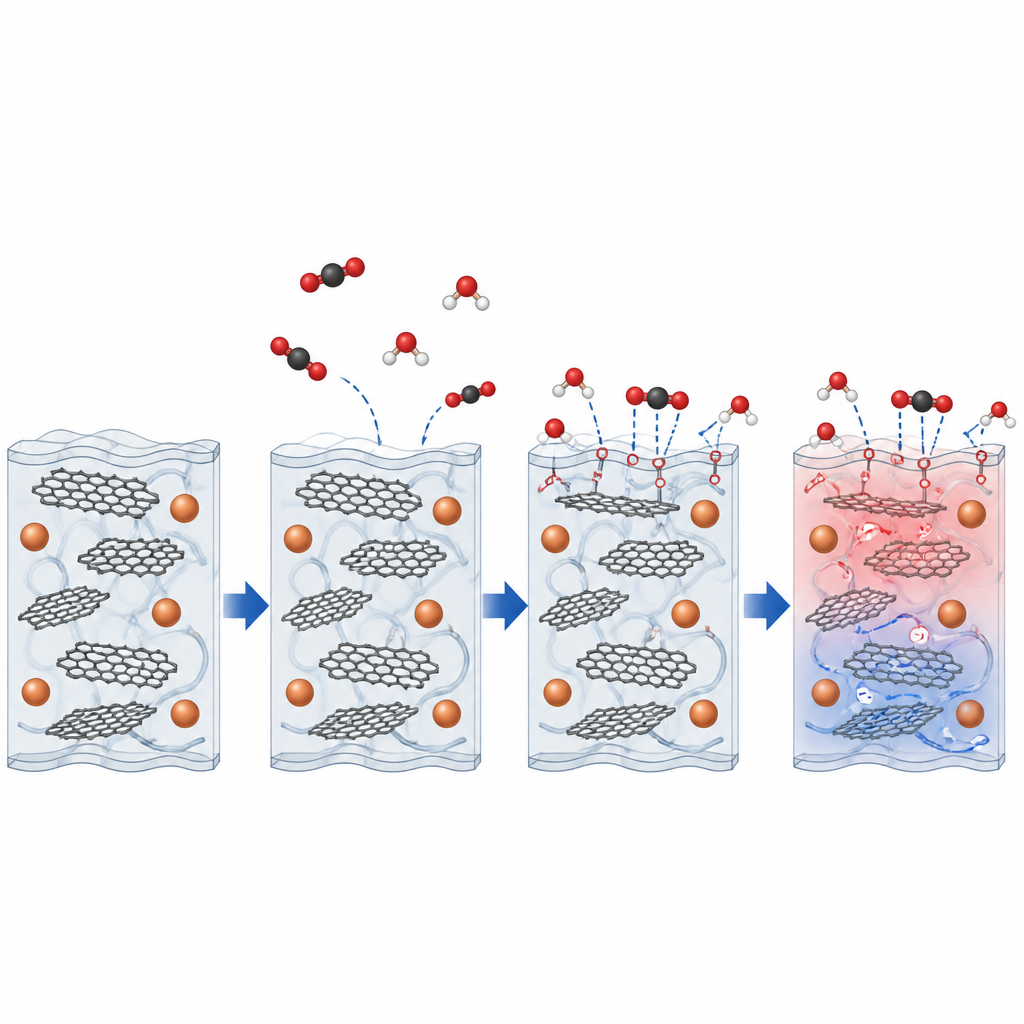
The study then probes how the hybrid films respond when one or two molecules of water or carbon dioxide are brought near the surface. The molecules do not form strong chemical bonds; instead, they are held by a mixture of hydrogen bonding and gentle, reversible attractions. Even so, their presence is enough to noticeably change the film’s electronic properties. In some cases, adsorption of a pair of water molecules lowers the energy gap by more than half, while also boosting the dipole moment, signaling a sizeable change in conductivity and optical behavior. For oxygen-rich structures, carbon dioxide binds slightly more strongly, but still in a way that should allow the gas to be removed and re-adsorbed repeatedly, a desirable feature for reusable sensors.
Pathway toward future gas and humidity sensors
Overall, the work shows that carefully mixing PVA with copper oxide and graphene oxide can transform a simple plastic into a flexible material whose electrical and adsorption properties can be tuned by design. By tracing how subtle shifts in bonding, charge distribution, and weak interactions alter the energy landscape, the study identifies specific hybrid structures that should be especially sensitive to water and carbon dioxide. For a lay reader, the takeaway is that everyday-style plastics can be reimagined as smart skins that gently “feel” their surroundings, offering a roadmap for developing thin, adaptable coatings for future gas and humidity sensing technologies.
Citation: Ibrahim, A., El Aal, M.A., El-Zahed, H. et al. DFT study on tunable electronic and adsorption properties of poly(vinyl alcohol)/copper oxide/graphene oxide hybrid nanostructures. Sci Rep 16, 16191 (2026). https://doi.org/10.1038/s41598-026-54159-y
Keywords: polymer nanocomposite, gas sensing, graphene oxide, copper oxide, humidity sensor