Clear Sky Science · en
Experimental investigation into friction reduction induced by normal vibration from frequency dependence to unified vibration velocity amplitude
Shaking Things to Make Them Slide
From car engines to tiny machines inside electronics, friction quietly wastes energy and wears parts down. Engineers have long known that adding a gentle shake can make surfaces slide more easily, but why this works, and how it changes with different kinds of vibration, has been less clear. This study explores how shaking one surface up and down can tame friction across a wide range of vibration speeds, from slow shudders to high-pitched buzzes, and looks for a simple rule that explains it all.
How the Test Bed Was Built
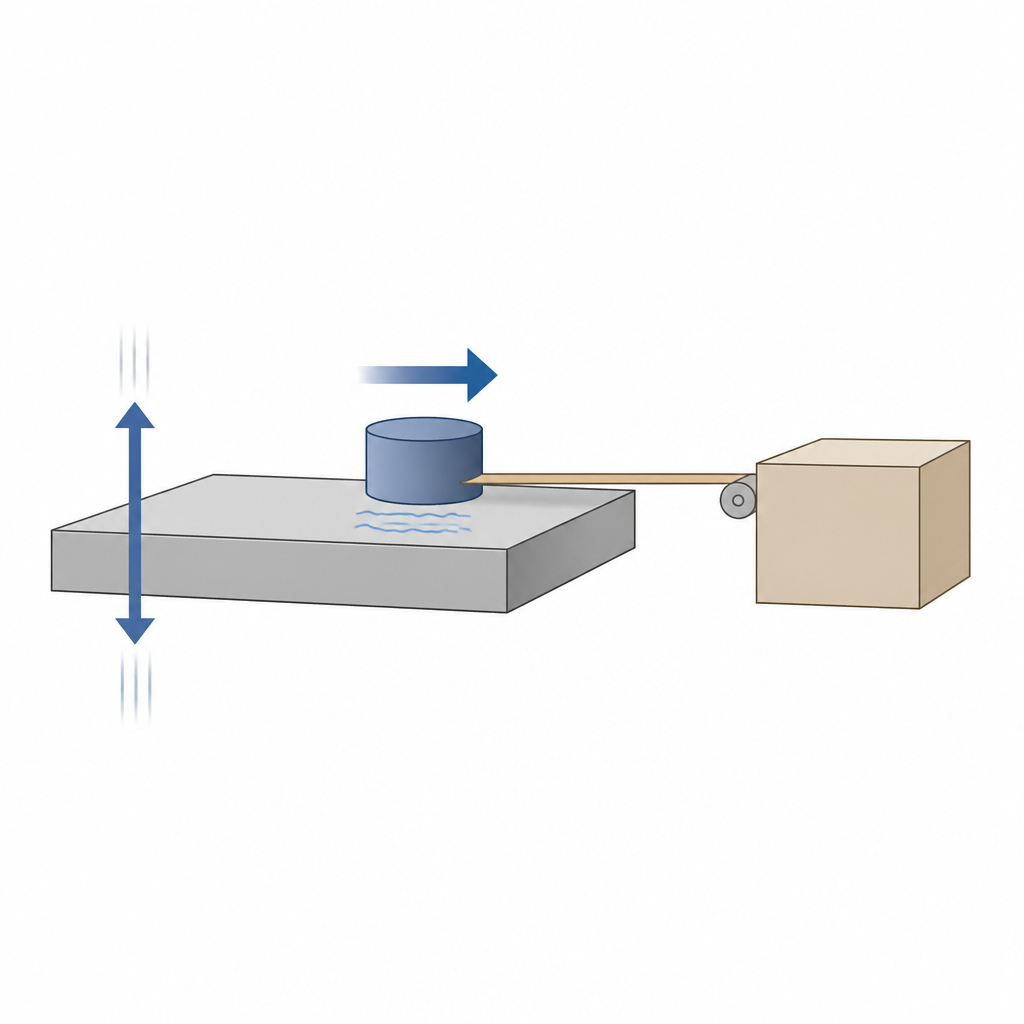
To study friction in a controlled way, the researchers built a compact sliding rig. A small metal cylinder sat on a square metal plate that could vibrate straight up and down in a smooth, repeating motion. A thin metal strip pulled the cylinder sideways at a steady speed while a force sensor measured how hard the strip had to pull, which revealed the friction between the cylinder and the plate. Three laser instruments tracked how fast the plate bounced vertically, how fast it wiggled sideways, and how quickly the cylinder slid along. This setup let the team vary how strong and how fast the vertical shaking was while keeping the sliding motion the same.
Slow Shakes and Sudden Slips
At low vibration frequencies, where the motion feels more like a slow shake than a buzz, the team found that friction only dropped sharply when the sliding motion itself behaved in a start and stop fashion. In these cases, the cylinder would alternately stick to the plate and then slip forward, or the direction of the friction force could briefly flip. The measurements showed that when the sideways speed of the plate and the cylinder matched or crossed, these stick and slip episodes appeared, and the average friction force fell. If the vertical shaking was too weak to trigger this behavior, the friction changed very little, even though the plate was still vibrating.
Fast Vibrations with Constant Sliding
At much higher frequencies, thousands of times per second, the story changed. Even when the cylinder slid smoothly without any clear sticking or reversal of friction, the measured friction force still declined as the strength of the vertical vibration increased. By tuning the vibration close to the natural resonance of the plate, the researchers could boost the vertical motion enough that the friction dropped toward very small values. Under the strongest high-frequency shaking, calculations suggest that the contact between the cylinder and plate briefly opened and closed, even if those tiny separations were too quick to see directly in the force signal.
A Single Speed Scale Behind It All
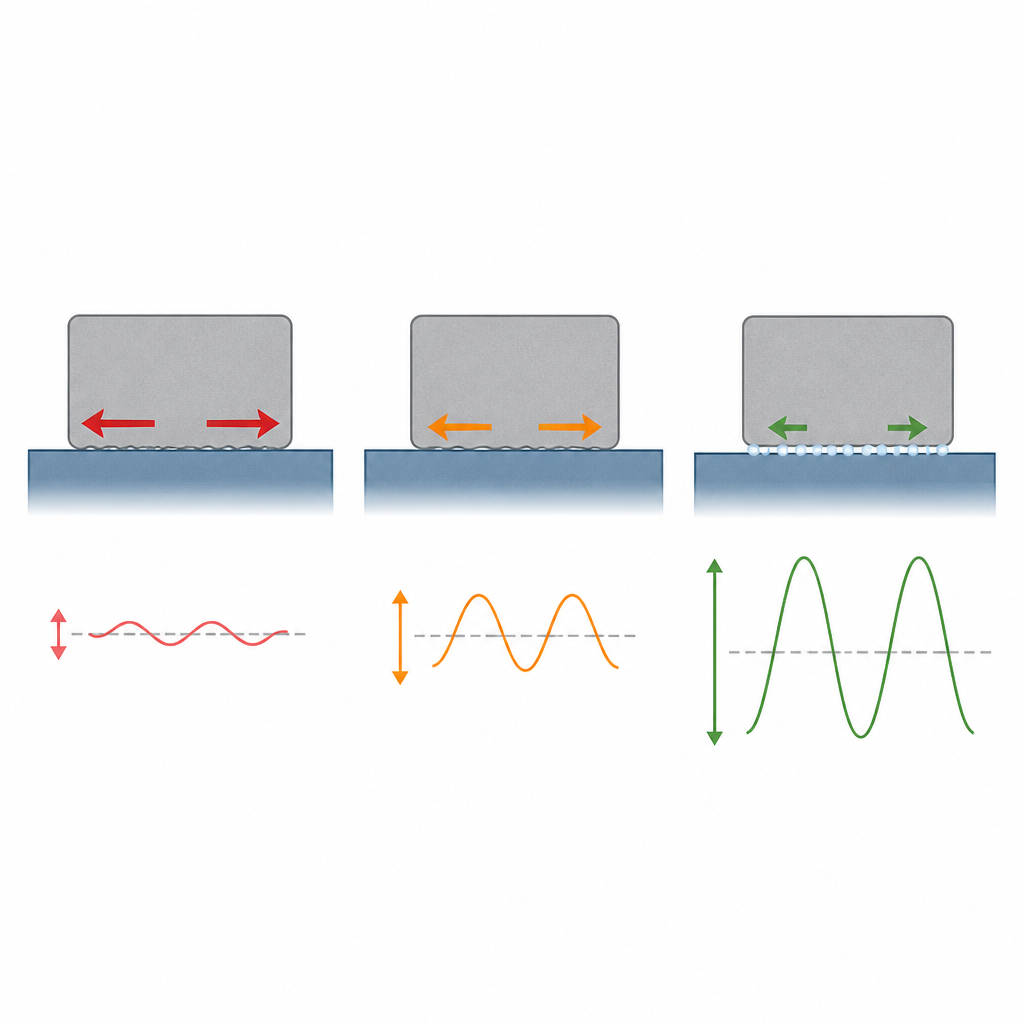
Although the low and high frequency cases looked quite different on the surface, the team discovered that a single measure tied them together: how fast the plate was moving up and down at its peak, called the vibration velocity. When they converted their data from simple vibration height to this vertical speed and plotted friction against it, results from very different frequencies started to line up. In general, higher vertical vibration speed meant lower friction, regardless of whether the change came from large, slow motions or tiny, rapid ones. The exact details still depended on the hardware, but this vertical speed set the overall trend.
From Tiny Contacts to Everyday Machines
The way friction shrank in these tests mirrors what other groups have seen when they shake tiny contacts with microscopes: increasing vibration can drive friction down to extremely low levels once it passes a certain strength. This similarity hints that the same basic rule, based on how quickly the surfaces separate and press back together, may apply from atomic scales up to visible sliders. In simple terms, the faster the surface is driven up and down, the easier it is to break the microscopic sticking points that cause resistance, making sliding smoother and less costly in energy.
Citation: Lu, J., Zhao, Z., Zhao, S. et al. Experimental investigation into friction reduction induced by normal vibration from frequency dependence to unified vibration velocity amplitude. Sci Rep 16, 16003 (2026). https://doi.org/10.1038/s41598-026-54137-4
Keywords: vibration, friction, tribology, superlubricity, mechanical systems