Clear Sky Science · en
Data-driven prediction of micro-piled raft load–settlement using machine learning and Monte Carlo simulation
Why tiny piles under big buildings matter
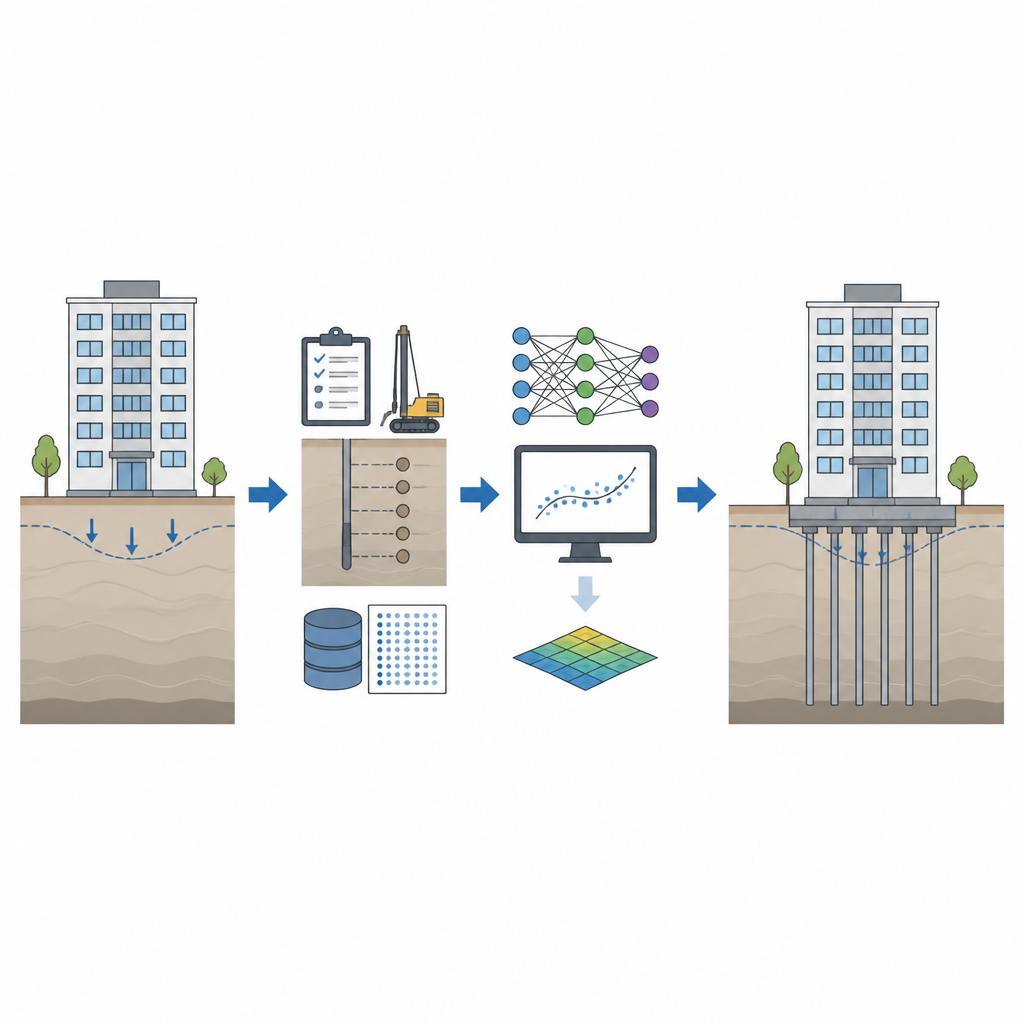
Modern cities rely on deep foundations to keep buildings stable, even when they sit on soft clay that can slowly squeeze and settle. Engineers increasingly turn to very slender piles, called micropiles, combined with a flat concrete raft to safely carry loads where space is tight or ground conditions are tricky. This study explores how data and artificial intelligence can help predict how much such micro-piled rafts will sink under load, giving designers a faster and more reliable way to judge safety and long-term performance.
Small piles, big support
A micro-piled raft foundation combines a thick concrete slab with many thin, steel-reinforced piles drilled deep into the ground. Although each pile is only a few centimeters wide, together they can support large buildings while keeping settlement small. They are especially useful in soft clay, where traditional shallow foundations would sink too much. The behavior of this system is complicated because the raft, the clustered micropiles, and the surrounding soil all interact. Factors such as pile length and spacing, raft size and thickness, and the strength of the clay all influence how the load is shared and how much the ground compresses under different levels of stress.
Building a rich test database
To study this behavior, the author assembled a database of 480 experimental cases drawn from earlier laboratory model tests and large-scale field measurements on micro-piled rafts in cohesive soils. For each case, the data include the geometry of the raft, the size, number, and arrangement of micropiles, the strength of the clay, and the applied load, along with the measured settlement. By keeping the clay conditions relatively controlled while varying the foundation layout, the dataset focuses on how design choices affect performance. This makes it well suited for training computer models that can learn subtle patterns linking foundation design, soil properties, and resulting ground movement.
Training machines to read the ground
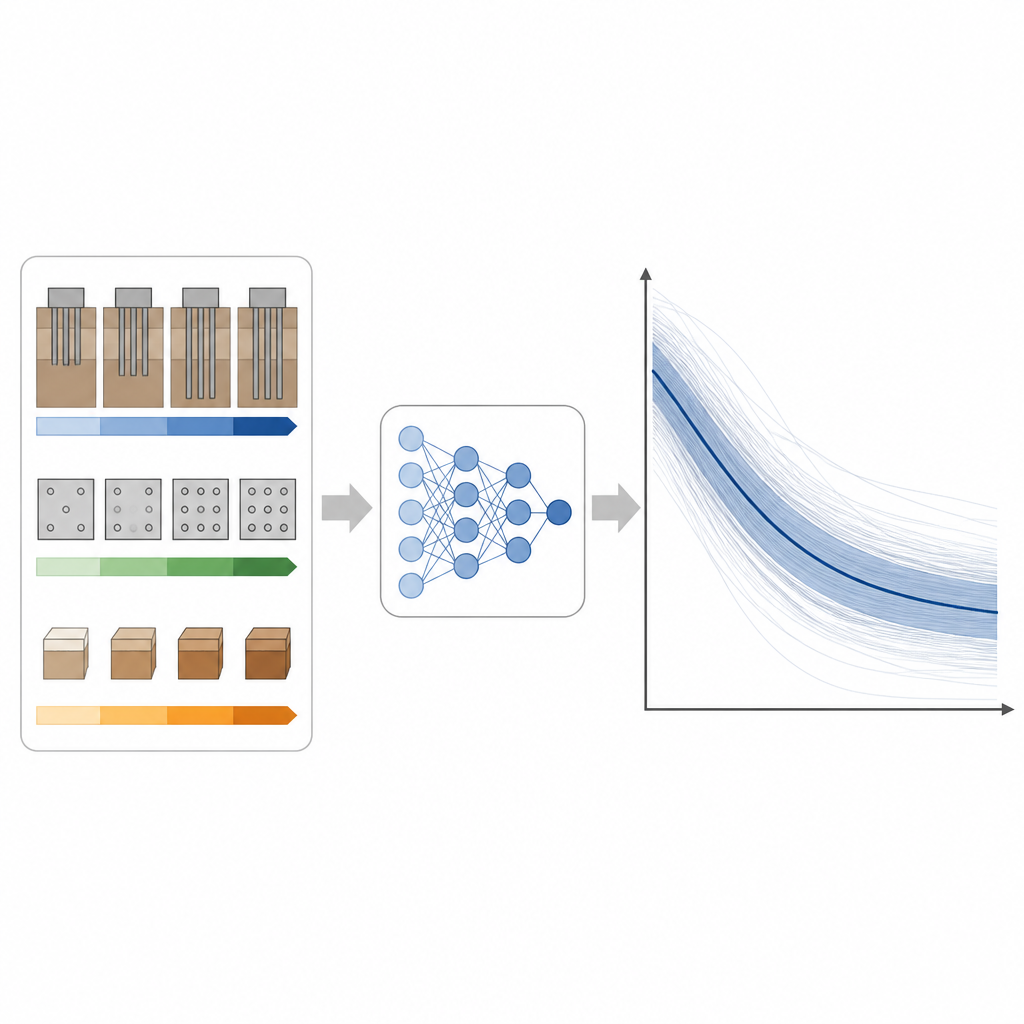
The study compares six popular machine learning methods to see which best predicts settlement from the available inputs. These include tree-based techniques such as random forests and boosting methods, a neighbor-based method, and two kernel-based methods: support vector regression and Gaussian process regression. All models are tuned carefully using Bayesian optimization and cross-validation to avoid relying on a convenient but misleading set of settings. Their performance is judged using several error measures and visual checks that compare predicted and measured settlements over many different load levels. Although most models fit the training data very well, many of them stumble when asked to predict completely new cases.
Why one model stands out
Gaussian process regression emerges as the most trustworthy tool in this comparison. It captures the curved, nonlinear relationship between load and settlement without simply memorizing past results. On test data that the model has never seen, it maintains high accuracy with low average error measured in millimeters. It also provides confidence bands around each prediction, indicating how certain it is under different conditions. To probe this further, the study feeds the model with thousands of slightly varied input combinations using Monte Carlo simulation, mimicking small uncertainties in dimensions and soil strength. The resulting spread of predicted settlements remains narrow, and the average predicted load–settlement curves closely follow those measured in experiments.
Seeing which factors matter most
Beyond raw accuracy, the study examines how the model makes its decisions using an interpretability tool called SHAP. This analysis shows that the most influential factor is the applied load itself, followed by pile length and raft width, which together control how forces are transferred into the ground. The number and spacing of piles also play a role, but to a lesser degree within the tested range. Clay strength and raft thickness appear less prominent in the statistical ranking because they are tightly linked in the available data, not because they lack physical importance. Overall, the ranking of influential features lines up well with long-standing engineering intuition about how foundations behave in soft clay.
What this means for future designs
The work demonstrates that carefully tuned machine learning, especially Gaussian process regression combined with Monte Carlo simulation, can offer engineers a practical tool for predicting how micro-piled rafts will settle under different loads while also quantifying the uncertainty in those predictions. For now, the findings are strongest within the controlled conditions of the laboratory and selected field tests, and the study calls for more full-scale data and broader soil ranges. Even so, the framework shows how data-driven models and traditional geotechnical understanding can work together to create safer, more efficient foundation designs on challenging ground.
Citation: El Gendy, M. Data-driven prediction of micro-piled raft load–settlement using machine learning and Monte Carlo simulation. Sci Rep 16, 16180 (2026). https://doi.org/10.1038/s41598-026-54119-6
Keywords: micro-piled raft foundations, machine learning, Gaussian process regression, load-settlement behavior, Monte Carlo simulation