Clear Sky Science · en
Improving airport security with IoT-powered deep learning methods for threat detection and intelligent recommendation systems
Why Smarter Airports Matter to Travelers
Air travel is busier than ever, and most passengers only notice security when it is slow or stressful. This study explores how a new blend of smart sensors and artificial intelligence could make airports both safer and smoother to move through. By teaching computers to recognize unusual behavior and risky objects in real time, the researchers aim to reduce long lines, cut down on false alarms, and help security staff focus on the situations that truly matter.

From Cameras and Sensors to a Living Nervous System
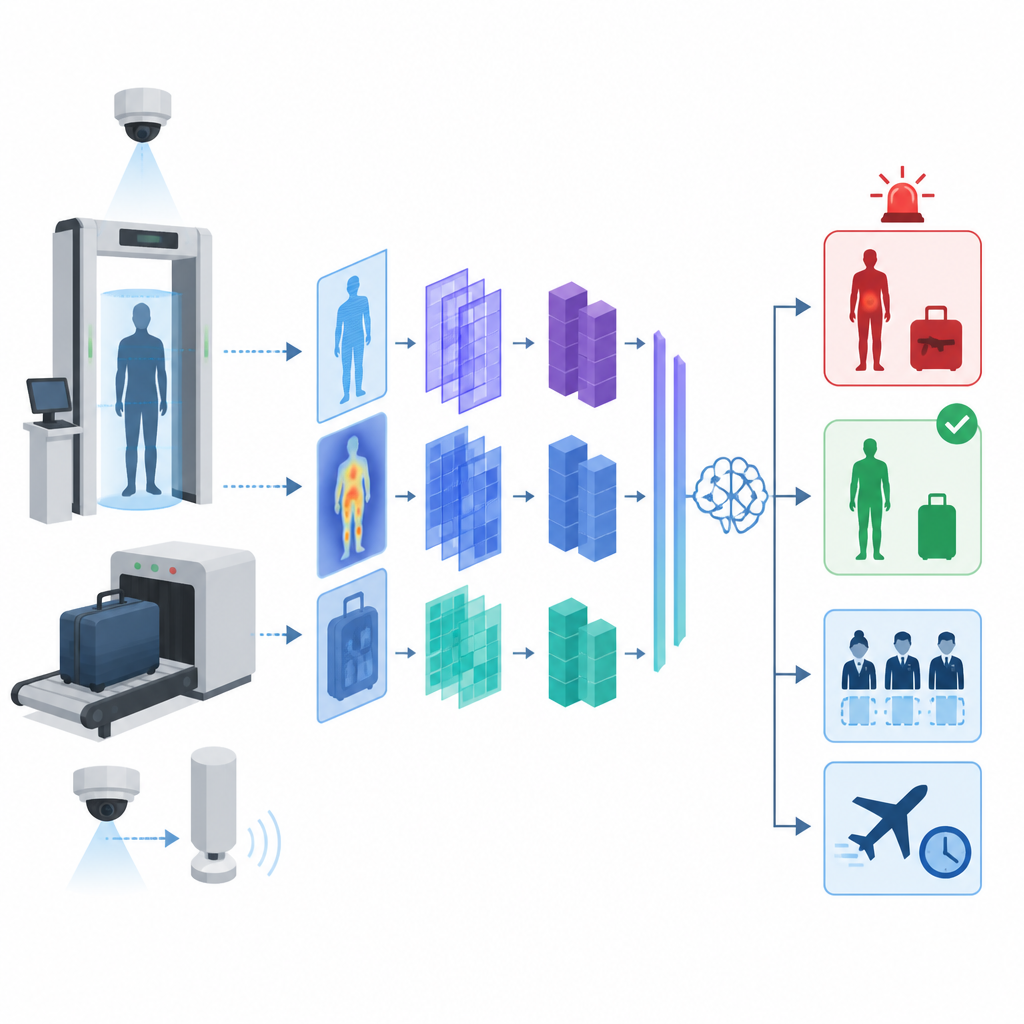
The authors propose an airport security framework called ISODI that treats the terminal like a connected nervous system. Cameras, motion detectors, access badges, and environmental sensors all feed into one digital pipeline. This stream of information is cleaned and synchronized so that a person leaving a bag, a crowd building up, or a restricted door opening can be understood together instead of as isolated events. By combining many sources, the system can watch over large spaces more reliably than human guards alone.
How the Digital Watchdog Learns What Is Unusual
At the heart of ISODI are deep learning models, a family of computer programs inspired by the brain. One part specializes in images, scanning body-scan pictures and video frames for guns or other hidden objects. Another part focuses on sequences of numbers, such as changing sensor readings or the ebb and flow of passengers over time. The study makes creative use of a technique called multi-view learning: three-dimensional body scans are turned into several two-dimensional views so that well-tested image networks can analyze them efficiently.
Teaching the System Using Real Airport Data
To see how well this approach works, the researchers trained and tested their models on two large, publicly available datasets. One contains full-body scans similar to those used in many airports, where hidden threats may be present under clothing. The team’s transfer learning model, which reuses knowledge from existing image libraries, correctly spotted threats on new, unseen scans with more than 99% accuracy on key measures. A second dataset records millions of commercial flights, including delays and diversions. Here ISODI was used to flag unusual patterns linked to problems such as security-related delays, and it outperformed common methods like decision trees and nearest-neighbor algorithms.
Turning Alerts into Smart Decisions
Detecting a problem is only half the battle; reacting wisely is just as important. ISODI includes an intelligent recommendation module that ranks risks and suggests how to deploy security staff. When the system notices something odd, it can highlight the area, suggest sending officers there, and lower attention in calmer zones. It keeps learning from feedback: if an unattended bag turns out to be harmless, that pattern is logged so similar cases are handled more smoothly next time. This closed loop aims to cut false alarms that slow passengers while ensuring genuine dangers are not missed.
Balancing Safety, Speed, and Privacy
The framework is designed with practical concerns in mind. The methods are chosen to run fast enough for real-time use and to cope with noisy cameras, changing lighting, and occasional sensor failures. The authors also emphasize privacy: personal details are removed or converted into abstract features, and data handling follows strict rules so that individuals are not easily identifiable. Still, they note that real-world trials in working airports are essential to confirm performance, handle rare but serious threat scenarios, and make sure privacy safeguards hold up outside the lab.
What This Means for Your Next Flight
In simple terms, this research shows how airports could use smart technology to be more like a vigilant, well-trained team than a scattered set of checkpoints. By fusing many sensors, advanced pattern recognition, and decision-making tools, the ISODI framework sharply improves the ability to spot true security risks while keeping false alarms low. If fully tested and carefully deployed, systems like this could help keep flights safe, shorten delays related to security issues, and make the journey from curb to gate feel less like a bottleneck and more like a well-organized flow.
Citation: Basem, M., Zaki, J., Saraya, M.S. et al. Improving airport security with IoT-powered deep learning methods for threat detection and intelligent recommendation systems. Sci Rep 16, 16591 (2026). https://doi.org/10.1038/s41598-026-54104-z
Keywords: airport security, artificial intelligence, IoT sensors, anomaly detection, deep learning