Clear Sky Science · en
Assessment of tribological performance and thermal stability of metakaolin-based geopolymer composites reinforced with high TiO2 concentration
Stronger, Longer Lasting Building Blocks
Concrete and brick are everywhere, from homes to highways, but they come with a heavy environmental cost and can suffer in harsh conditions. This study looks at a cleaner type of binder called a geopolymer and shows how mixing in a common white pigment, titanium dioxide, can make it tougher, more heat resistant, and better suited for demanding uses such as industrial floors, high temperature equipment, and infrastructure in extreme climates.
A New Kind of Stone-Like Material
Instead of relying on traditional cement, the researchers start with metakaolin, a refined clay rich in silicon and aluminum. When this powder is mixed with a strongly alkaline liquid, it hardens into a stone-like network called a geopolymer. Geopolymers already use less energy and create fewer emissions than Portland cement, but for many real-world jobs they must also resist wear, cracking, and high temperatures. The team set out to see what would happen if they replaced a large share of the metakaolin with titanium dioxide powder, not just a little, but up to half of the solid material by weight.
Filling in the Gaps
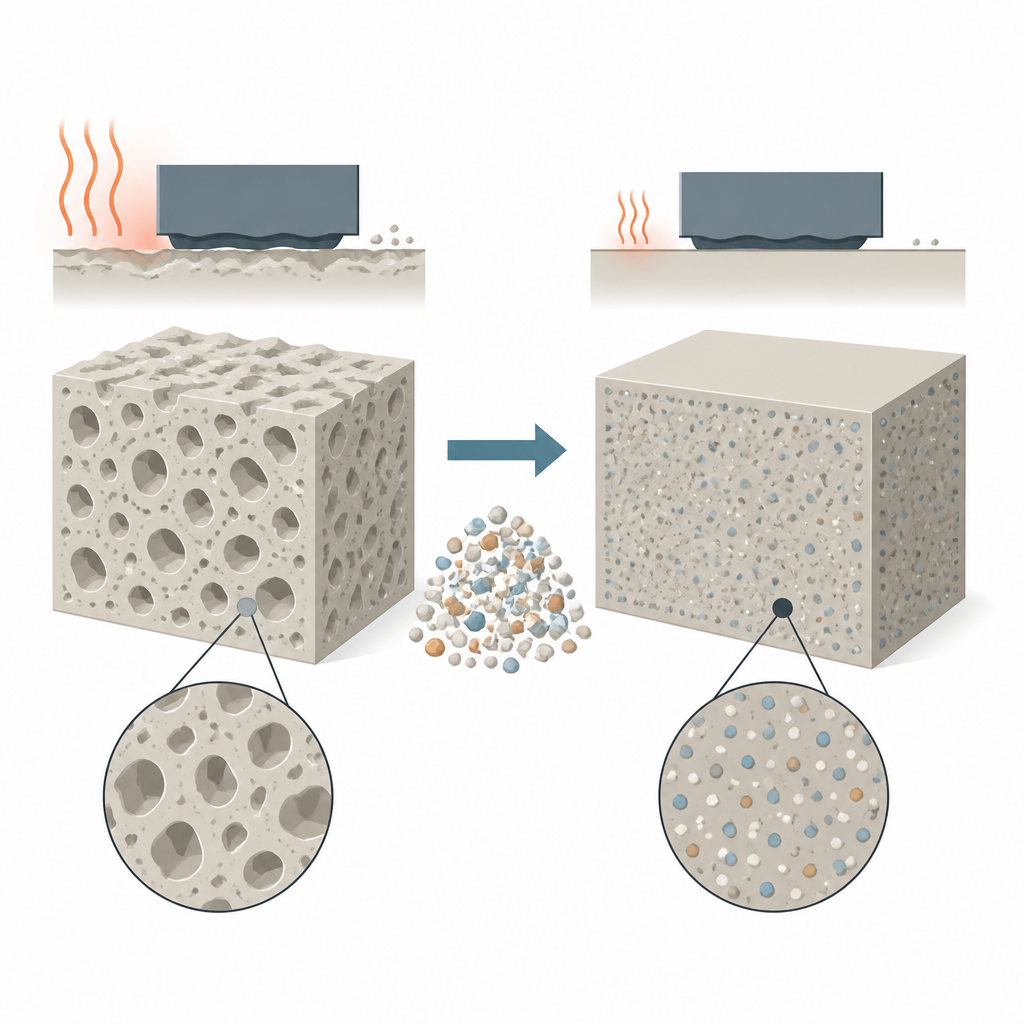
By carefully measuring bulk density, open pores, and how much water the blocks could soak up, the authors showed that the tiny titanium dioxide grains act like fine sand poured into a sponge. As more powder was added, the hardened blocks became heavier for their size and contained fewer and smaller connected pores. Water absorption dropped by more than a third between the plain geopolymer and the version loaded with titanium dioxide, and the internal voids that water could reach also shrank. Microscopic images backed this up, revealing that low and moderate amounts of the filler smooth out the internal structure, while very high contents create regions dominated by tightly packed particles that still leave the overall material quite dense.
Behavior Under Load and Heat
The study also tested how the blocks respond when squeezed and heated. Stress–strain curves showed that adding titanium dioxide steadily increased compressive strength, with the strongest samples carrying roughly twice the load of the unmodified geopolymer before failing. At one intermediate level, clumps of particles created weak spots that crushed gradually, giving the material a more gradual, less brittle failure. When the samples were heated from room temperature to nearly 1000 degrees Celsius, those with titanium dioxide lost less weight at low and medium temperatures, meaning they contained less loose water and fewer unstable components. At high temperatures they left behind more solid residue, thanks to the heat-tolerant nature of the titanium dioxide particles and the tighter packing of the hardened network.
Smoother Sliding and Less Wear
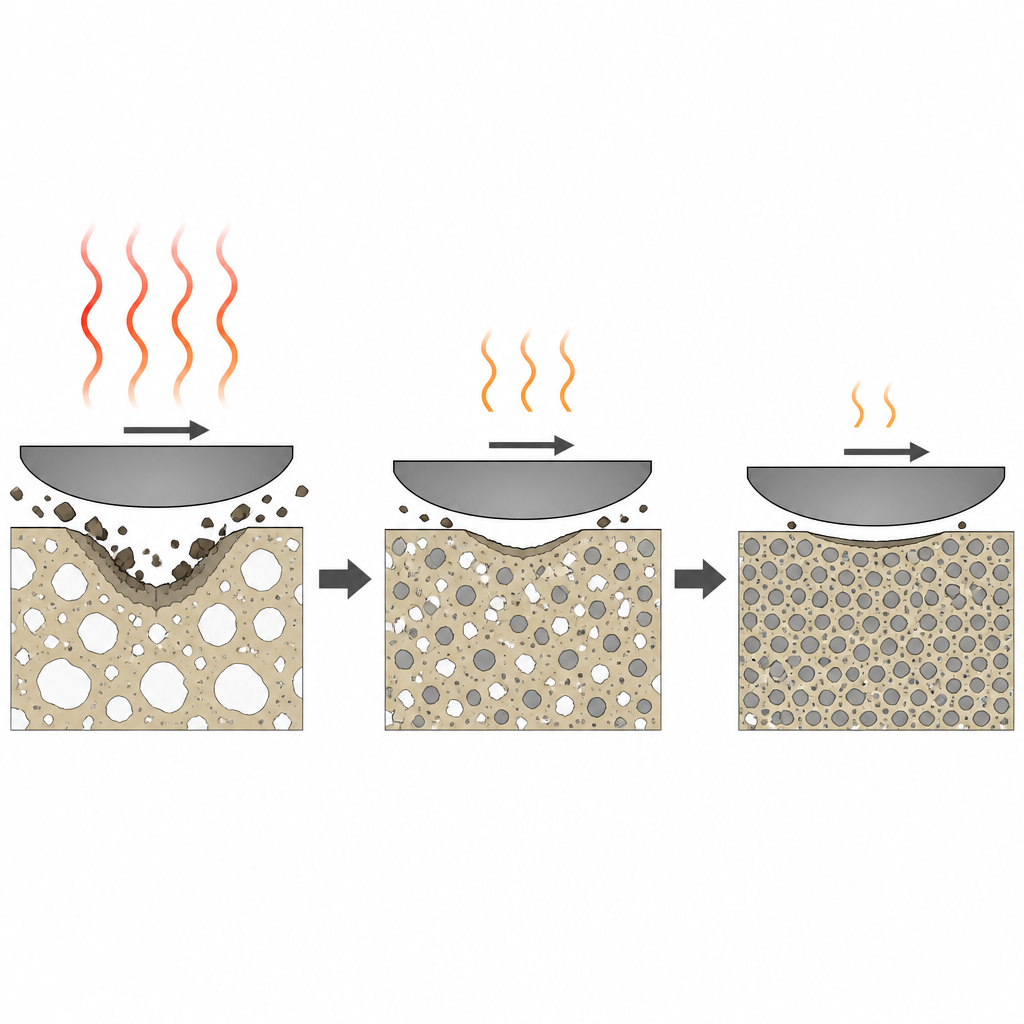
To mimic conditions such as machinery parts rubbing against supports or vehicles grinding over floors, the researchers slid a hard ball across the surface of each block under load. The plain geopolymer showed the highest friction and the greatest wear, cutting a deep track and producing lots of debris. As titanium dioxide content increased, both friction and wear dropped, and the depth and width of the worn tracks shrank. At around 40 to 50 percent filler, the wear rate fell by about two thirds and the steady friction level dropped from roughly one third of the normal load to under one third. Microscopy of the worn surfaces showed that, rather than breaking into sharp chips, the modified surfaces developed smoother tracks with fewer grooves, as the hard particles helped carry the load and protected the softer binder beneath.
What This Means for Future Structures
For non-specialists, the key message is that a simple white powder added in large amounts can turn an already greener binder into a much tougher, more durable material. By packing into the gaps and standing up to both heat and rubbing, titanium dioxide helps geopolymers resist cracking, water penetration, and surface damage. This combination of lower environmental impact and improved performance suggests that metakaolin-based geopolymer composites enriched with titanium dioxide could become attractive alternatives to conventional cement in high performance structures, particularly where high temperatures and heavy wear would quickly damage ordinary concrete.
Citation: Hassan, M.A., Awys, S. & Ali Ali EL-Remaily, M.A.EA. Assessment of tribological performance and thermal stability of metakaolin-based geopolymer composites reinforced with high TiO2 concentration. Sci Rep 16, 16441 (2026). https://doi.org/10.1038/s41598-026-54064-4
Keywords: geopolymer, titanium dioxide, wear resistance, thermal stability, sustainable concrete