Clear Sky Science · en
Reconstructing charcoal formation temperatures in archaeology and volcanology using an automated 532 nm Raman spectroscopy approach
Reading the hidden history in burnt wood
When a campfire or volcanic blast chars wood, it leaves behind more than blackened scraps. Locked inside that charcoal is a record of how hot the fire once burned. This study shows how scientists can read that record quickly and gently, helping archaeologists understand ancient kilns and potters, and volcanologists gauge the heat of past eruptions, without destroying precious samples.
Why burnt wood matters to science
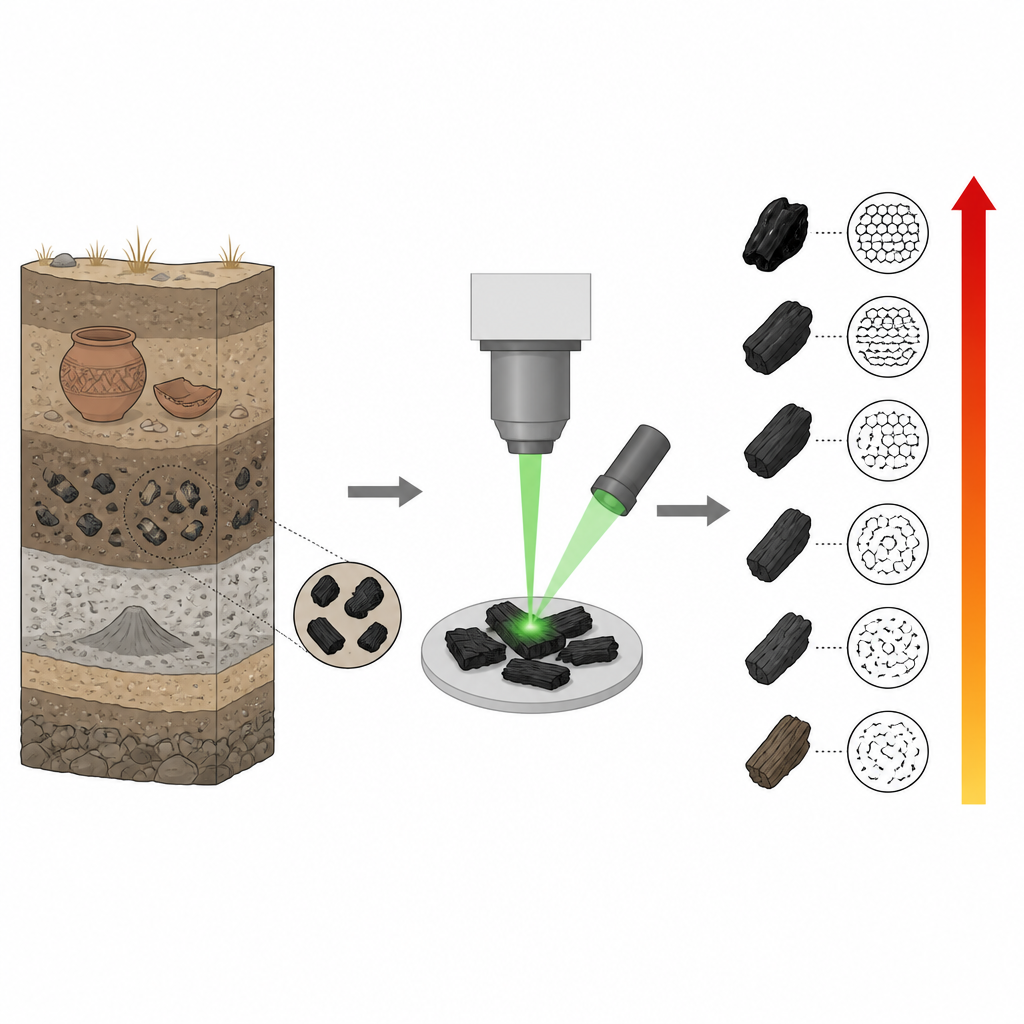
Charcoal is the long-lasting residue of incomplete burning of plants. It can survive in soil and rocks for thousands of years, preserving clues about past human activity, climate, and volcanic events. Archaeologists use charcoal to date sites and to trace how people fueled fires or made pottery. Volcanologists study charcoal trapped in ash deposits to estimate how hot deadly ash clouds once were. Beyond when and where fires happened, researchers now want to know how hot they burned, because temperature controls how ceramics behave, how vegetation is destroyed, and how dangerous volcanic flows can be.
Taking a light-based fingerprint of charcoal
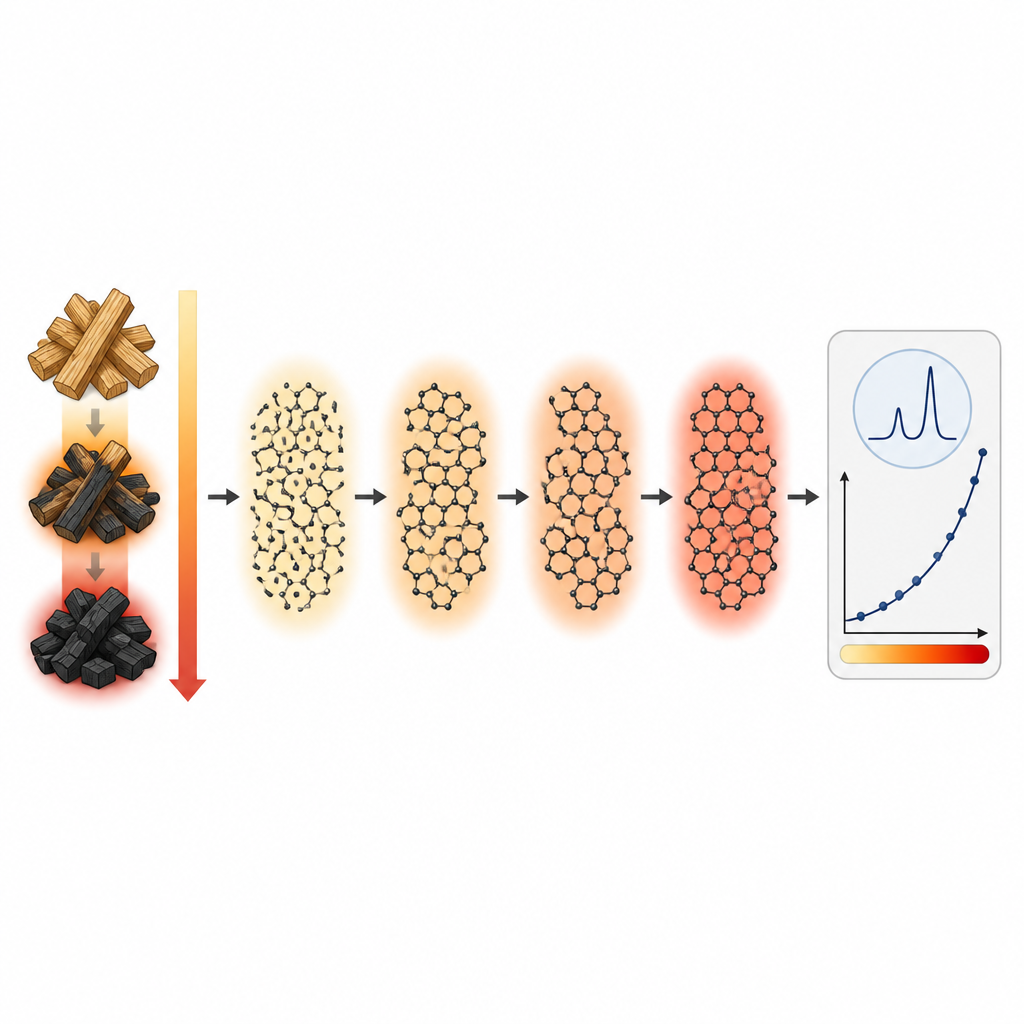
The team relies on Raman spectroscopy, a technique that shines laser light on a material and records how the light scatters. For charcoal, the pattern contains two main peaks that change in a predictable way as wood is heated. By carefully measuring the relative heights of these peaks, scientists can link a piece of charcoal to the maximum temperature it experienced. Earlier studies built such temperature scales for some laser colors, but a popular green laser setting at 532 nanometers lacked a reliable calibration. That gap prevented labs using different instruments from comparing results with confidence.
Building a temperature scale from controlled fires
To fill this gap, the researchers manufactured their own charcoal from pine wood under tightly controlled conditions, heating batches between a little over 400 degrees Celsius and 1200 degrees. For each temperature, they collected hundreds of Raman measurements, cleaned the data with automated filtering and baseline removal, and calculated the key peak-height ratio. From these data they derived a curve that links that ratio to formation temperature, including realistic uncertainty ranges. They also tracked subtle shifts in the peak position, which help flag changes in the internal carbon structure and the possible effects of later alteration by weathering.
Testing on bonfires, pottery, and volcanic ash
The new calibration was then tested in situations that mimic real-world samples. Charcoal from monitored spruce and beech bonfires yielded temperatures that closely matched recorded peak values, even though the wood types and heating histories differed from the original pine. In experimental pottery, the method worked on both burned wood fragments mixed into the clay and on the blackened ceramic surface itself, allowing firing conditions to be estimated without cutting into the vessel. Thin sections of pottery prepared for microscopic study, including surfaces that had been polished, gave the same temperature results as fresh fracture surfaces, showing that normal sample preparation does not disturb the charcoal signal.
Reading the heat of a past eruption
The team also examined charcoal from a volcanic deposit in Kenya formed by a pyroclastic density current, a fast, hot flow of ash and gas. This charcoal had been exposed to air and moisture for centuries, which can chemically alter it and distort the Raman pattern. By looking at the spread of measurements and focusing on data points that most closely resembled their fresh reference material, the researchers estimated that the charcoal formed at roughly 620 to 700 degrees Celsius. This approach shows that even weathered charcoal can still yield useful temperature ranges if treated statistically rather than relying on a single measurement.
What this means for understanding past fires
In simple terms, the study turns charcoal into a natural thermometer that can be read quickly and consistently across many labs. Their open-access web tool, called CHARM, lets users upload Raman data, automatically clean it, and obtain estimated charring temperatures along with clear graphics. This makes it easier for archaeologists to infer how hot ancient kilns or hearths burned, for volcanologists to constrain the heat of past flows, and for other researchers to study thermally altered carbon. By standardizing both the measurement and the data processing, the method opens a new window into the thermal history of fires recorded in the Earth and in human-made objects.
Citation: Dellefant, F., Brückner, O., Budka, J. et al. Reconstructing charcoal formation temperatures in archaeology and volcanology using an automated 532 nm Raman spectroscopy approach. Sci Rep 16, 16018 (2026). https://doi.org/10.1038/s41598-026-53711-0
Keywords: charcoal temperature, Raman spectroscopy, archaeological ceramics, pyroclastic density current, amorphous carbon