Clear Sky Science · en
Modeling and experimental insight into the electronic and structural properties of Sodium alginate/Polypyrrole/Titanium dioxide nanocomposites
Why seaweed and smart plastics matter
Modern gadgets, medical sensors, and environmental cleaners all rely on materials that can move electrical charges in a controlled way. This study explores a new blend made from a seaweed-based substance, a conducting plastic, and tiny particles of a common white pigment to see if they can work together as a flexible, eco-friendly electronic material for sensors, energy devices, and biomedical uses. 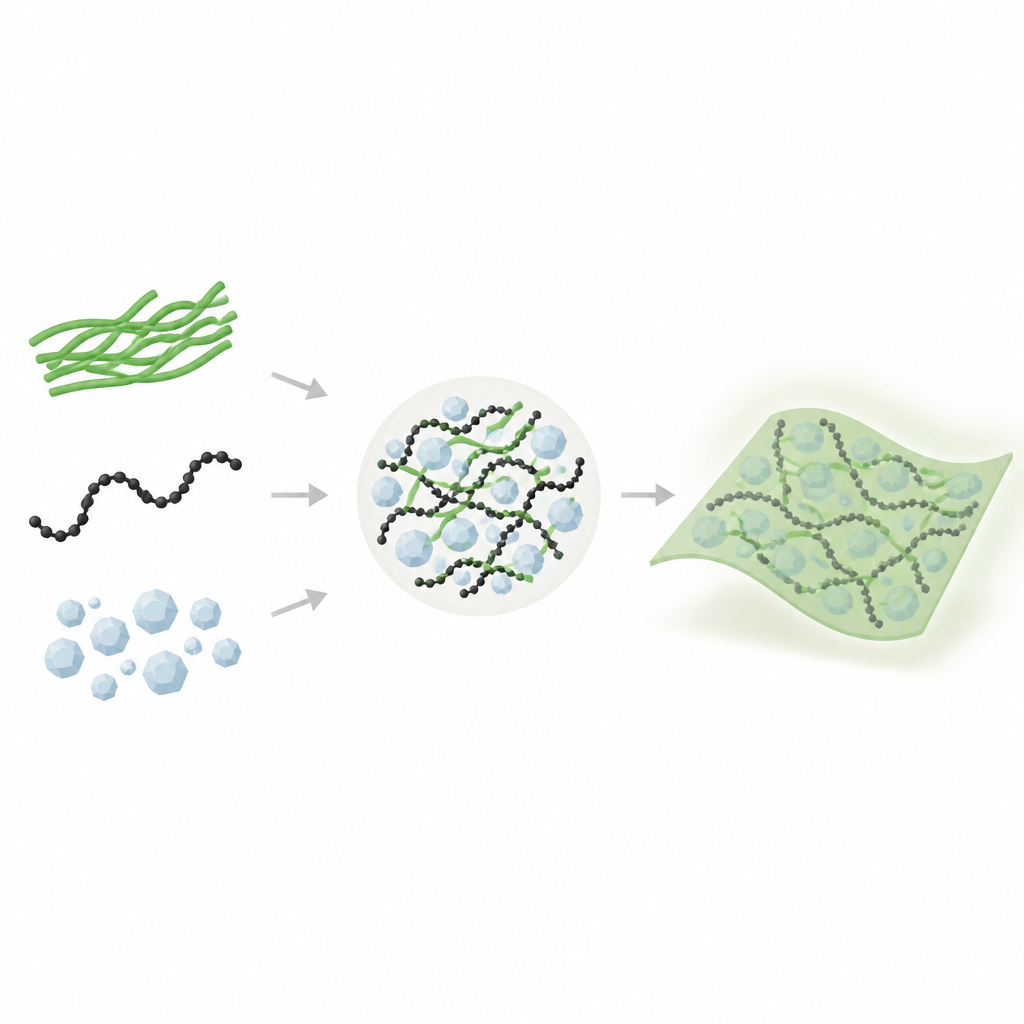
Blending three unlikely partners
The researchers focused on a ternary composite that combines sodium alginate, a natural polymer extracted from brown algae, polypyrrole, a well-known conducting plastic, and titanium dioxide, a robust white semiconductor used in paints and sunscreens. Sodium alginate offers safety, biocompatibility, and the ability to form films and gels; polypyrrole provides electrical conductivity; titanium dioxide contributes stability and strong interaction with light. By weaving these three ingredients together, the team hoped to create a material that is both environmentally friendly and electronically active.
Using computers to look inside the material
To see how the atoms and electrons behave in this blend, the team used quantum chemistry calculations known as density functional theory. These methods let them model small chunks of sodium alginate, polypyrrole, and titanium dioxide and then combine them in many possible ways. They examined how easily electrons could jump across the material by tracking the energy gap between filled and empty electronic states, the overall polarity of each structure, and maps of where positive and negative charges tend to collect. They also used tools that separate the material into tiny regions and measure how electrons are shared or attracted, revealing which arrangements are most stable.
Finding the best paths for charge flow
The calculations showed that when sodium alginate is linked with polypyrrole and titanium dioxide in the right geometry, the energy gap becomes smaller, which makes it easier for electrons to move. The addition of polypyrrole introduces new electronic states that sit between those of the alginate and titanium dioxide, creating smoother pathways for charge transfer instead of large blocked regions. Global indicators such as ionization energy, hardness, and tendency to accept electrons confirmed a synergistic effect: sodium alginate brings reactivity, titanium dioxide brings stability and strong electron attraction, and polypyrrole acts as a conductive bridge between them. Non-covalent interactions such as hydrogen bonds help the alginate framework hold everything in place, reinforcing structural stability while still allowing charges to travel.
Checking theory against real films
To test whether the computer models reflect actual materials, the researchers synthesized titanium dioxide nanoparticles and mixed them with sodium alginate to cast thin films containing different amounts of the inorganic particles. They then measured how these films absorbed infrared light and ultraviolet-visible light and compared the resulting spectra with the predicted ones. The positions and shapes of key peaks, linked to stretching and bending of specific chemical bonds and to electronic excitations, agreed well between experiment and theory, with only small shifts. Further calculations that added a correction for subtle long-range attractions refined the electronic picture, making the predicted energy gap even smaller and closer to what would be expected in real devices. 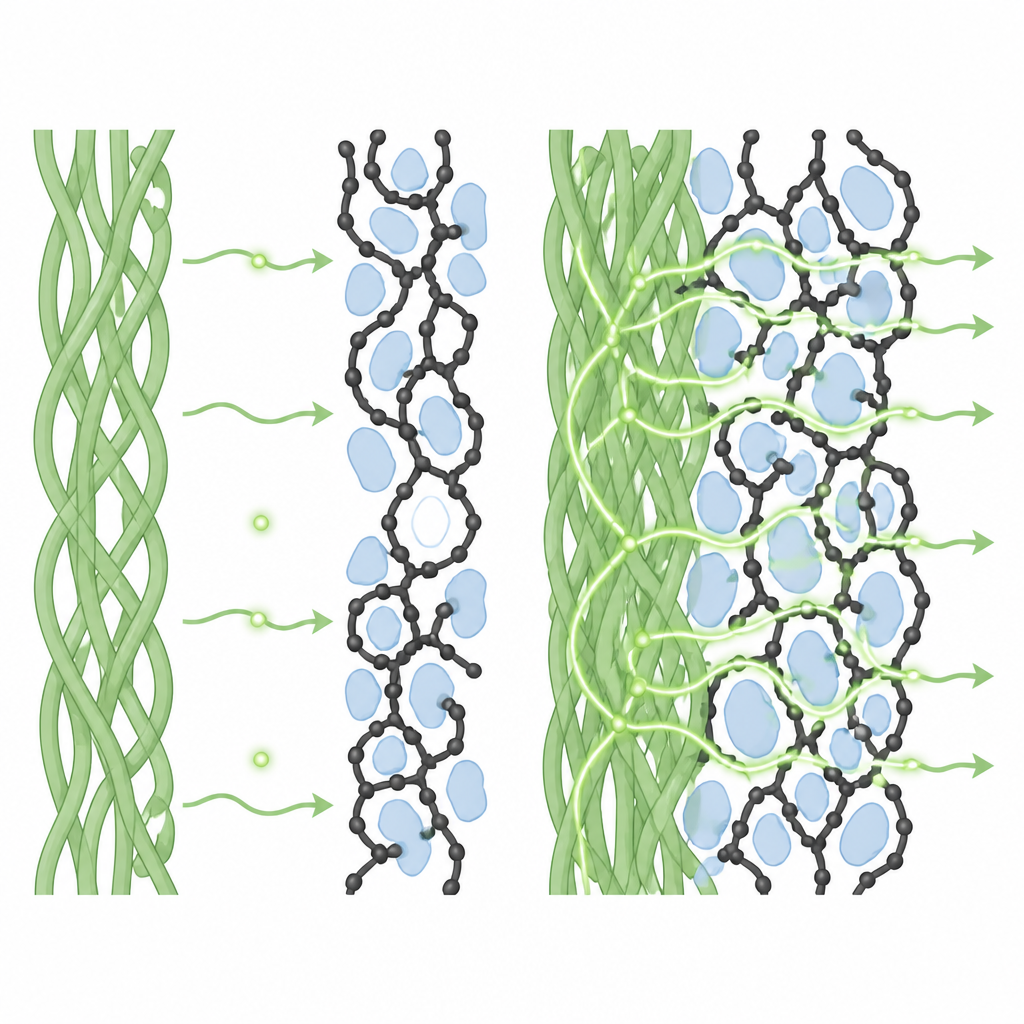
What this means for future devices
In simple terms, the study shows that a film built from seaweed-based polymer, conducting plastic, and titanium dioxide nanoparticles can be designed so that electrons move more easily through it while the structure stays stable. The work does not claim that this composite is ready-made for a specific product, but it demonstrates that combining detailed computer modeling with careful measurements can guide the design of greener electronic materials. With further testing and optimization, similar nanocomposites could become useful building blocks for sensitive sensors, energy storage components, pollution cleanup systems, and biocompatible electronic tools.
Citation: Salem, A.M., Hassan, R.A., El-Rahman, N.M.S.A. et al. Modeling and experimental insight into the electronic and structural properties of Sodium alginate/Polypyrrole/Titanium dioxide nanocomposites. Sci Rep 16, 16571 (2026). https://doi.org/10.1038/s41598-026-53676-0
Keywords: sodium alginate, polypyrrole, titanium dioxide, nanocomposite, electronic properties