Clear Sky Science · en
Flexural behavior and crack development of reinforced geopolymer slabs with longitudinal voids: an experimental study
Why lighter, greener floors matter
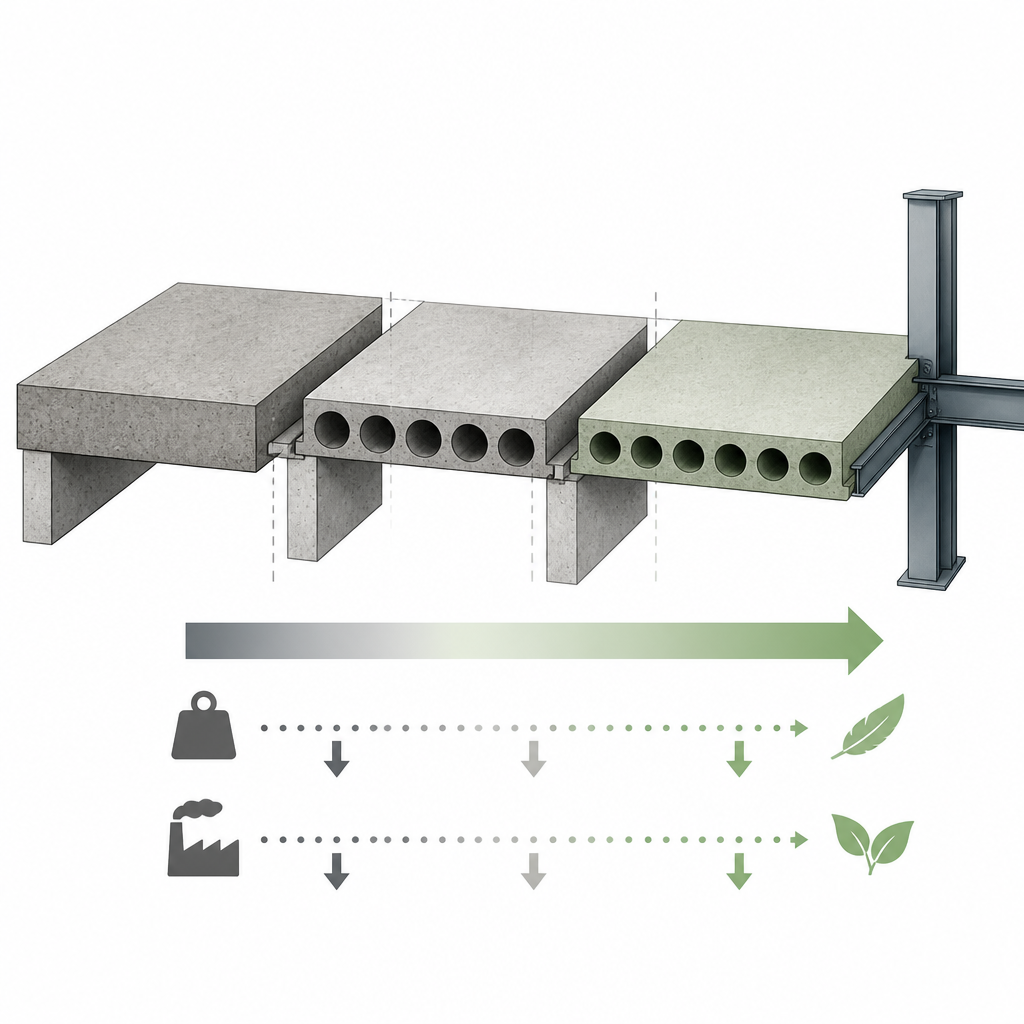
Modern buildings rely on vast areas of concrete floor slabs, which make up a big share of both construction cost and climate impact. This study explores a new way to build these slabs using geopolymer concrete made from fly ash and waste rubber, and by carving long hollow tubes through the slab to cut weight. The work asks a simple question with big practical consequences: can we make lighter, lower carbon slabs that still carry loads safely and resist cracking like ordinary concrete floors?
A different kind of concrete
Traditional concrete binds sand and stone with Portland cement, whose production releases large amounts of carbon dioxide. Geopolymer concrete replaces cement with industrial by products rich in silica and alumina, such as fly ash from power plants. In this research, the authors used a fly ash based geopolymer activated by alkaline solutions, and added a modest amount of treated rubber fibers cut from old tires. The fly ash turns waste into a useful ingredient, while the rubber is intended to make the otherwise brittle geopolymer a bit more forgiving when it cracks. Earlier tests on small cubes, cylinders, and beams showed that this mix reached higher compressive, tensile, and bending strength than a standard cement mix of similar grade, with only a slightly lower stiffness.
Turning solid slabs into hollow cores
To see how this new concrete behaves in real structural elements, the team cast seven reinforced slabs. Two were solid: one made with ordinary cement concrete and one with the geopolymer mix. The other five were longer hollow core slabs made of geopolymer concrete, where plastic pipes running along the length of the slab formed circular voids. By changing the pipe diameters, the researchers created three different void levels, removing between about 12 and 24 percent of the concrete volume. They also varied a key geometric measure, the ratio between span and depth of the slab, which strongly affects how a slab bends and where it is most vulnerable.
Pushing slabs to the breaking point
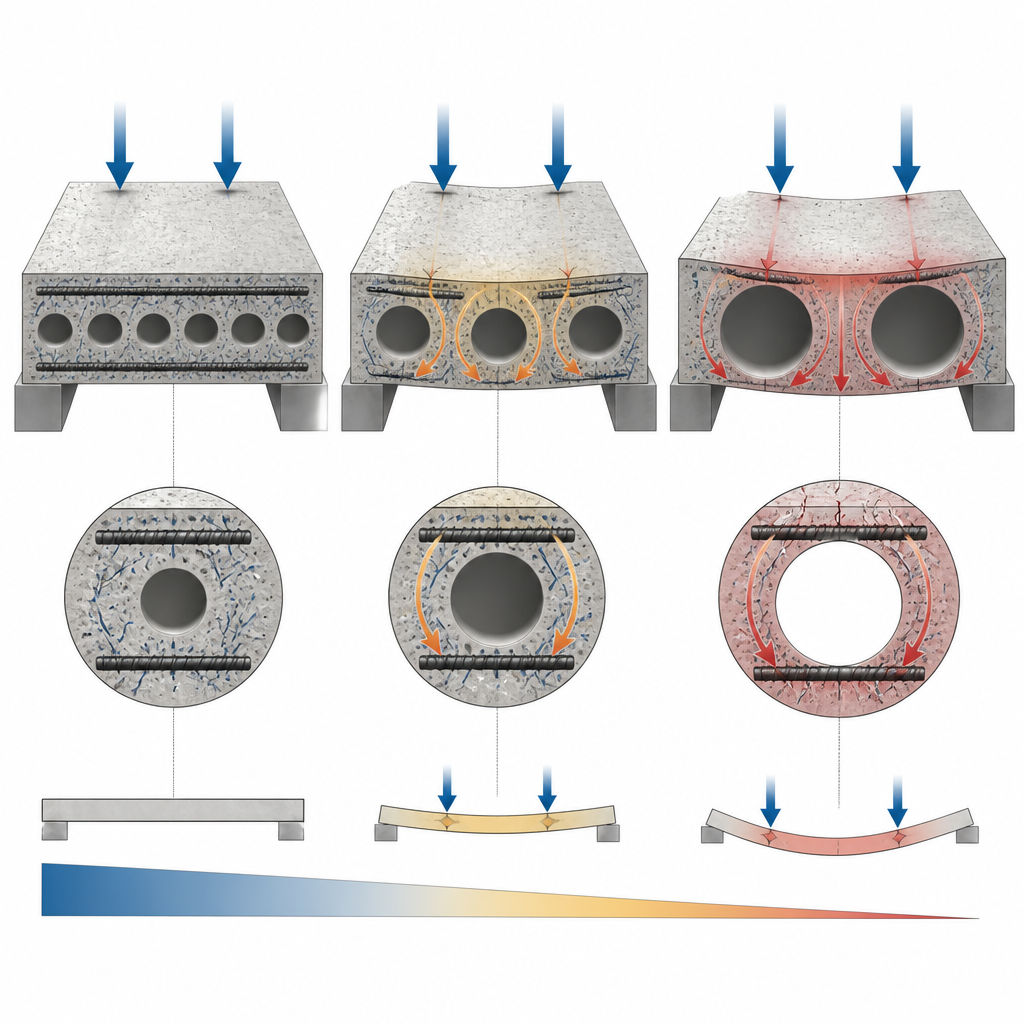
All slabs were tested in the laboratory using a four point loading setup, where two equal loads press down between supports, creating a constant bending region in the middle. During testing, the researchers carefully tracked when the first visible cracks formed, how the pattern of cracks spread, how much the mid span deflected, and the load at failure. They also compared these observations with values calculated from standard design rules used worldwide for reinforced concrete. This allowed them to judge not only how the new materials and shapes behaved, but also whether routine engineering formulas remain trustworthy when cement is replaced by geopolymer binders.
What happens when you add voids
The solid geopolymer slab performed slightly better than the solid cement slab, carrying a bit more load at first cracking and at failure, and developing a larger number of finer cracks. The added rubber fibers helped spread damage more evenly, giving the geopolymer slab a more ductile, less sudden failure. In the hollow core slabs, the picture was more mixed. Carving out voids made the slabs lighter but also reduced their stiffness and strength. As the total void area increased from about one eighth to nearly one quarter of the section, the loads that caused first cracking and eventual failure both dropped. Longer effective spans had a similar effect: increasing the span to depth ratio almost halved the ultimate load while increasing deflection. Even so, measured crack widths stayed within common service limits, and the hollow slabs still kept a high share of the strength of the solid control slab.
Design rules that still hold
When the team compared experimental data with calculations from American and European concrete codes, they found good agreement, typically within about ten percent. For solid slabs, theory predicted both strength and deflection quite closely. For hollow core slabs, the simplified formulas tended to overestimate deflection, partly because the permanent plastic pipes inside the voids add some stiffness that the equations do not include. Predictions of crack width based on Eurocode rules also matched the measured values well; in most cases the real cracks were slightly smaller than the calculated upper bound. These results suggest that engineers can adapt familiar design methods to geopolymer hollow core slabs with reasonable confidence, while recognizing some conservatism in the service behavior.
What this means for future buildings
For non specialists, the takeaway is that floor systems can be made both lighter and cleaner without sacrificing safety, by pairing hollow core geometry with geopolymer concrete that recycles fly ash and waste rubber. The study shows that a well designed geopolymer mix can match or slightly surpass the flexural performance of standard concrete, and that hollow cores can significantly cut material use as long as void size and span are kept within sensible ranges. Because standard calculation tools still work for these slabs, the path to practical adoption in low carbon buildings becomes more straightforward, offering designers a realistic option to reduce the environmental footprint of concrete floors while maintaining reliable structural behavior.
Citation: Aziz, Y.H.A., Malky, A.E. & El-Sayed, T.A. Flexural behavior and crack development of reinforced geopolymer slabs with longitudinal voids: an experimental study. Sci Rep 16, 16026 (2026). https://doi.org/10.1038/s41598-026-53647-5
Keywords: geopolymer concrete, hollow core slab, flexural behavior, crack development, sustainable structures