Clear Sky Science · en
Loop dynamics govern MALT1 activation revealed by integrative AlphaFold, MD, and NMR analysis
Why tiny motions in one protein matter
MALT1 is a protein that helps switch immune cells on and off, and it has become a promising target for treating certain cancers and autoimmune diseases. Yet this molecular switch does not simply flip between on and off like a light; instead, it wiggles and flexes through many shapes in response to the saltiness of its surroundings. This study shows how subtle motions in a few flexible parts of MALT1 control whether it can cut its targets, offering clues for designing drugs that nudge the protein toward more or less activity.
A shape-shifting switch in immune cells
MALT1 sits at the heart of a signaling hub that tells B and T cells when to respond to threats. When active, it acts like a molecular scissors, cutting other proteins to amplify immune signals. Earlier work suggested that MALT1 needs to pair up and rearrange parts of its structure before these scissors can work, but much of that knowledge came from static crystal structures. Those structures capture frozen snapshots of active or inactive forms, but they cannot show how the protein moves in solution, where immune signaling actually happens.
Watching protein motion across salt levels
The researchers combined three powerful approaches to follow MALT1 in motion. They used AlphaFold models as starting blueprints, ran long molecular dynamics simulations to let the protein move freely on the computer, and then checked those motions against precise NMR measurements of the protein in solution. They focused on the catalytic core of MALT1 and varied the amount and type of salt in the simulated and experimental environment. This allowed them to see how changes in ionic strength shift the balance between inactive and active-like shapes, especially in several short, flexible loops that surround the active site.
How salt guides the dance of flexible loops
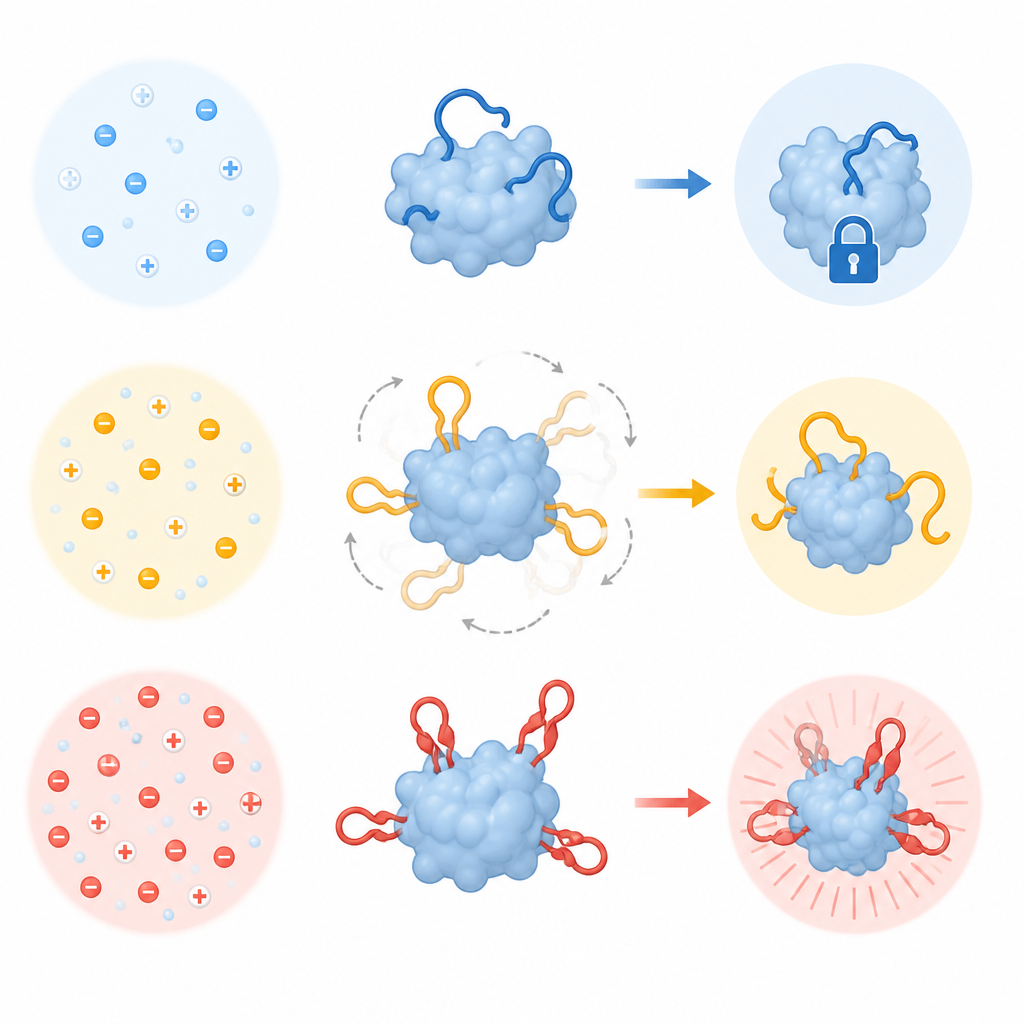
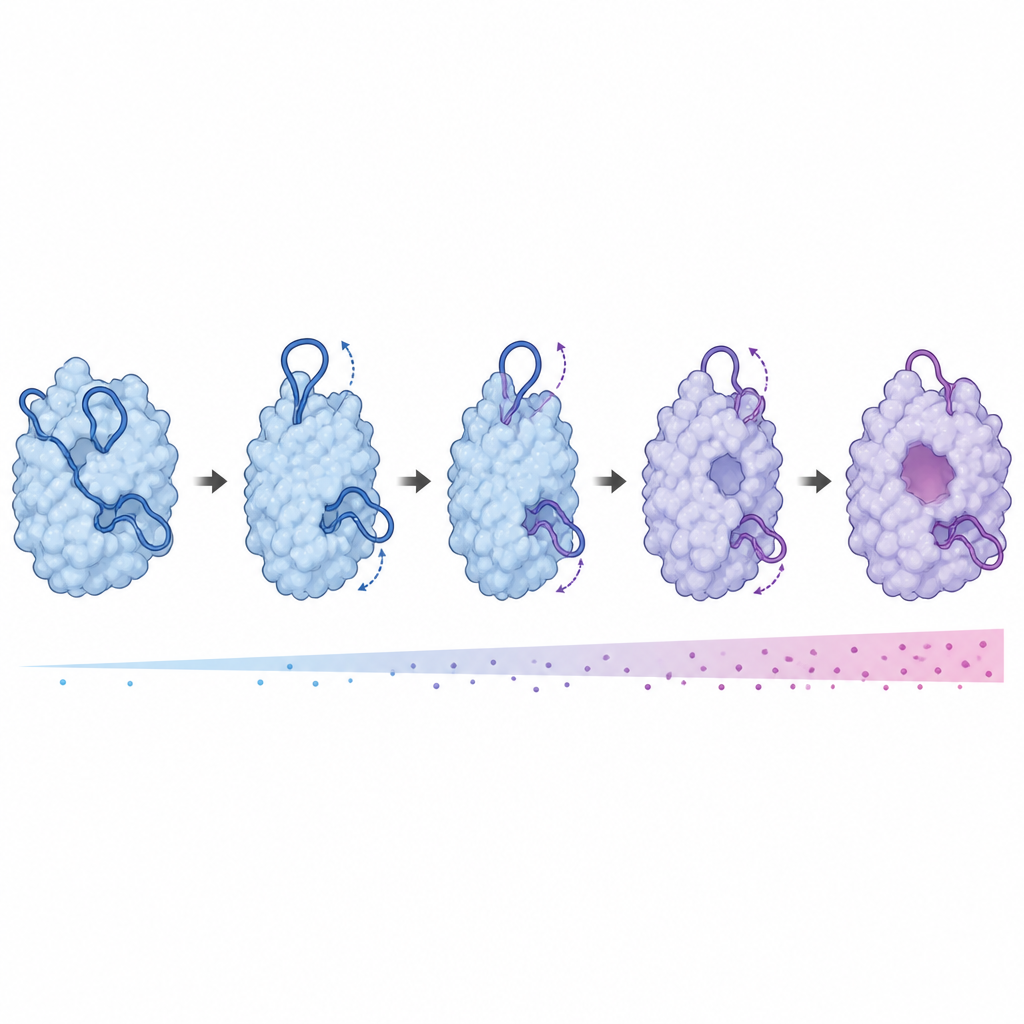
Under low-salt conditions similar to those used in NMR experiments, all simulations, no matter how they started, settled into the same general arrangement: a clearly inactive state. In this state, a key amino acid side chain (W580) rotates inward and two nearby loops rearrange to cover the cutting site, blocking access for substrates. At intermediate salt levels that mimic common activity assays, those loops no longer stay put. Instead, they move back and forth between inactive-like and active-like positions, briefly uncovering the active site before closing again. At very high salt, motion is strongly damped; the loops and W580 remain locked in whichever state they began, and the protein becomes trapped in that conformational basin.
Stable cores and flexible edges
Despite these shifts in loop behavior, the inner cores of the protein’s domains remain surprisingly rigid. NMR data on fast methyl motions and computer analyses of backbone fluctuations show that buried hydrophobic clusters act as stable anchors, while mobility is concentrated in a small set of regulatory loops and the linker between domains. When the team compared many simulated ensembles to the experimental NMR relaxation data, the low-salt inactive ensemble gave the best match, confirming that this quiet, loop-closed form dominates in solution under those conditions. Simulations starting from both AlphaFold models and standard crystal structures converged on similar dynamics, underscoring that the key behavior is an intrinsic property of the catalytic core.
What this means for tuning immune activity
Taken together, the work paints MALT1 not as a rigid on/off switch but as a dynamic population of shapes whose distribution is tuned by salt and other environmental factors. The crucial control points are flexible loops that act like movable gates over the active site, coordinated with the orientation of W580. By understanding how ionic strength shifts these gates between closed, reversible, and locked states, researchers gain a roadmap for designing molecules that stabilize particular loop arrangements and thereby dial MALT1 activity up or down. For drug discovery and basic immunology alike, this loop-centered view of regulation offers a more realistic and actionable picture of how this important enzyme is controlled in living cells.
Citation: Lesovoy, D., Agback, T., Roshchin, K. et al. Loop dynamics govern MALT1 activation revealed by integrative AlphaFold, MD, and NMR analysis. Sci Rep 16, 15709 (2026). https://doi.org/10.1038/s41598-026-53505-4
Keywords: MALT1, protein dynamics, ionic strength, immune signaling, molecular simulations