Clear Sky Science · en
Soliton dynamics in the stochastic nonlinear Schrödinger equation with self-phase modulation and multiplicative white noise
Why random noise matters for light waves
Modern technologies such as fiber internet and laser systems rely on tightly shaped pulses of light that travel long distances without falling apart. In the real world, however, these pulses are never completely isolated from random disturbances. This paper explores how such randomness, or noise, reshapes special wave patterns called solitons in optical media and similar systems, revealing when these pulses remain robust and when they lose their identity.
Light pulses that hold their shape
Solitons are wave packets that can travel without spreading out, thanks to a balance between different physical effects. In optics, they appear as either bright humps of light riding on a dark background or dark holes carved into a brighter beam. Because solitons can carry information over long distances, scientists use them to model signal transmission in optical fibers and other nonlinear materials. The authors focus on a mathematical model that captures how such solitons evolve in time and space when a key nonlinear effect called self phase modulation dominates and when the medium is free from the usual spreading effect known as dispersion.
Adding randomness to the picture
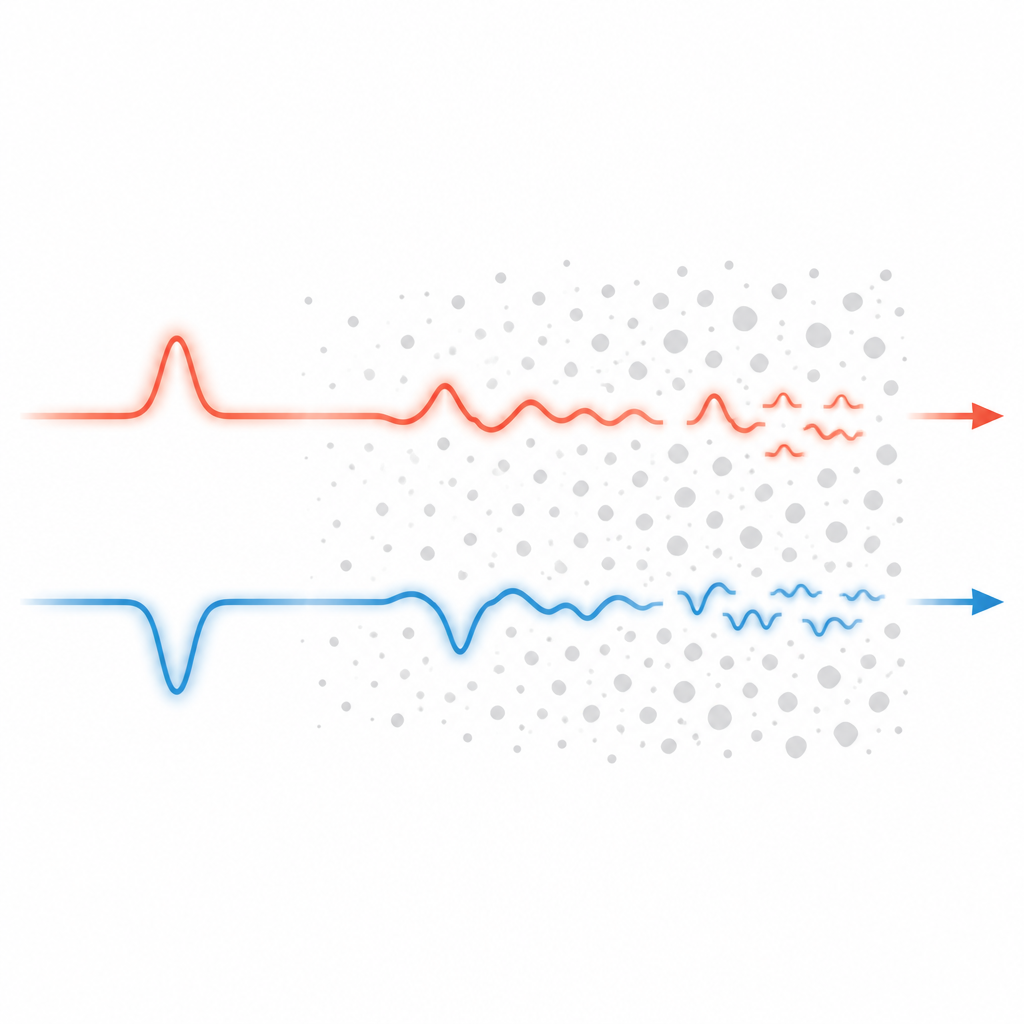
Real optical systems are never perfectly quiet. Fluctuations in the material or environment act like noise that nudges the wave in unpredictable ways. In this study the noise is multiplicative, meaning that stronger parts of the wave feel stronger kicks. Instead of a uniform background hiss, the disturbance scales with the wave’s own strength, creating a feedback between the pulse and the randomness. This setup is described mathematically by a stochastic version of the nonlinear Schrödinger equation, a core model in wave physics, now driven by a random process that imitates Brownian motion.
A toolbox for exact wave patterns
To make sense of this noisy system, the authors use an analytical technique called the improved modified extended tanh function method. Rather than relying only on computer simulations, this method systematically converts the original equation into a simpler form whose solutions can be written down exactly. Within a single framework, they generate a wide range of wave patterns: bright and dark solitons, spike like singular waves, regularly repeating patterns, and more elaborate shapes built from Jacobi and Weierstrass elliptic functions. These exact expressions act like reference fingerprints that show how different kinds of waves may look when noise is present.
How noise reshapes bright and dark solitons
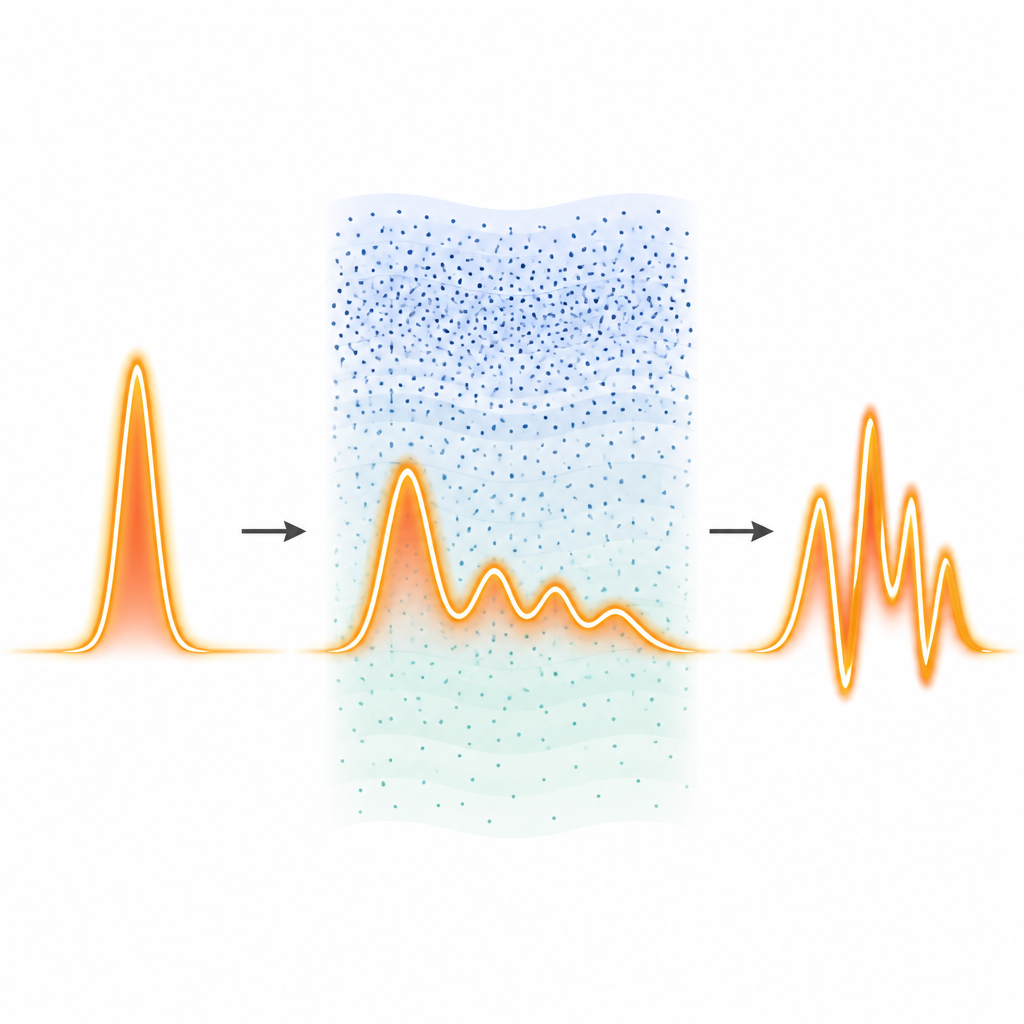
With these solutions in hand, the authors explore how changing the noise strength alters soliton shapes. They analyze both two dimensional cuts and three dimensional surfaces of the real and imaginary parts of the waves for several noise levels, from a perfectly quiet case to strongly disturbed regimes. For bright solitons, weak noise introduces mild ripples while preserving the main bell shaped profile. As the noise grows, the pulse broadens and develops irregular peaks and valleys, and at high noise levels its once smooth, localized structure becomes highly distorted. Dark solitons, which appear as dips in an otherwise uniform background, respond differently. Random fluctuations gradually fill in the central dip and roughen the surrounding background, and strong noise eventually erases the dark notch entirely, replacing it with oscillatory structures that no longer resemble the original wave.
What this means for noisy wave systems
The study shows that not all solitons respond equally to random disturbances. Under the conditions examined, bright solitons tolerate moderate noise before losing their identity, while dark solitons prove more vulnerable to background fluctuations. By providing many exact noisy wave patterns and clear visual comparisons across noise levels, the work offers a structured way to pinpoint when soliton based signals remain reliable and when randomness overwhelms them. These results give researchers useful benchmarks and tools for analyzing noisy wave propagation in optical media and other systems where both nonlinearity and randomness play central roles.
Citation: Shehab, M.F., Ahmed, H.M. & Hussein, H.H. Soliton dynamics in the stochastic nonlinear Schrödinger equation with self-phase modulation and multiplicative white noise. Sci Rep 16, 16432 (2026). https://doi.org/10.1038/s41598-026-53450-2
Keywords: optical solitons, stochastic waves, multiplicative noise, self phase modulation, nonlinear Schrödinger equation