Clear Sky Science · en
The contribution of soil extract composition and cyclic moisture dynamics to the physicochemical aging of superabsorbent polyacrylic acid and polyacrylamide hydrogels
Why soil sponges matter for farms and gardens
Across the world, farmers are turning to tiny "soil sponges" to help crops ride out droughts and sudden downpours. These sponges are superabsorbent gels mixed into soil to hold extra water and keep the ground from crumbling. But what happens to these materials after months or years of natural wet and dry cycles in real soils? This study takes a close look at how two common synthetic soil gels change over time, and what that could mean for water savings, soil health, and the risk of long lasting plastic like residues.
Two popular soil helpers under the microscope
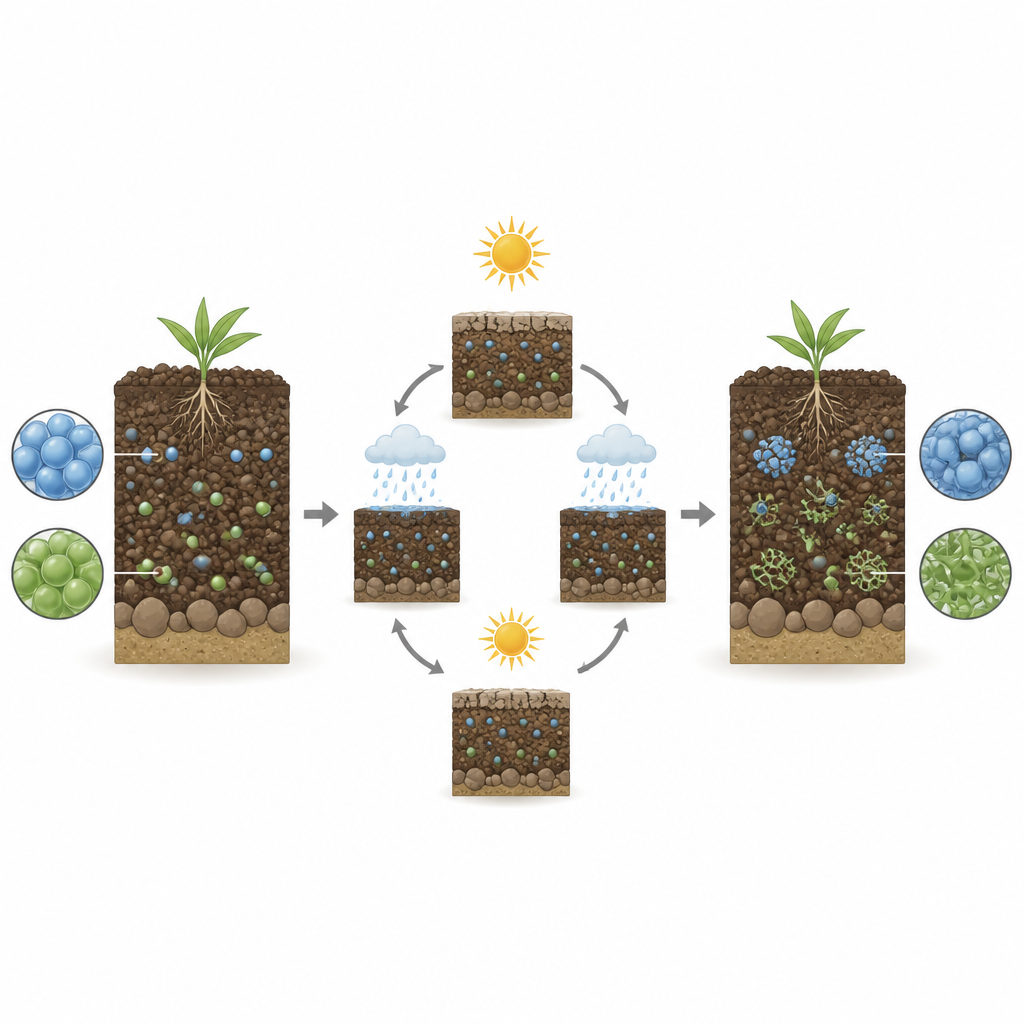
The researchers focused on two widely used superabsorbent polymers: polyacrylic acid (PAA) and polyacrylamide (PAM). Both can soak up many times their weight in water and form soft three dimensional networks that sit in the gaps between soil particles. PAA carries electrical charges along its chains, while PAM is mostly neutral. That small chemical difference turns out to matter a lot. To mimic real field conditions, the team soaked these polymers either in pure water or in water extracts from three soil types sand, loam, and clay and then pushed them through ten rounds of drying and rewetting, like a long series of hot weeks followed by rain.
How soil water chemistry shapes the gels
The soil extracts carried different mixes of dissolved salts and metal ions such as calcium, magnesium, aluminum, and manganese. These charged particles can grab onto the charged sites along the PAA chains and pull them together, tightening the gel network. Measurements of how much water the gels could hold, how stiff they became, and how water moved inside them all told a consistent story. When PAA swelled in soil extracts, especially in loam rich in calcium or sand with more aluminum and manganese, it took up less water, water moved more slowly inside, and the material behaved more like a soft solid than a loose gel. Surface sensitive tests and electron microscopy showed its structure becoming denser, with thicker walls and fewer open pores. PAM, with its neutral groups, reacted far less. Its water holding ability and inner structure stayed comparatively stable except in the sand extract, where some densification also appeared.
What repeated drying and rewetting do
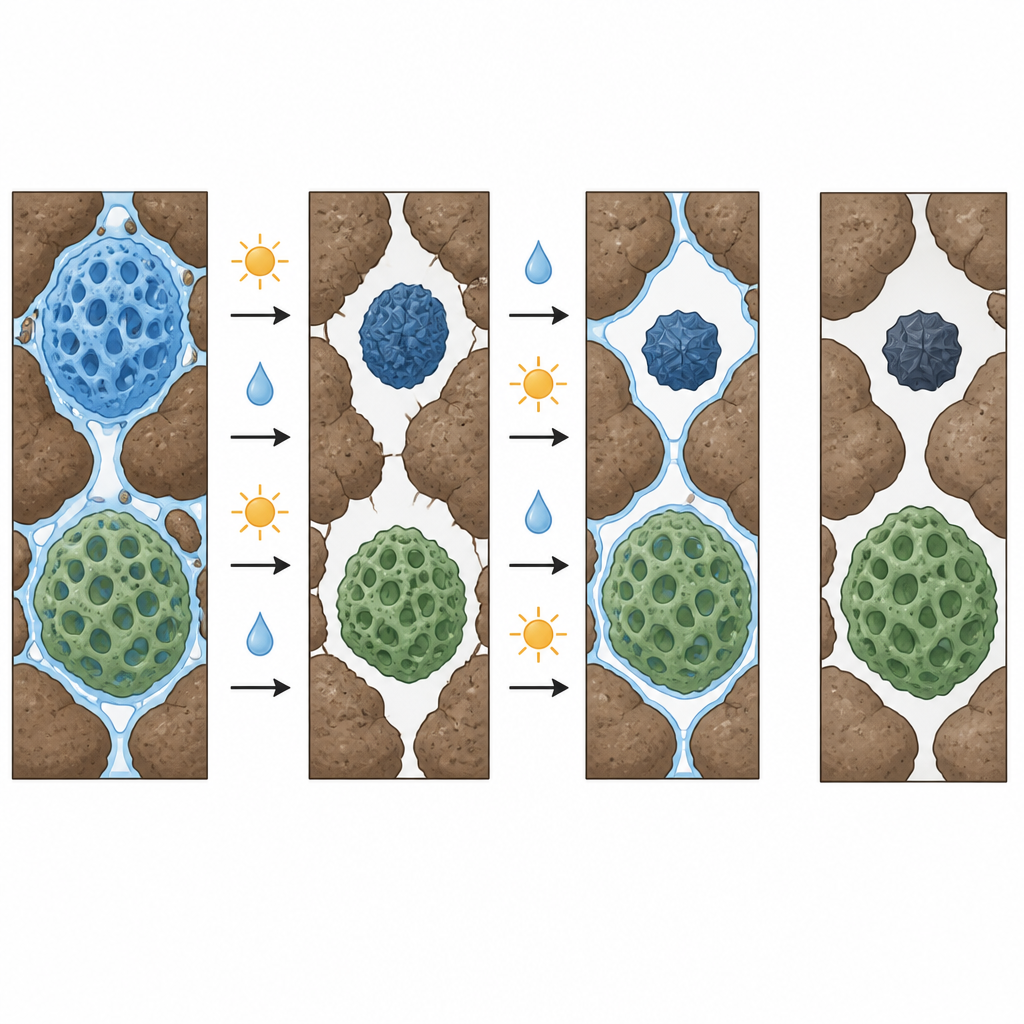
Subjecting the swollen gels to repeated wet dry cycles amplified these effects. For PAA, each cycle chipped away at its ability to reswell. Over time, it absorbed markedly less water, its internal water relaxed faster meaning it was more tightly trapped and its mechanical tests showed growing resistance to flow, the hallmark of a more rigid, plastic like body. Microscopy revealed broken edges, compacted lamella like sheets, and thickened junctions between chains. Spectroscopy pointed to stronger interactions between its chemical groups and soil derived ions and to rearranged chain backbones, all signs of physicochemical aging. In contrast, PAM largely shrugged off the moisture swings. Its swelling capacity fluctuated only modestly, its structure remained more open, and its chemical signals changed only slightly, suggesting fewer new bonds and less chain damage.
Clues about long lasting soil residues
Putting all measurements together, statistical analyses confirmed that the key drivers of aging were the type of polymer, the make up of the soil solution, and the number of wet dry cycles. Anionic PAA repeatedly exposed to mineral rich soil water shifted toward a denser, stiffer, less rewettable state, while neutral PAM stayed more resilient. Earlier work has hinted that such gels can form hardened skins and organo mineral complexes in real soils. This study strengthens the picture that, at least for PAA, natural swings in moisture and soil chemistry alone can push a once soft water sponge toward solid, plastic like fragments that may linger in the ground.
What this means for future soils
For farmers, engineers, and land managers, the message is double edged. Superabsorbent gels can still help soils hold water and resist erosion, but their behavior is not fixed. Charged gels like PAA may lose much of their swelling power with time and leave behind tougher residues, especially in mineral rich soils under strong dry wet cycles. More stable gels like PAM may keep their structure longer but also persist in the environment. The authors argue that field studies are now crucial to track these aging paths under real conditions and to test alternative, more degradable materials. Understanding how soil sponges evolve from soft helpers into possible plastic like particles will be key to designing future products that support both crop yields and long term soil health.
Citation: Neff, J., Buchmann, C. The contribution of soil extract composition and cyclic moisture dynamics to the physicochemical aging of superabsorbent polyacrylic acid and polyacrylamide hydrogels. Sci Rep 16, 15983 (2026). https://doi.org/10.1038/s41598-026-53381-y
Keywords: superabsorbent polymers, soil hydrogels, polyacrylic acid, polyacrylamide, drying wetting cycles