Clear Sky Science · en
Spheroids reveal hypoxia‑driven spatial restriction of adenoviral infection
Why oxygen levels matter for virus based cancer treatment
Many experimental cancer treatments use harmless versions of viruses to attack tumors from the inside. Yet solid tumors often grow in low oxygen conditions, especially deep in their cores. This study explores how those oxygen poor zones affect the ability of a common therapeutic virus to infect and spread through clusters of pancreatic cancer cells, offering clues about why some promising treatments work well in the lab but struggle in patients.
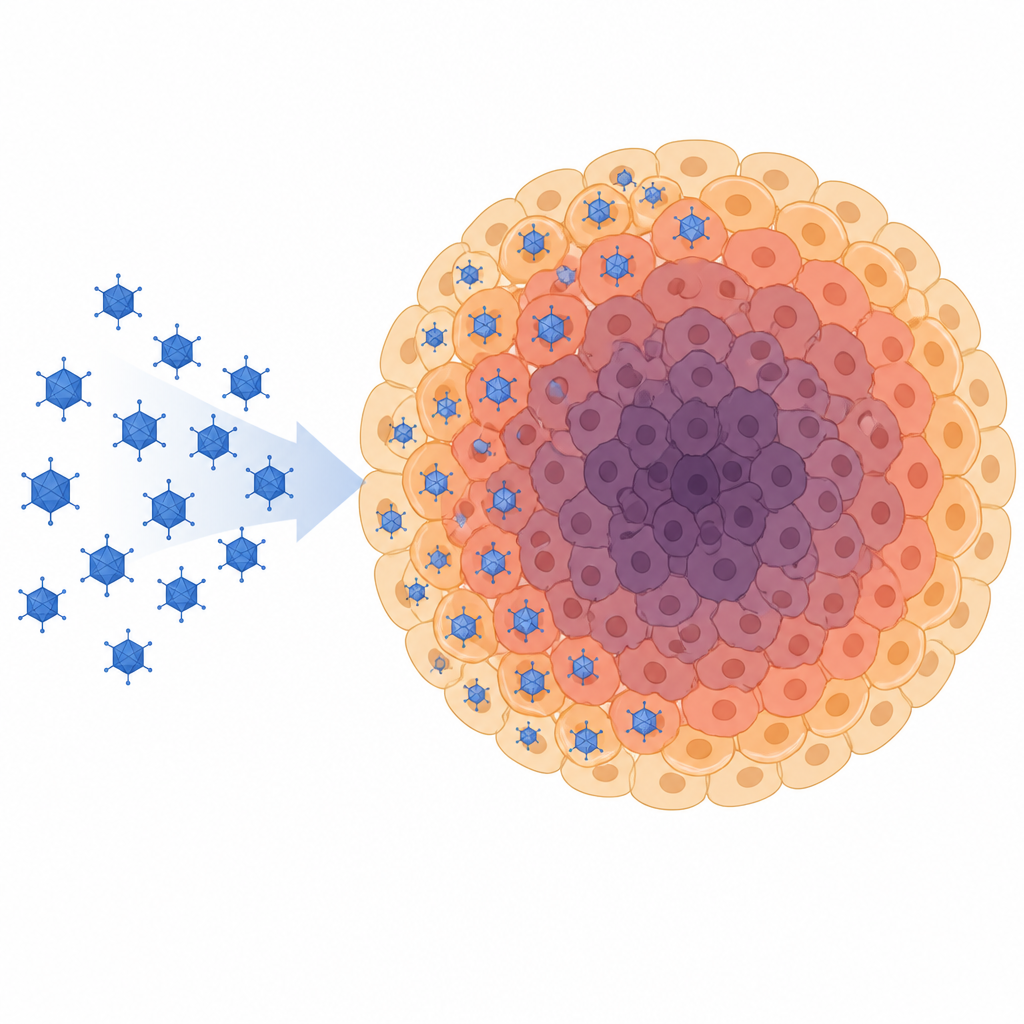
Using tiny tumor like clusters as a test bed
Instead of relying only on flat cell layers in a dish, the researchers grew three dimensional balls of cancer cells called spheroids. These structures mimic key features of real tumors, including better oxygen supply at the surface and low oxygen in the center. After testing several human cell lines, they found that KP4 pancreatic cancer cells formed the most compact, round, and stable spheroids, making them well suited for careful slicing and microscopic analysis.
Mapping the oxygen landscape inside the cell clusters
To see where oxygen was scarce within the spheroids, the team added a special dye that glows more strongly when cells experience low oxygen. Thin sections cut through the spheroids revealed a pattern similar to that seen in real solid tumors. Cells at the outer rim showed mostly weak signal, indicating better oxygenation, while an inner band of cells glowed brightly, marking a hypoxic zone surrounding an unstable, partly broken core. This confirmed that the spheroid model naturally builds up an oxygen gradient without the need for special low oxygen chambers.
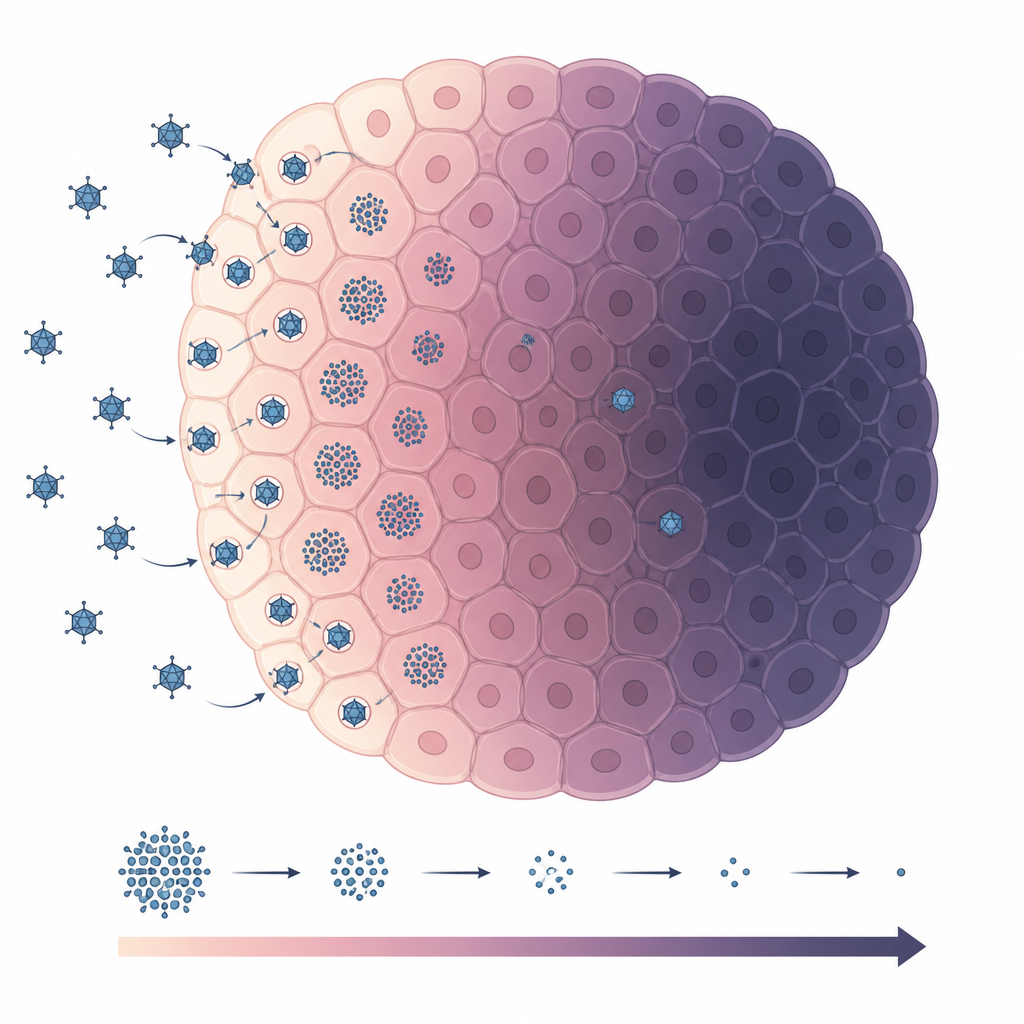
How low oxygen blocks virus activity and shapes its spread
The study then focused on human adenovirus type 5, a well studied virus used as a base for many oncolytic therapies. First, in simple flat cultures, the team showed that KP4 cells respond normally to low oxygen, switching on a key sensor protein and sharply reducing production of a viral building block protein. This confirmed that hypoxia directly dampens the virus’s ability to make new components. When the same virus was added while KP4 cells were forming spheroids, infected cells appeared almost only at the well oxygenated outer edge, leaving the hypoxic core largely virus free. The virus could enter and express its marker gene mainly where oxygen was available.
Timing of infection changes the infection pattern
The researchers then asked what would happen if cells were infected under normal oxygen before being assembled into spheroids. In this scenario, KP4 cells were mixed with virus while freely floating in a stirred flask, then allowed to form spheroids after a day of infection at normal oxygen levels. Now, when the spheroids were examined, virus positive cells were no longer confined to the surface. Instead, they were spread more evenly from the rim toward the center. Quantitative image analysis showed more infected cells in deeper regions compared with spheroids that had experienced infection and hypoxia development at the same time.
What this means for future cancer virotherapy
For non specialists, the key message is that low oxygen inside solid tumors not only slows virus growth but also keeps therapeutic viruses from reaching the cells that need to be killed in the tumor core. By using realistic three dimensional cell models that mimic oxygen gradients, scientists can better predict how virus based cancer treatments will behave in the body and design improved vectors and dosing strategies that work despite hypoxia. In short, where oxygen is scarce, virus therapy struggles, and that challenge must be built into future treatment planning.
Citation: Büttner, T., Wang, X., Krishnacoumar, B. et al. Spheroids reveal hypoxia‑driven spatial restriction of adenoviral infection. Sci Rep 16, 15864 (2026). https://doi.org/10.1038/s41598-026-53319-4
Keywords: tumor hypoxia, adenovirus therapy, 3D spheroids, oncolytic viruses, pancreatic cancer