Clear Sky Science · en
Directed mutagenesis of large multi-subunit protein complexes by plasmid sub-fragmentation
Making Big Proteins Easier to Tinker With
Many of the molecular machines that power life are huge and complex, which makes them hard to redesign or even gently tweak in the lab. This study presents a straightforward way to introduce precise genetic changes into very large protein assemblies, opening the door to better tests of how these machines work and how specific parts contribute to their function.
Why Changing DNA Matters
Modern biology relies on the ability to change individual letters in DNA and see how proteins respond. By altering single building blocks, researchers can pinpoint which parts of a protein are critical for tasks like energy production or signaling. Existing methods work well for small genes, but they struggle with very long stretches of DNA that encode multi-part protein complexes. When the DNA gets too long, the copying enzymes used in standard lab methods lose accuracy or fail to finish the job, wasting time and materials and limiting what scientists can test.
The Challenge of a Giant Respiratory Machine
The authors focus on a massive protein assembly called Complex I from Escherichia coli, a bacterium often used in research. Complex I helps convert the energy stored in food into a form cells can use, and it is made of many subunits encoded by more than 15,000 DNA letters on a plasmid over 21,000 letters long. Traditional mutagenesis methods, such as widely used quick-change protocols, are pushed beyond their comfort zone at this size. The copying enzymes either make too many errors or cannot reliably span the whole plasmid, especially when several similar subunits share related DNA sequences that can confuse the process.
Breaking a Big Problem into Smaller Pieces
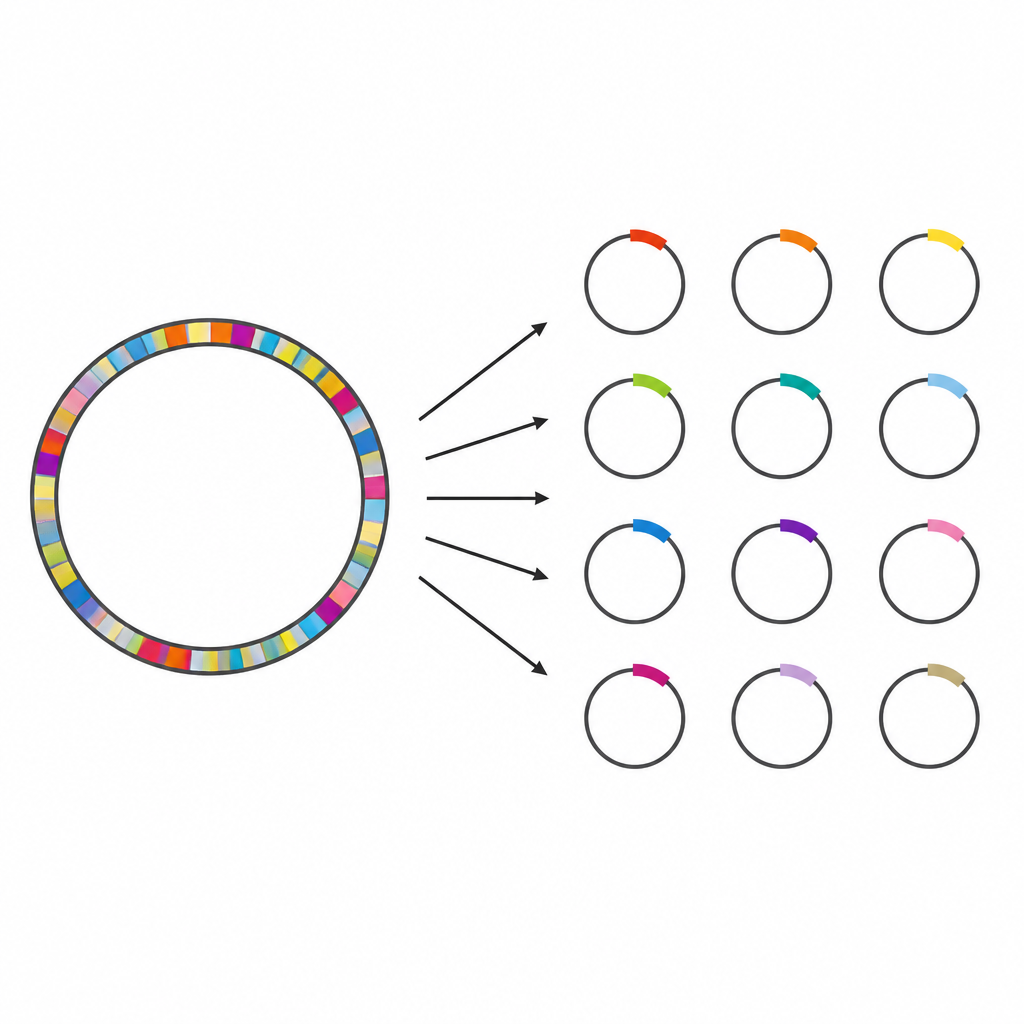
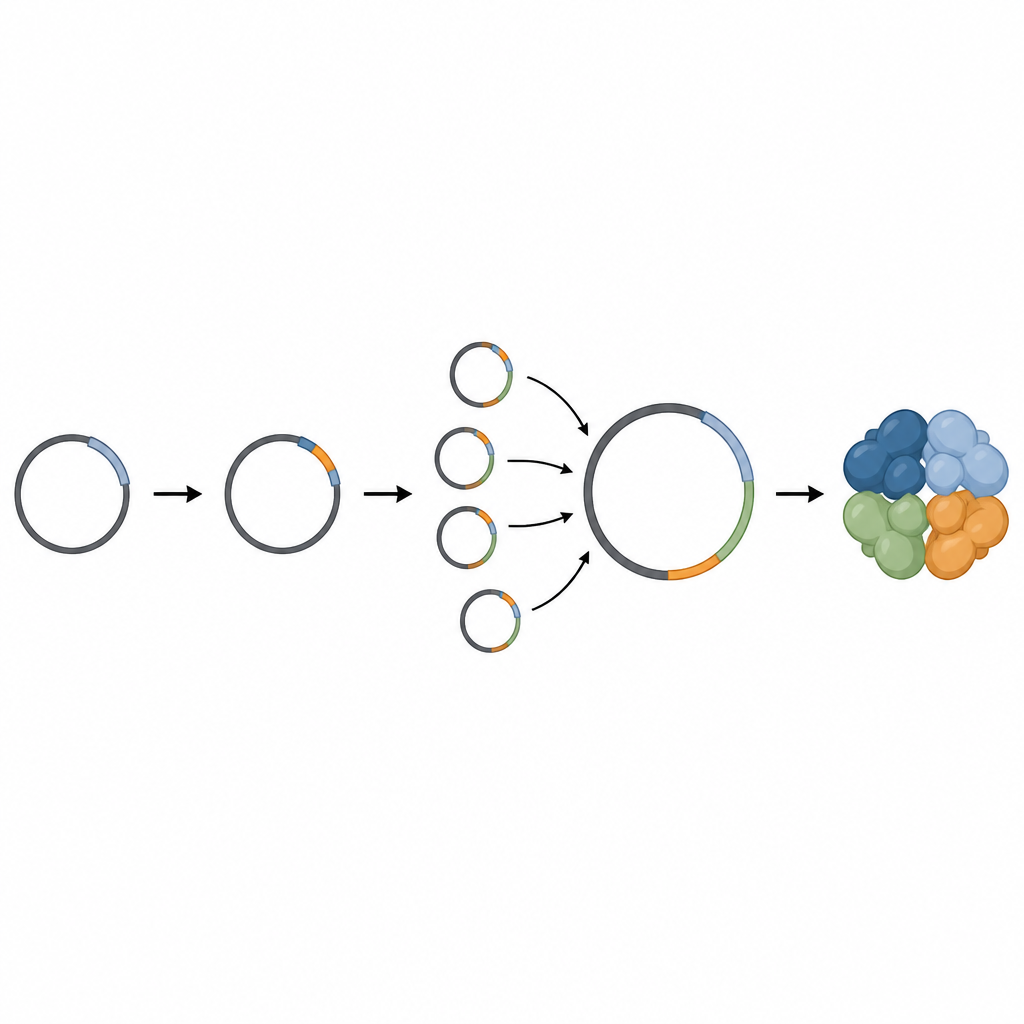
To overcome this, the researchers created a strategy they call plasmid sub-fragmentation. Instead of trying to mutate the giant plasmid in one piece, they cut its coding region into 20 shorter fragments of roughly 900 DNA letters each, with small overlaps between neighboring pieces. Each fragment was moved into a smaller, easy-to-handle cloning plasmid. Because these shorter constructs fall well within the comfortable working range of high-fidelity copying enzymes, precise single-letter changes could be introduced with much higher reliability. After confirming each change by sequencing, the altered fragment was stitched back into the original large plasmid using a joining method that links overlapping DNA ends without leaving extra scar sequences.
Testing the Method in Living Cells
The team applied this approach to several fragments corresponding to subunits that sit at key positions in Complex I, where earlier work suggested important roles in energy conversion. They introduced nine different single-letter changes into selected fragments, then reassembled these into the full plasmid and tested the resulting bacterial strains. Sequencing showed that the intended mutations were the only changes across the entire 21,360-letter plasmid, indicating very high accuracy. The bacteria carrying the modified Complex I grew well, and the purified protein complexes contained all expected subunits, showing that the redesigned machines were correctly built and assembled in the membrane.
What This Means Going Forward
By turning one unwieldy DNA molecule into a reusable library of smaller pieces, this plasmid sub-fragmentation approach makes it much easier to introduce precise changes into very large protein systems. For non-specialists, the key outcome is a toolkit that lets scientists probe the inner workings of giant molecular machines, such as those that power respiration, with far greater control. This can help resolve long-standing questions about how these complexes move charges and protons, and it can be extended to other large, multi-part proteins where current methods fall short.
Citation: Beghiah, A., Kaila, V.R.I. Directed mutagenesis of large multi-subunit protein complexes by plasmid sub-fragmentation. Sci Rep 16, 16149 (2026). https://doi.org/10.1038/s41598-026-53234-8
Keywords: site-directed mutagenesis, Complex I, plasmid engineering, DNA fragments, protein complexes