Clear Sky Science · en
Enhancing composition-based materials property prediction by cross-modal knowledge transfer
Why guessing material behavior matters
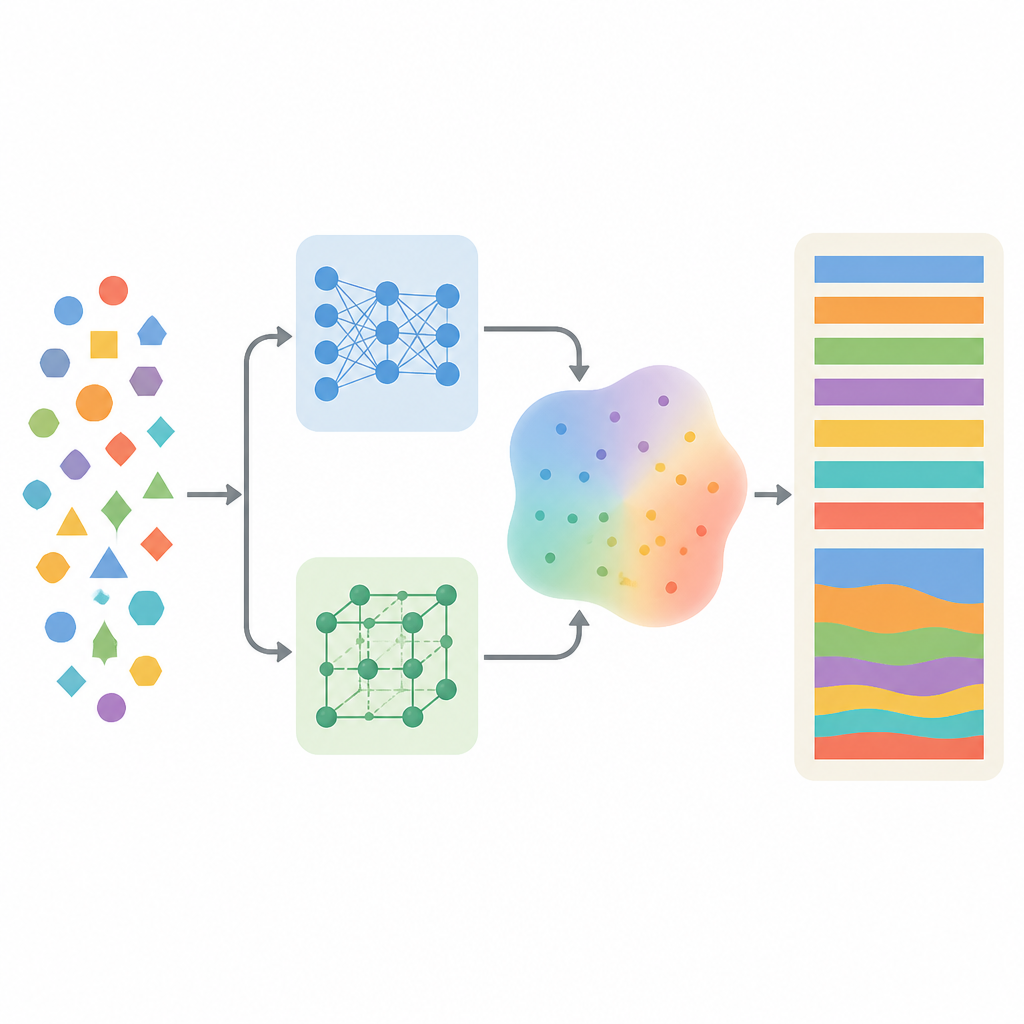
Designing new batteries, solar cells, or stronger alloys often starts from a simple recipe listing which elements to mix. Turning that recipe into a real material with known strength, conductivity, or stability usually demands costly quantum calculations or experiments. This study shows how advanced language based AI models, originally built to read text, can learn from many kinds of materials data and then predict important properties directly from a chemical formula, cutting the cost and time needed to explore huge spaces of possible compounds.
From recipes to predictions
Traditional machine learning tools in materials science fall into two camps. One family needs detailed crystal structures, describing how atoms are arranged in three dimensions, and can then predict properties accurately but at high computational cost. Another family only looks at the overall chemical formula, such as how many atoms of each element are present, which is cheaper but usually less accurate. The authors aim to close this gap: they want models that see only the formula yet perform nearly as well as structure aware methods, allowing rapid screening of compounds that have never been made or even structurally modeled.
Teaching AI to speak the language of materials
The team builds on chemical language models, which treat a formula as a string of tokens, much like words in a sentence. First, these models learn to fill in missing pieces of formulas, a training task that helps them capture regularities in which elements combine and in what ratios. The authors further bias this learning toward thermodynamically stable materials, so the model pays more attention to compositions that are realistic. They then introduce a crucial twist: instead of learning only from text like traditional language models, their models are aligned with a separate foundation model that has already learned from multiple sources, including crystal structures, electronic behavior, and charge distributions. In effect, the language model inherits rich structural knowledge while still working only with formulas.
Two paths for sharing knowledge
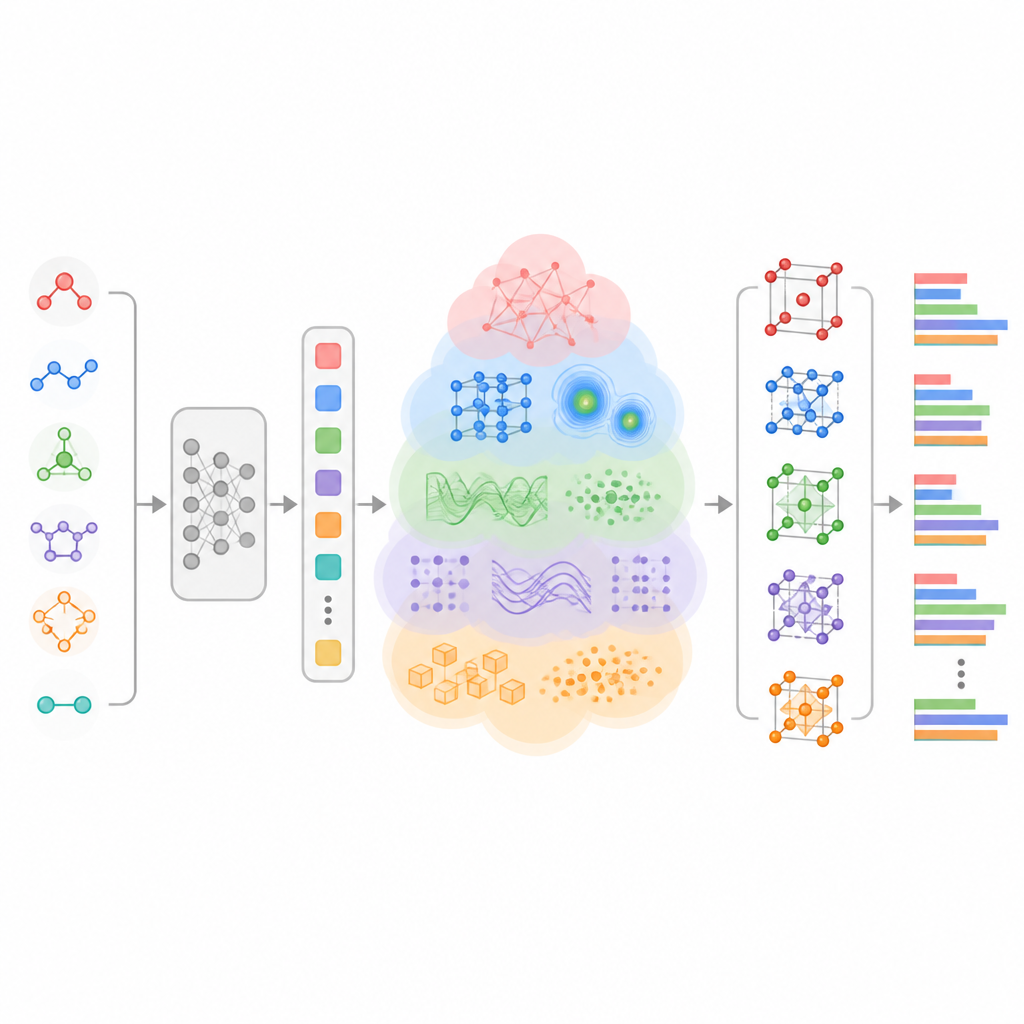
The researchers explore two complementary strategies, which they call implicit and explicit cross modal knowledge transfer. In the implicit version, the formula based language model is trained to match the internal representations produced by the multimodal foundation model, so it quietly absorbs how structures and electronic patterns relate to composition. In the explicit version, a large generative model first proposes likely crystal structures for each formula, and then graph neural networks, which are good at handling networks of atoms, predict properties from those structures. This two step route attempts to rebuild the missing crystal information before making a prediction.
How well the methods work
The models are tested on two large benchmark suites that cover dozens of target quantities, from band gaps relevant to solar cells to mechanical properties like shear modulus. Across most of these tasks, especially for datasets based on quantum mechanical calculations, the implicit transfer models deliver smaller prediction errors than earlier language models and often rival strong structure based competitors. The explicit transfer pipeline also improves over previous composition based language models but is slowed down by the need to generate crystal structures. Producing these structures can take tens of times longer per material than a direct language model prediction, particularly when compositions involve many different elements.
Peeking inside the black box
To understand what the language model has learned, the authors apply a game theoretic analysis that measures how different pieces of the input, alone or in combination, influence the predicted property. Looking at shear modulus, which relates to how resistant a material is to shape change, they find that certain elements and element groupings strongly raise or lower the value, in agreement with known hard compounds such as borides and carbides. Some three token patterns in the formula can even be linked to familiar crystal prototypes, suggesting that the model has implicitly picked up structural motifs from composition alone.
What this means for future materials discovery
Overall, the study shows that sharing knowledge between different types of materials data can significantly improve property prediction when only the chemical formula is available. The implicit approach, where the language model is guided by a multimodal foundation model, gives the best mix of accuracy and speed, making it attractive for large virtual screenings of new compounds. The explicit route that reconstructs crystal structures offers another promising angle, especially as structure generators improve. Together, these methods point toward AI tools that can rapidly sort through vast chemical spaces and highlight the most promising candidates long before a single crystal is grown.
Citation: Rubtsov, I., Dudakov, I., Kuratov, Y. et al. Enhancing composition-based materials property prediction by cross-modal knowledge transfer. Sci Rep 16, 16434 (2026). https://doi.org/10.1038/s41598-026-53182-3
Keywords: materials informatics, chemical language models, property prediction, multimodal learning, crystal structures