Clear Sky Science · en
The mediating role of partner support in the relationship between reproductive health concerns and psychological distress among cancer survivors
Why this topic matters to many families
Cancer treatments now help more young women live for many years after diagnosis, but they often leave difficult questions about having children, changes in the body, and long term health. These worries do not only affect the woman; they touch her relationship, sense of identity, and everyday mood. This study asks a simple but powerful question: how much can a caring partner ease the emotional strain that comes with these reproductive concerns for female cancer survivors?
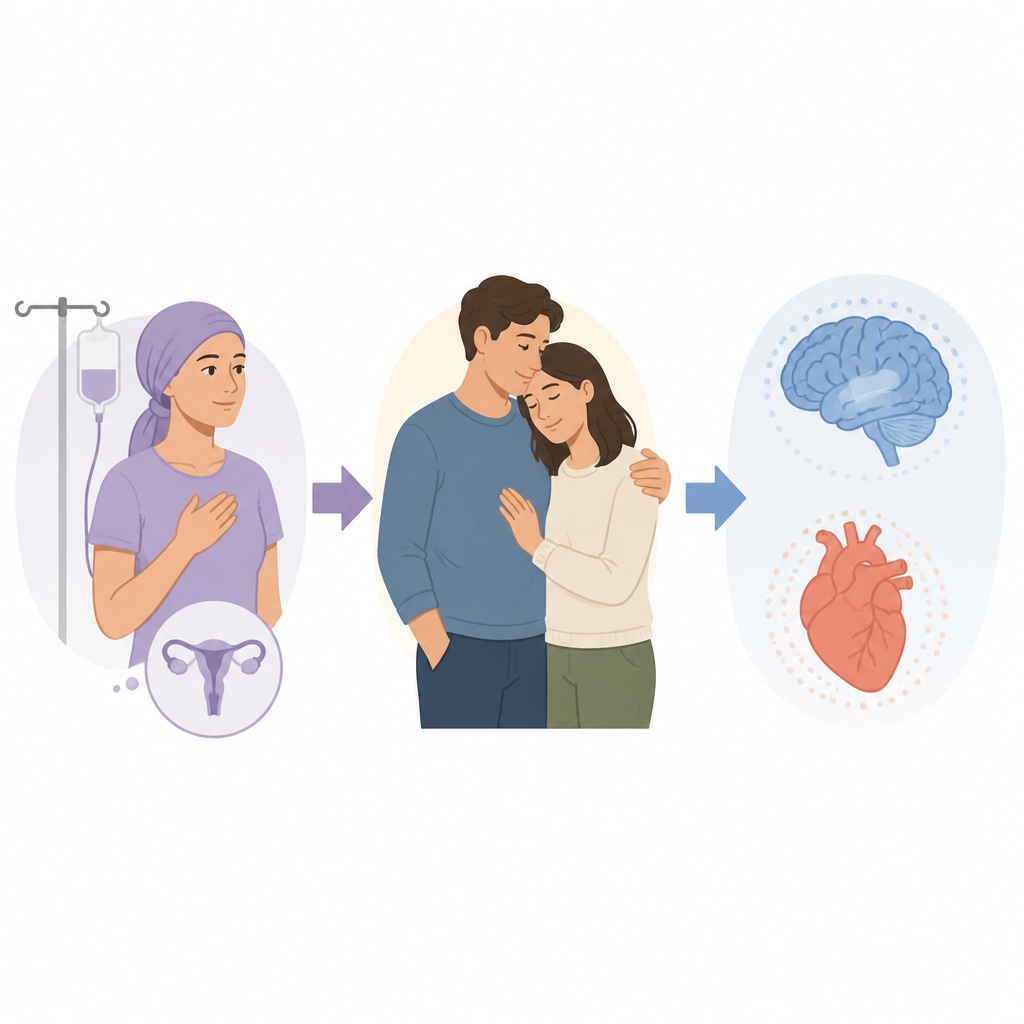
Reproductive worries after cancer
For women diagnosed with cancer during their childbearing years, surviving the disease is just the beginning. Many wonder whether they can still become pregnant, whether pregnancy would be safe, how treatments might affect their hormones or sexual life, and what this means for starting or growing a family. The researchers describe these as reproductive concerns, which include fears about fertility, possible health problems in the future, and the challenge of accepting changes to one’s body and plans. Earlier work shows that such concerns are very common and can feel as serious as the cancer itself, because they touch deeply held hopes about family and the future.
Emotional strain and the role of a partner
These reproductive worries often go hand in hand with psychological distress, a mix of anxiety, sadness, tension, and a sense of being overwhelmed. Distress can interfere with sleep, relationships, decision making, and overall quality of life. At the same time, a loving partner can be a powerful source of strength, offering comfort, practical help, and a shared approach to decisions about treatment and family planning. Yet support from a partner is not always simple; it can be helpful or, if clumsy or overprotective, feel unhelpful. The study set out to examine how perceived partner support relates to both reproductive concerns and distress among married female cancer survivors.

How the study was carried out
The research team surveyed 202 married women aged 20 to 49 who had been treated for cancer at a large hospital in Egypt. All were still within their reproductive years. The women completed well tested questionnaires, translated and adapted into Arabic, that measured three main areas: how worried they felt about fertility and health after cancer, how much support they felt they received from their partner, and how distressed or emotionally strained they felt in the past month. The scientists then used statistical methods to look at how these three areas were linked, and to test whether partner support acted as a bridge in the chain from reproductive worries to distress.
What the researchers found
Women who reported stronger reproductive concerns also reported higher psychological distress, confirming that these worries are closely tied to emotional suffering. Partner support showed the opposite pattern: women who felt more supported by their partner tended to have fewer reproductive concerns and lower distress. When the researchers built models to predict distress, adding partner support improved the explanation of who was suffering most. Part of the effect of reproductive concerns on distress flowed through partner support, meaning that women with more worries tended to feel less supported, and this reduced support in turn was linked to higher distress. However, partner support did not change how strongly concerns and distress were connected; the link between worry and distress was similar at high and low levels of support.
What it means for care and everyday life
In plain terms, the study suggests that reproductive worries after cancer and emotional distress travel together, and a caring partner can act as a cushion along this path but cannot fully break the link. For survivors and their families, this highlights two needs. First, health professionals should talk openly with women about fertility, pregnancy, and long term reproductive health, and help them find clear information and options. Second, partners should be invited into these conversations and given guidance on how to offer support that feels truly helpful. By addressing reproductive concerns directly and strengthening supportive relationships, survivorship care can better protect the emotional well being of women facing life after cancer.
Citation: Amin, S.M., Abdelaliem, S.M.F., Alabdullah, A.A.S. et al. The mediating role of partner support in the relationship between reproductive health concerns and psychological distress among cancer survivors. Sci Rep 16, 16142 (2026). https://doi.org/10.1038/s41598-026-53124-z
Keywords: cancer survivorship, reproductive health, partner support, psychological distress, fertility concerns