Clear Sky Science · en
Exact wave structures in magneto-optic soliton channels governed by Kudryashov-type coupled Schrödinger dynamics
Light pulses that refuse to spread out
Modern fiber optics move astonishing amounts of data, but every light pulse has a natural tendency to spread and blur as it travels. This paper explores a special kind of self-shaped light pulse, called a soliton, in magnetic fibers where light and magnetism interact. Understanding how these stubborn pulses keep their shape could help build faster, more reliable communication links and new all-optical switches for future networks.
Why stable light pulses matter
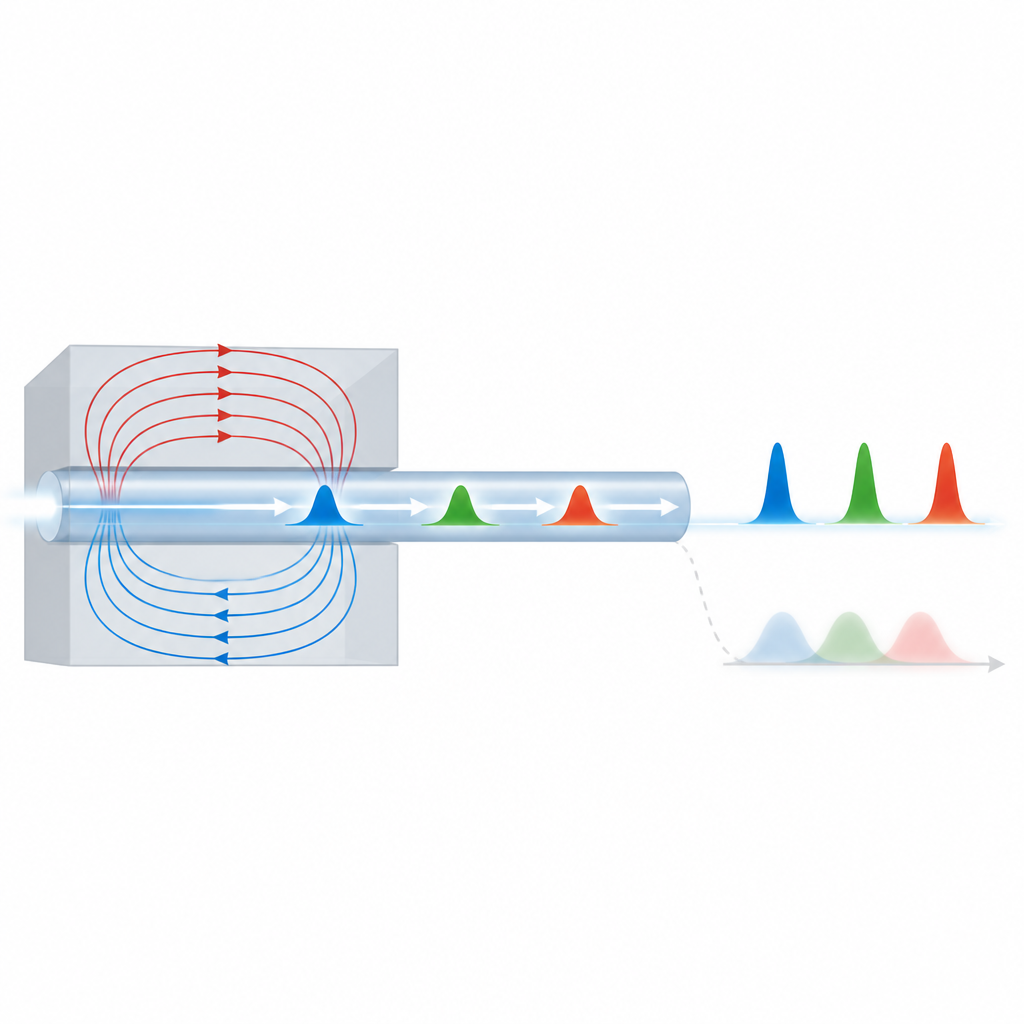
In long-distance fiber systems, each burst of light carries information. If pulses broaden too much, neighboring signals overlap and messages become garbled. Solitons are unusual pulses that balance two competing effects: spreading caused by the medium and self-focusing caused by the light’s own intensity. In magneto-optic waveguides, where a magnetic field influences the light, this balance becomes richer and more tunable. The authors focus on these environments because they can, in principle, be engineered to guide extremely short, high-speed pulses with fine control over their shape and speed.
A more complete recipe for the pulse
Most standard models treat light in fibers with a simplified equation that misses several higher-order effects. Here, the team adopts a more elaborate description that couples two interacting light waves and includes extra ingredients, such as how the pulse front can sharpen, how intensity changes feed back on the material, and how magnetization links the two waves. This coupled framework, inspired by a mathematical form known as Kudryashov-type nonlinearity, allows the researchers to describe not just one idealized soliton, but a wide family of possible pulse shapes that can form and travel in magnetized fibers.
A step-by-step method for exact pulse shapes
To analyze this complex model, the authors use a technique called the improved simple equation method. Rather than resorting only to heavy numerical simulations, this method converts the original wave equations into a simpler traveling-wave form that depends on a single combined space-time variable. The pulse profile is then written as a short expansion in terms of one auxiliary function whose behavior is governed by a basic differential rule. By carefully balancing the competing terms and solving the resulting algebraic conditions, the authors obtain exact, closed-form expressions for several distinct pulse types while keeping track of how each mathematical constant relates to physical features of the fiber and magnetic environment.
Families of pulses and how knobs tune them
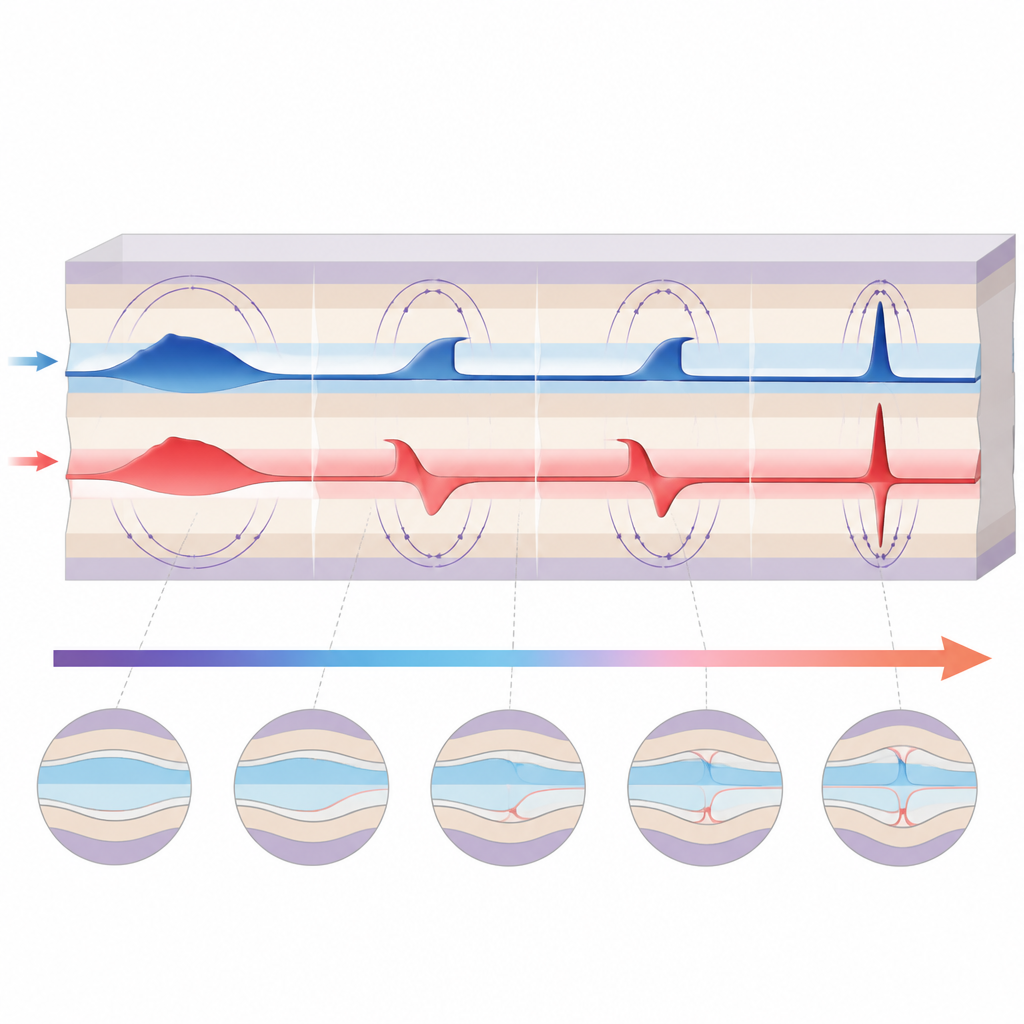
The mathematical solutions reveal three main families of wave structures. Singular pulses show extremely sharp peaks that can signal the operating limits of the medium. Kink and antikink pulses look more like smooth steps, connecting two different background levels as they move along the fiber. The study maps out how various parameters control these shapes: some shift the overall background level, others sharpen or soften the pulse edges, and still others adjust how localized and intense the pulse becomes. By plotting these solutions in two and three dimensions, the authors illustrate how changing a single coefficient can turn a gentle transition into a steep front or concentrate energy into a narrow spike.
What this means for photonic devices
Seen from a practical standpoint, the work offers a detailed menu of pulse types and tuning rules for magneto-optic waveguides. Because the solutions are exact, they provide clear guidelines for choosing fiber and magnetization settings that keep pulses stable over long distances, a key requirement for high-capacity communication systems. The same structures could act as controllable on–off transitions for all-optical switching, where the presence or absence of a robust pulse plays the role of a digital bit without needing electronics in between.
Take-home message for non-specialists
At its heart, this article shows how carefully crafted mathematics can predict very specific shapes of light that travel through magnetic fibers without falling apart. By including effects that simpler models ignore, the authors uncover new ways to sculpt these pulses and adjust how sharply they rise, how tall they are, and how they interact. These insights do not build a device by themselves, but they lay out a precise theoretical roadmap for engineers aiming to design faster, more flexible optical links and smart components that use light, rather than electricity, to process information.
Citation: Tarek, A., Ahmed, H.M., Badra, N. et al. Exact wave structures in magneto-optic soliton channels governed by Kudryashov-type coupled Schrödinger dynamics. Sci Rep 16, 16023 (2026). https://doi.org/10.1038/s41598-026-53103-4
Keywords: optical solitons, magneto optic waveguides, nonlinear Schrödinger equation, all optical switching, fiber optics