Clear Sky Science · en
Contextual elaboration shapes object recognition memory across levels of childhood adversity in healthy adults
Why the setting around a memory matters
We rarely remember objects in isolation: a favorite mug sits on a kitchen table, a toy lies on a bedroom floor. This study asks a simple but important question for anyone interested in memory and mental health: does paying closer attention to the setting around an object help us remember it better, and does a history of difficult childhood experiences change how this works in adulthood?

How the study tested everyday memory
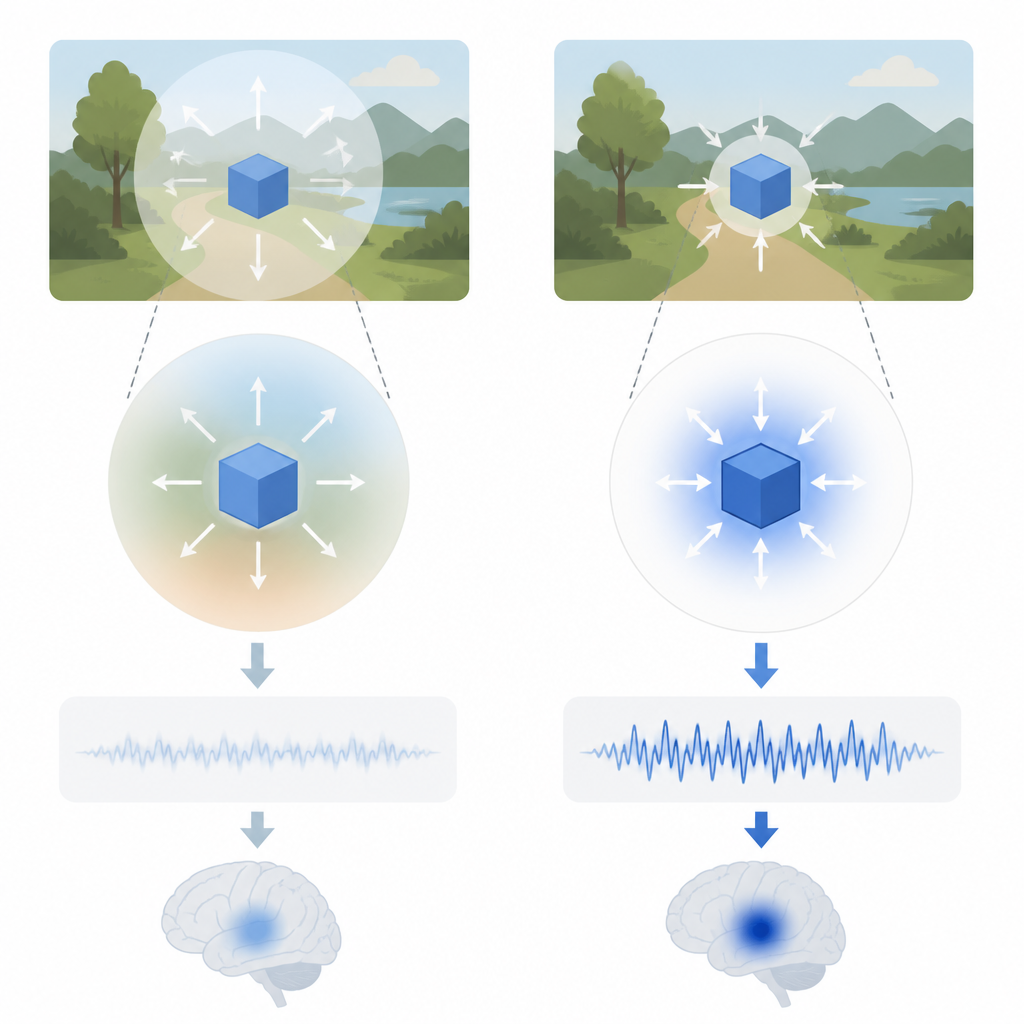
The researchers invited healthy young adults into the lab to complete a computer-based memory task. Participants saw photos of everyday objects, such as tools or toys, placed in different background scenes like living rooms, offices, airports, or forests. The key twist was that people were randomly assigned to one of two ways of looking at these picture pairs. One group was asked to think about how well each object fit into its background scene, encouraging them to consider the wider context. The other group focused on the object alone, judging whether it would fit inside a shoebox, which kept attention on the item rather than its surroundings.
What happened when memories were tested
After this viewing phase, participants unexpectedly completed a memory test. They again saw objects on the same backgrounds, but now some objects were exactly the same as before, some were very similar versions, and some were completely new. For each one, people had to decide whether the object was old, similar, or new. This allowed the researchers to measure two things: simple recognition of previously seen objects and the finer ability to tell apart highly similar items, a skill known as mnemonic discrimination. By comparing the two viewing conditions, the team could see whether elaborating the context boosted or hindered these aspects of memory.
Context focus did not help recognition
Contrary to expectations, participants who focused on the background context actually remembered objects less accurately than those who focused on the objects themselves. Their recognition scores were lower, even though they spent more time looking at each picture. The extra time suggested that the context-focused task demanded more mental effort, but this effort did not translate into clearer memories of the objects. Instead, attention appeared to be split between object and background, weakening the sharpness of the object trace. At the same time, people in the high-context condition were slightly less likely to dismiss similar “look-alike” objects as completely new, pointing to a stronger general feeling of familiarity rather than more precise memory.
Childhood hardship and object memory
The study also examined how self-reported childhood adversity, such as emotional neglect or abuse, related to memory in this task. All participants were currently healthy, but their questionnaire scores varied. Across the whole group, higher levels of childhood adversity were linked to somewhat poorer recognition of objects, particularly when people had encoded them under the object-focused, low-context instructions. In this condition, where fewer background cues were available to support recall, individuals with more adverse experiences tended to show lower recognition scores. These links did not extend clearly to the ability to distinguish highly similar objects, and the statistical interactions between adversity and context condition were small.
What these findings mean for everyday life
Overall, the results suggest that simply adding more context during learning does not always make memories stronger. Under some conditions, concentrating on the setting can draw attention away from the item you actually need to remember, leading to weaker recognition later on. For adults who experienced more hardship in childhood, object memory may be slightly more fragile when there is little contextual support to lean on. Rather than pointing to dramatic memory deficits, the study highlights subtle, task-dependent differences in how people use context, and hints that early life stress may be one factor shaping these patterns in otherwise healthy adults.
Citation: Hanert, A., Pedersen, A. Contextual elaboration shapes object recognition memory across levels of childhood adversity in healthy adults. Sci Rep 16, 15343 (2026). https://doi.org/10.1038/s41598-026-53083-5
Keywords: childhood adversity, episodic memory, contextual cues, object recognition, mnemonic discrimination