Clear Sky Science · en
Benchmarking engineered exchange interactions on NISQ hardware
Why this study matters for future computers
Quantum computers promise to tackle problems in chemistry, finance, and security that overwhelm today’s machines, but only if their basic building blocks work reliably. This paper examines how well a special type of quantum operation, called an exchange interaction, can be carried out on existing noisy quantum hardware, offering a realistic snapshot of where the technology stands and how to use it wisely.
Swapping information between tiny quantum bits
In many quantum algorithms, two quantum bits need to share and swap their information in a controlled way. The study focuses on two related operations, known as iSWAP and square root of iSWAP, which shuffle the excitations between a pair of qubits while also creating entanglement, the uniquely quantum link that underpins most quantum speedups. These operations are especially useful for simulating magnetic materials and for routing information efficiently across a chip where not all qubits are directly connected.
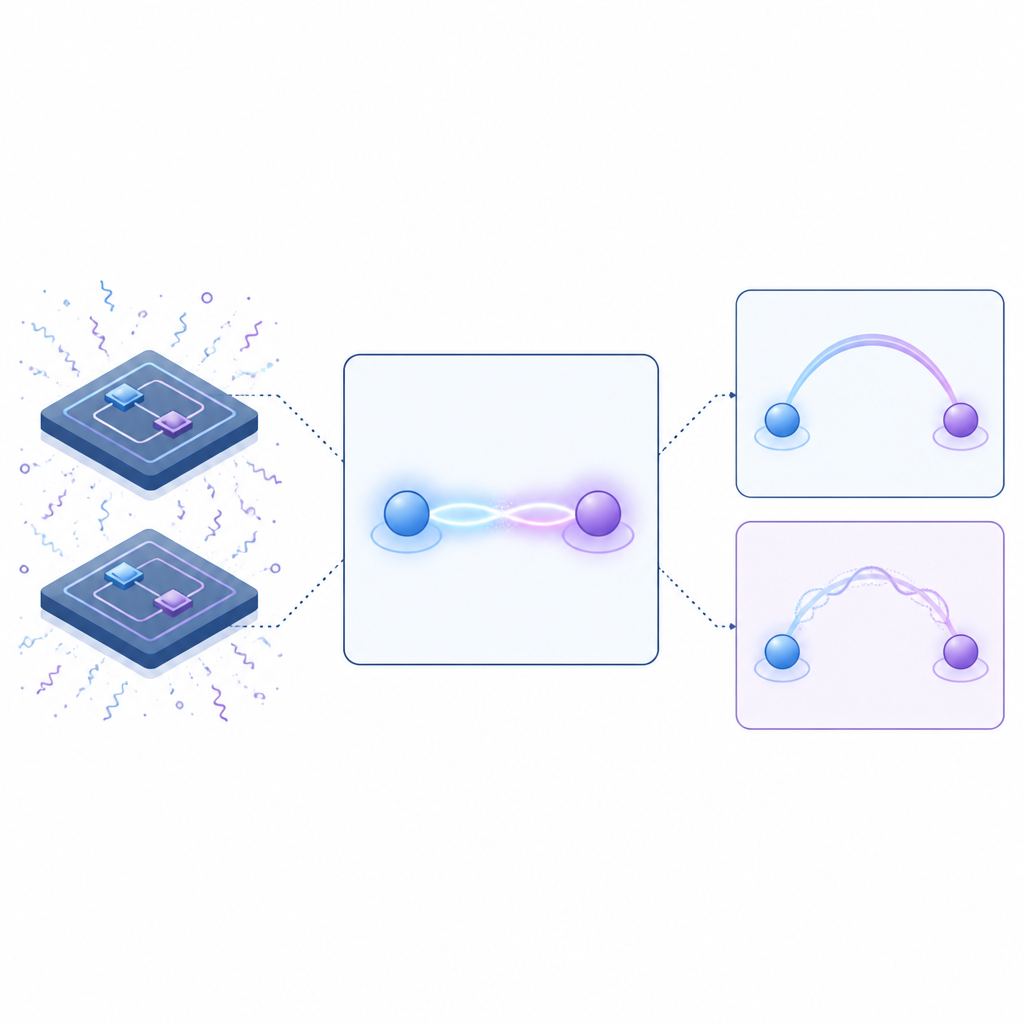
Making theory fit real devices
On the superconducting processor used here, built on IBM’s Falcon architecture, iSWAP and its variant are not native moves. Instead, they must be constructed from a small toolbox of simpler actions, mainly CNOT, RZ, and SX gates. The author designed hardware-aware versions of the two exchange operations that use only two CNOT gates each, interleaved with single-qubit rotations, to keep the overall circuit short. Shorter circuits matter because today’s devices quickly lose quantum information and accumulate errors as more steps are added.
Putting the gates to the test
To see how well these engineered gates perform, the study uses two complementary checks. Direct state measurements start from a simple input state and count how often the device returns the expected outcome versus unwanted results. Quantum process tomography goes much deeper: it reconstructs a full picture of how the device transforms any possible input, producing a “fingerprint” of the operation and a single accuracy score called process fidelity. On a perfect simulator, both exchange gates show very high fidelities around 97 to 98 percent, limited only by statistical noise from a finite number of measurement shots.
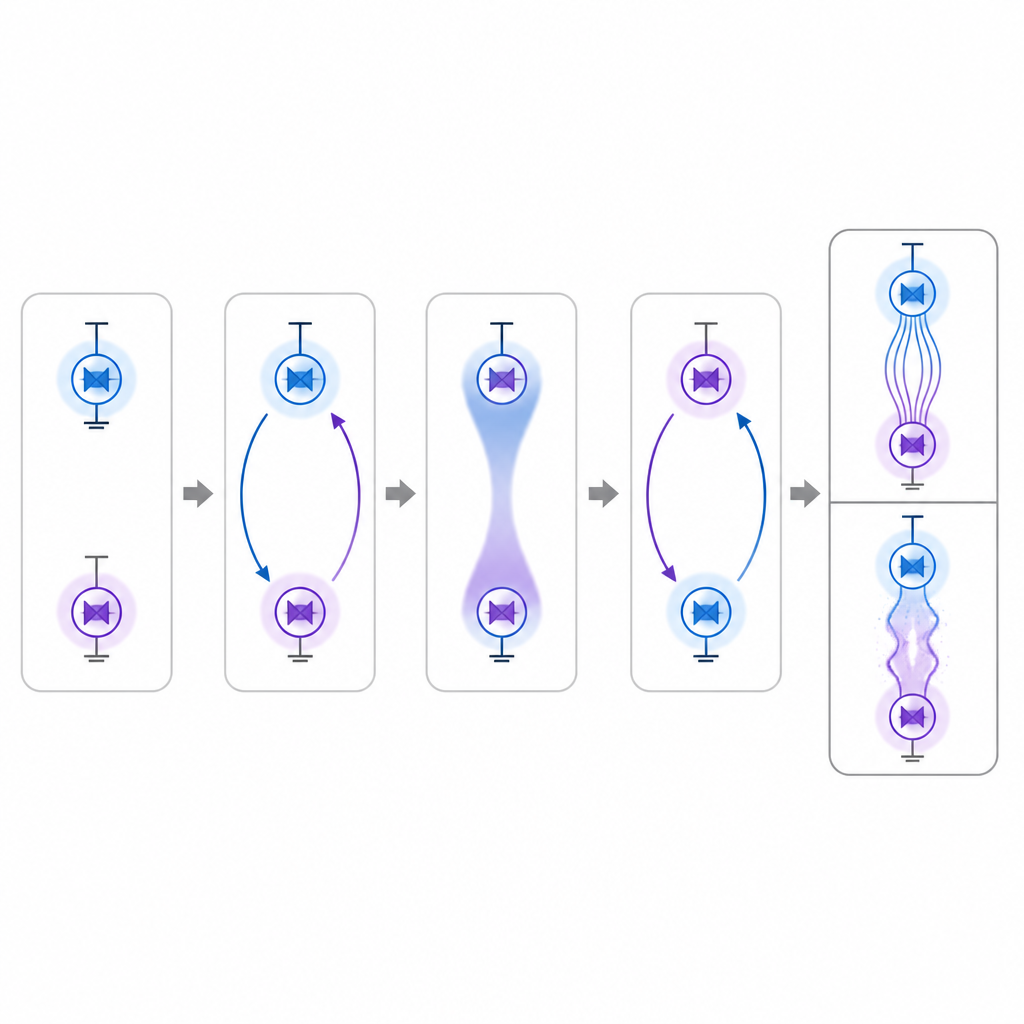
What happens on real noisy hardware
When the same tests run on the physical quantum chip, the exchange gates show a clear drop in performance. The iSWAP implementation reaches a process fidelity of about 89.7 percent and the square root version about 87.7 percent, a loss of roughly 9 to 10 percentage points compared with the simulator. Direct state measurements reveal that, starting from the simple two-qubit “both off” state, the iSWAP gate preserves that state slightly more often than its cousin, but also produces more of the “both on” error outcome. By comparing these behaviors with a standard CNOT gate and with detailed device metrics such as energy relaxation, dephasing, and readout errors, the study links performance differences to specific hardware limitations and variations between qubits.
What this tells us about the road ahead
For non-specialists, the key message is that useful quantum gates can be built from limited hardware tools, but their reliability is still strongly shaped by noise in today’s devices. The engineered exchange interactions studied here perform competitively with native operations while exposing where errors creep in and how different designs trade one type of mistake for another. These benchmarks give algorithm designers practical data to choose between gate options, inspire strategies to reduce dominant error channels, and guide future improvements in chip design as the field moves toward more dependable, fault-tolerant quantum computers.
Citation: AbuGhanem, M. Benchmarking engineered exchange interactions on NISQ hardware. Sci Rep 16, 16132 (2026). https://doi.org/10.1038/s41598-026-53082-6
Keywords: quantum gates, superconducting qubits, entanglement, NISQ hardware, quantum benchmarking