Clear Sky Science · en
A case-aware feature modulation framework for defect classification in power lines
Keeping the lights on
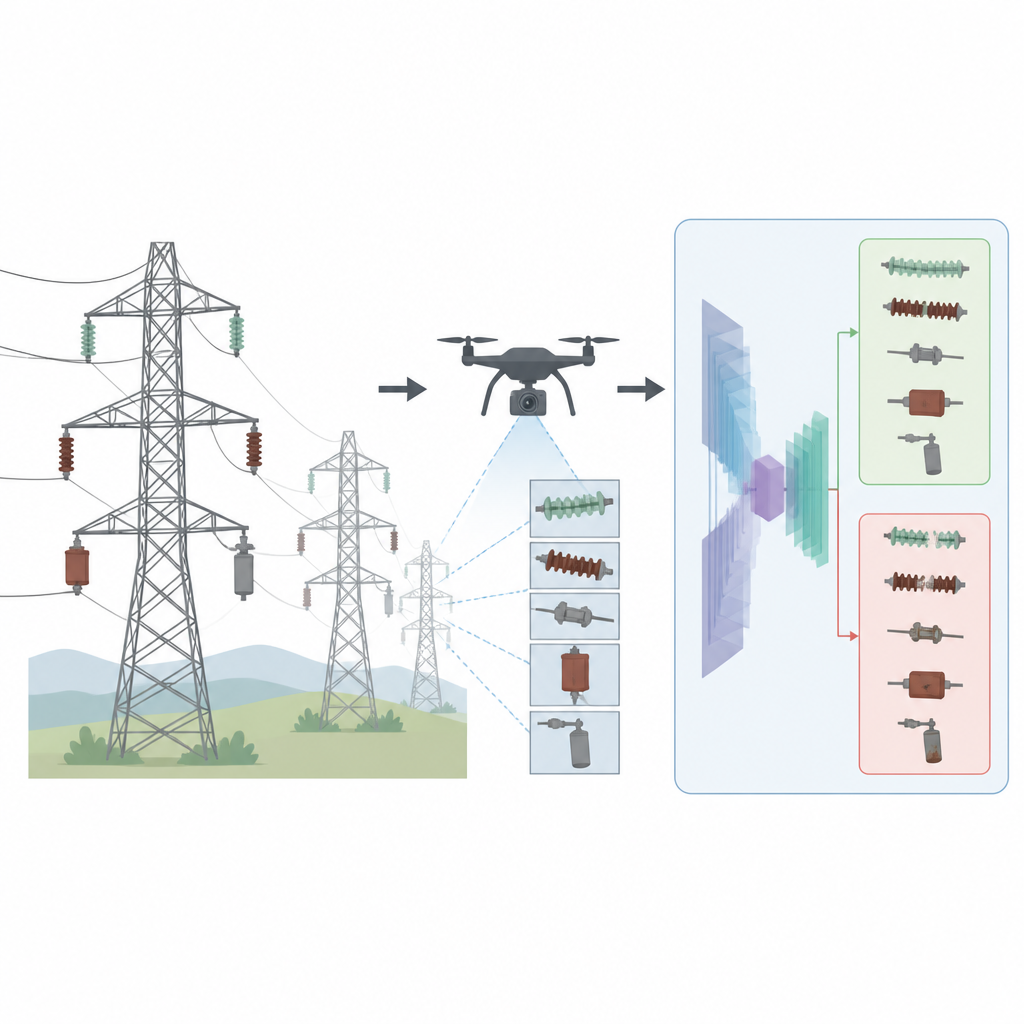
Modern life depends on power lines that quietly span mountains, fields, and cities. Yet the hardware that holds these lines in the air slowly wears out under wind, pollution, and weather. Spotting dangerous defects before they cause blackouts is vital, but manual inspection is slow, costly, and sometimes risky. This study presents a smarter, camera-based way to check several kinds of power line parts at once, using a single artificial intelligence model that learns to recognize many different kinds of damage.
Why power line parts need a closer look
Overhead transmission lines rely on insulators and metal fittings to keep high-voltage conductors safely separated from grounded towers. These components are constantly exposed to dust, salt, moisture, and temperature swings, which can lead to rust, missing pieces, and dirt layers that encourage unwanted electric currents. Traditional checks often involve technicians walking under lines, tapping parts, or measuring electrical behavior, sometimes aided by drones or thermal cameras. While useful, these approaches can miss subtle problems, struggle with large networks, and require multiple tools tuned to specific fault types.
Teaching one system to handle many defects
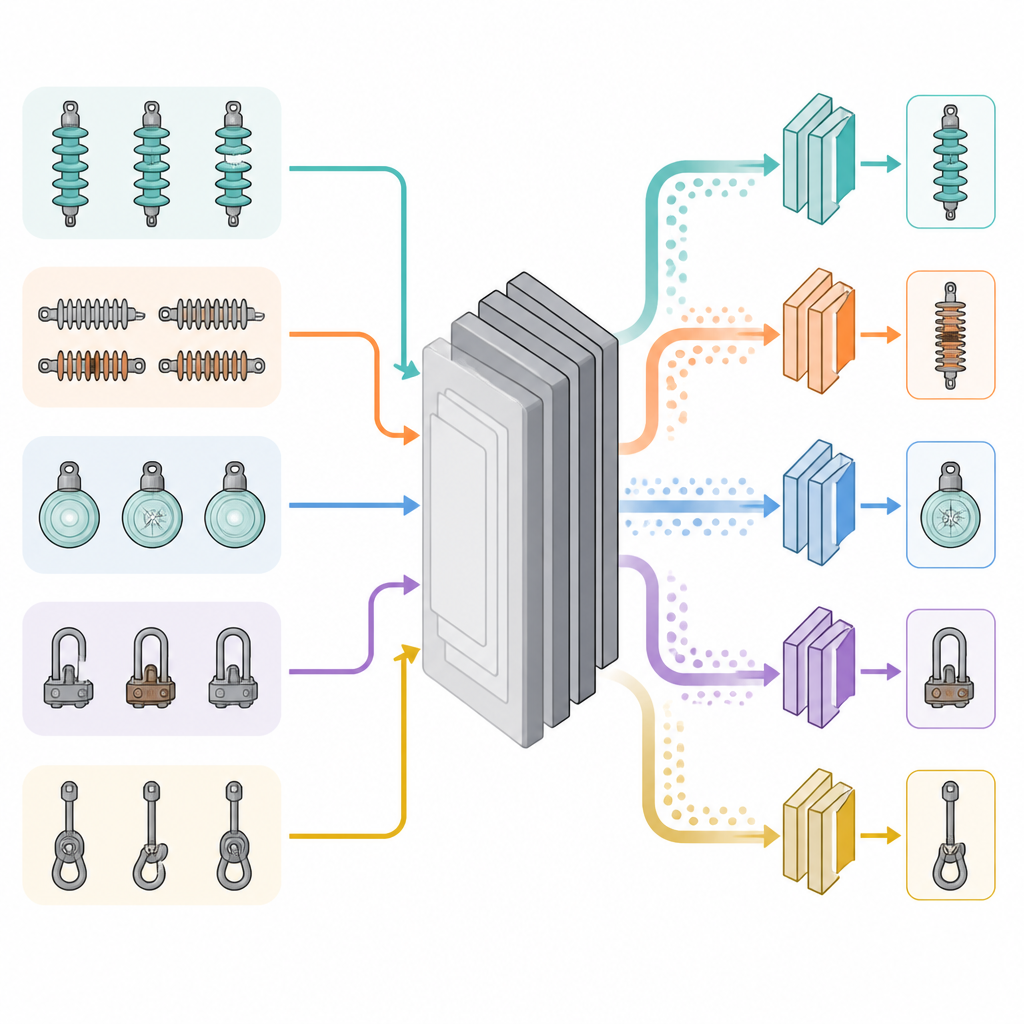
The researchers built a new image-based inspection framework called MS-CADFM-SSL that aims to replace a patchwork of single-purpose models with one coordinated system. It is trained on a public dataset of power line assets that includes five common component groups: glass insulators, lightning rod suspensions, polymer shackles, vari-grip connectors, and yoke suspensions. Each group contains both healthy and faulty examples, such as missing glass caps, corrosion on metal links, or bird nests tangled in hardware. Real inspection data are messy, with some defect types appearing far less often than normal conditions, so the authors use extensive image preprocessing and augmentation to mimic varied viewpoints and lighting.
How the smart inspector learns from pictures
At the heart of the framework is an image network that first teaches itself general visual patterns from unlabeled pictures, such as edges, textures, and surface roughness. This self-training step reduces the need for large hand-labeled datasets. The network then learns to extract information at multiple levels, from fine details like rust spots to broader shapes like missing pieces. On top of this shared backbone, the model applies case-aware feature modulation: for each component type, it gently reweights which visual signals matter most, so the same base network can pay attention to different clues when judging, for example, a glass string versus a steel yoke.
Keeping tasks separate but still connected
Because the system serves several inspection tasks at once, it must avoid “cross-talk,” where patterns useful for one component confuse another. To address this, the authors introduce an extra training rule that nudges the specialized parts of the model to focus on different aspects of the shared features, rather than all latching onto the same cues. They also adjust the learning process to give more weight to rare defect examples, helping the model stay sensitive to unusual but critical failures. Through these design choices, the framework balances the benefits of shared learning across tasks with the need for crisp boundaries between them.
How well the approach works in practice
When tested on all five component cases, the framework achieves very high scores for precision, recall, and overall accuracy, outperforming several advanced deep learning competitors. It correctly identifies almost all severe defects while keeping false alarms low, even in situations where damaged examples are scarce. Step-by-step experiments confirm that each added idea, from self-supervised learning to case-aware modulation and the separation rule, contributes to performance gains. Visual explanations show that the model tends to focus on physically meaningful regions, such as corroded surfaces or missing caps, which can support engineers who review the decisions.
What this means for future power grid checks
For non-specialists, the key message is that a single, well-designed AI can learn to be a versatile inspector across many types of power line hardware, rather than requiring a separate tool for each. By catching faults earlier and reducing manual effort, such systems could help utilities maintain reliability while keeping costs under control. The authors note that challenges remain for very rare or tiny defects and that current tests use still images. They propose extending the approach to video, thermal images, and other sensor data, and eventually adding prediction of defect severity to guide maintenance teams more effectively.
Citation: Ezzulddin, N.F., Abdulkareem, Z.M., Alsabti, S.M.B. et al. A case-aware feature modulation framework for defect classification in power lines. Sci Rep 16, 16419 (2026). https://doi.org/10.1038/s41598-026-53001-9
Keywords: power line inspection, insulator defects, deep learning, multi task learning, infrastructure monitoring