Clear Sky Science · en
Experimental evolution reveals genomic signatures of variety-specific selection of Cercospora beticola in Germany
Why crop diseases and hidden evolution matter
Cercospora leaf spot is a tiny fungal disease with a big impact on sugar beet, a crop that supplies much of the world’s sugar. Farmers have long leaned on fungicide sprays to keep it in check, but the fungus is evolving resistance, making those chemicals less effective. Plant breeders are turning instead to sugar beet varieties that can better withstand infection. This study asks a crucial question for food production: how quickly can the fungus adapt to these resistant plants, and what does that adaptation look like in its DNA?
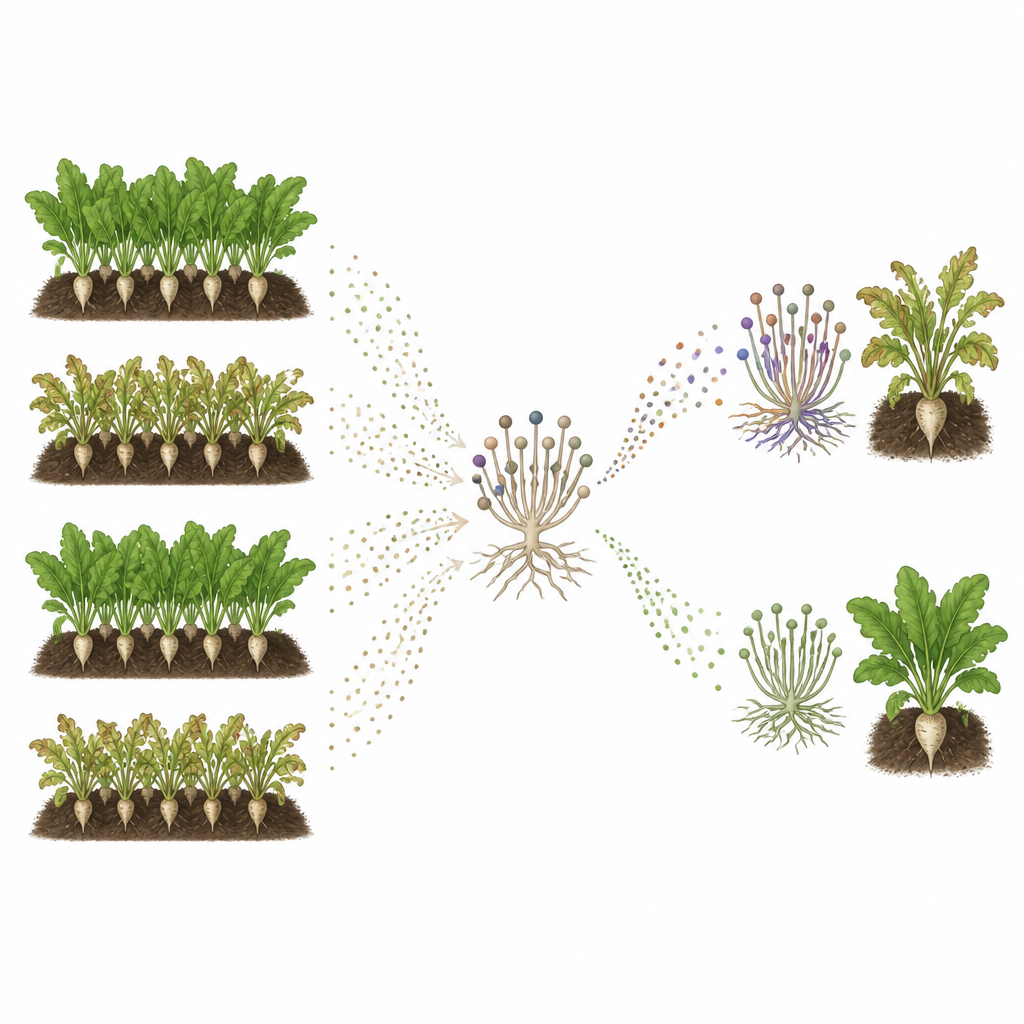
Following a crop disease over time
The research team set up field trials at four locations in Germany, planting four sugar beet varieties that ranged from highly susceptible to highly resistant to Cercospora leaf spot. Over three years, they recycled the fungus from each plot back onto the same variety and location. At the end of each season, they collected infected leaves separately from every variety and site, dried them, and used this material to start the next year’s infections. This created controlled mini-ecosystems in which the fungus repeatedly faced the same host plant and local conditions, mimicking evolution in fast forward.
Taking a genetic snapshot of the fungus
From these trials, the scientists isolated 900 individual Cercospora beticola strains and decoded their entire genomes. They compared hundreds of thousands of DNA markers to see how fungal populations were structured across space, time, and host variety. At the start, strains from different locations were mostly mixed, suggesting that spores move widely between regions rather than staying local. Some sites showed signs that the fungus may reproduce sexually, shuffling its genes, while others appeared more skewed toward clonal reproduction. Overall, most genetic differences were found between individual strains rather than between locations, pointing to a large, diverse gene pool.
What changes when the host fights back
When the team looked at how populations changed over the three years, they found only modest and inconsistent signs that local field conditions alone caused strong genetic splits. In contrast, the resistance of the sugar beet variety made a clearer mark. The most resistant variety, referred to as variety D, consistently had the lowest disease levels in the field. Fungal populations that had to infect this tough host became less genetically diverse and formed distinct lineages that separated from those infecting more susceptible varieties. Statistical measures of DNA variation and differences between groups showed that the fungus on variety D was being pushed in a different evolutionary direction than those on easier hosts.
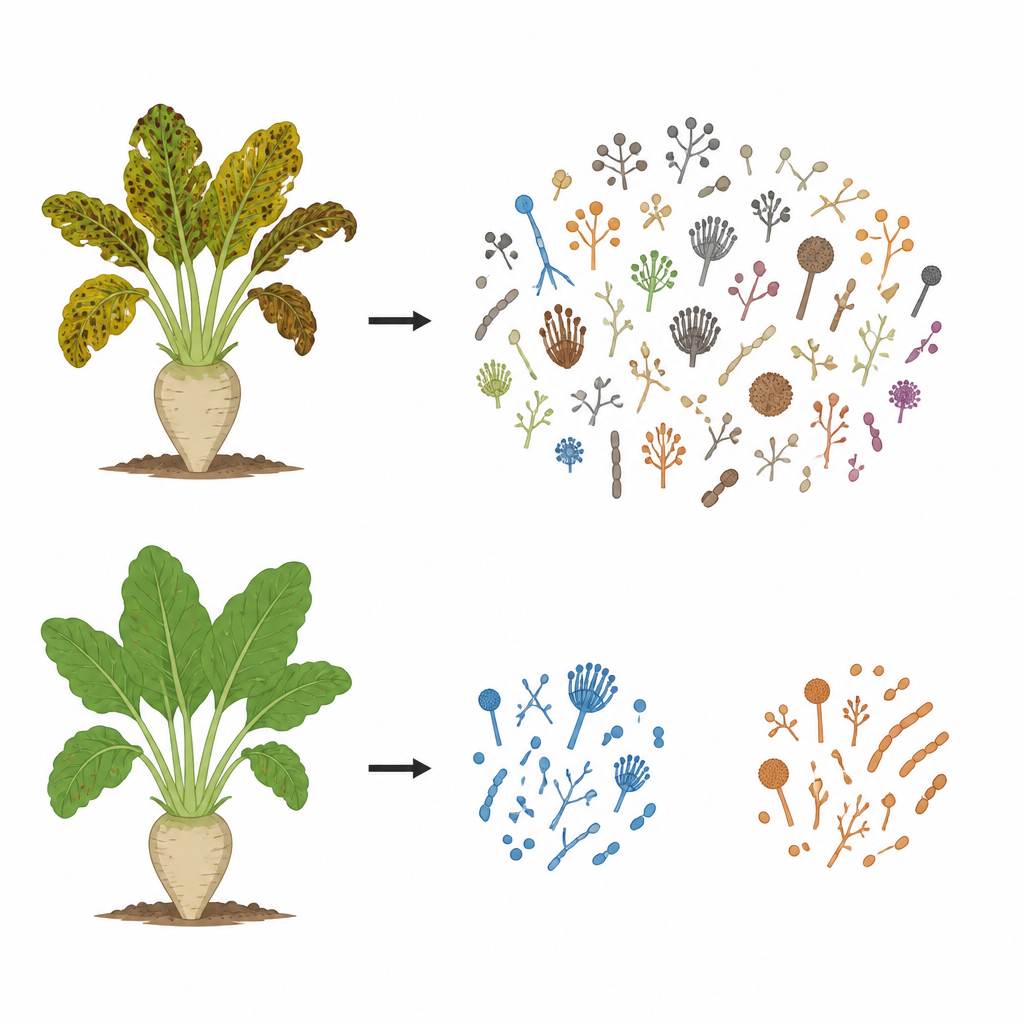
Pinpointing genes linked to adaptation
To find out where in the genome this adaptation was happening, the researchers scanned for regions that differed sharply between fungus from the most susceptible variety and from the highly resistant variety. They also searched for patterns that signal recent strong selection, where a helpful genetic variant quickly spreads through a population. Overlapping these signals highlighted seven small stretches of DNA containing 26 genes. Most were involved in basic cell functions like nutrient use and stress response, but two stood out as secreted proteins predicted to act as effectors, the molecular tools fungi use to interact with plant defenses. Both belonged to a protein family known in other fungi for helping them cope with oxidative and other stresses, suggesting these candidates may help Cercospora beticola survive on resistant sugar beet.
What this means for future harvests
For non-specialists, the key message is that the fungus attacking sugar beet can adapt surprisingly quickly to resistant crop varieties, and that this shift leaves clear fingerprints in its genome. The study shows that resistant plants do not simply block disease; they also steer the evolution of their pathogens, favoring strains that can cope with tougher defenses. By identifying specific genes that may be involved in this process, the work lays groundwork for breeding strategies and disease management plans that anticipate, rather than just react to, the fungus’s next moves.
Citation: Yang, Y., Wyatt, N.A., Martinez, A.L. et al. Experimental evolution reveals genomic signatures of variety-specific selection of Cercospora beticola in Germany. Sci Rep 16, 15881 (2026). https://doi.org/10.1038/s41598-026-52994-7
Keywords: Cercospora leaf spot, sugar beet, fungal evolution, host resistance, plant pathogen genomics