Clear Sky Science · en
Structurally diverse secondary metabolites from the dung-inhabiting fungus Botryotrichum murorum
Medicine from unexpected places
Animal droppings may seem an unlikely place to hunt for future medicines, yet they are home to fierce battles between microbes. In this crowded world, fungi must defend themselves with potent chemical weapons. This study explores one such fungus living in tortoise dung and reveals a surprising set of new and rare molecules that could inspire future antibiotics and anticancer agents. 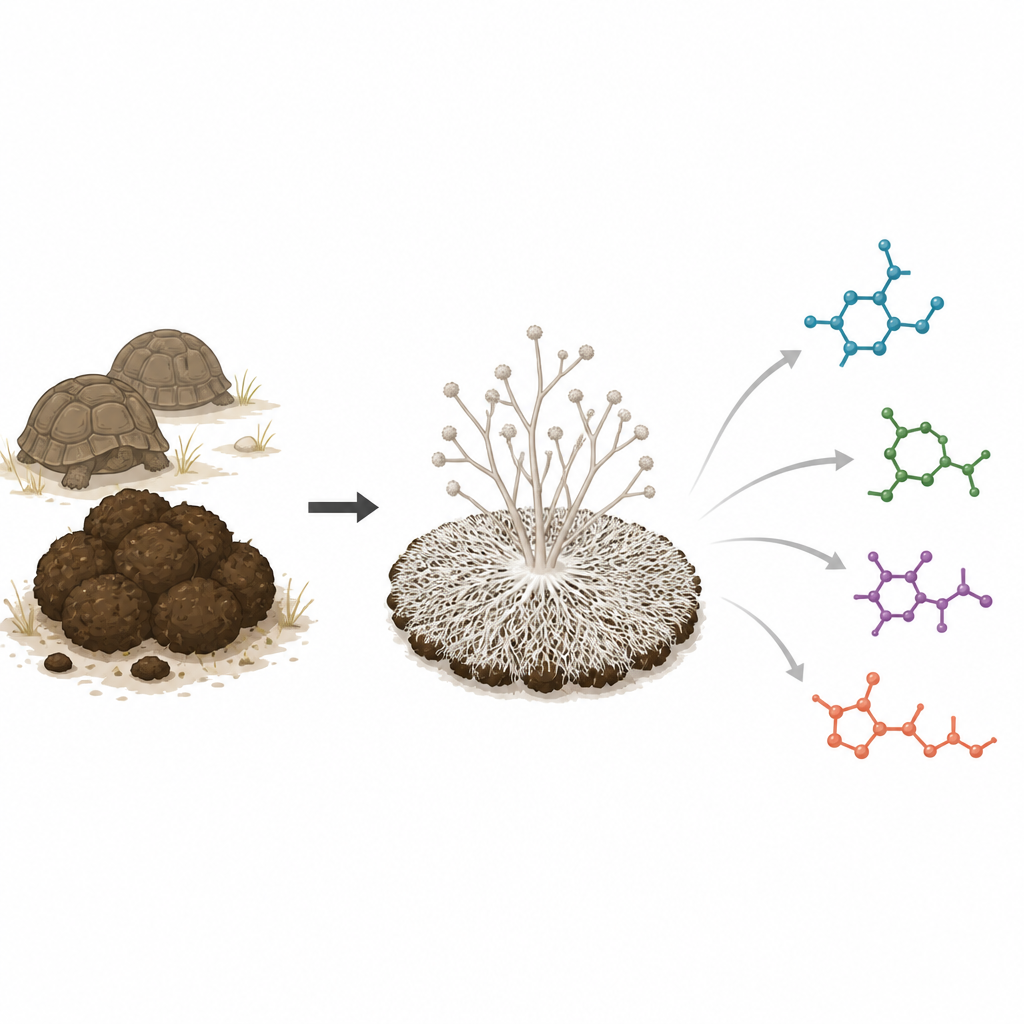
A fungus living on dung
The researchers focused on Botryotrichum murorum, a fungus that thrives on animal dung, an environment packed with bacteria and other competitors. Using a mix of DNA analysis and microscopy, they confirmed that their strain, collected from zoo tortoise droppings, belonged to this species. Dung-dwelling fungi are already known as rich sources of bioactive compounds, but B. murorum had been studied very little before. This made it a promising target for uncovering fresh chemical diversity.
Scanning the chemical landscape
To see what the fungus could make, the team grew it on solid rice-based medium and examined the resulting extract with advanced mass spectrometry tools that weigh and sort thousands of molecules at once. Computer methods grouped these molecules into networks based on how they broke apart in the instrument, hinting at which ones were related in structure. The analysis revealed more than three thousand chemical signals, most of which did not match known compounds, suggesting that B. murorum produces many previously unseen metabolites. Because many appeared only in tiny amounts, the team scaled up the cultures to harvest enough material for full characterization. 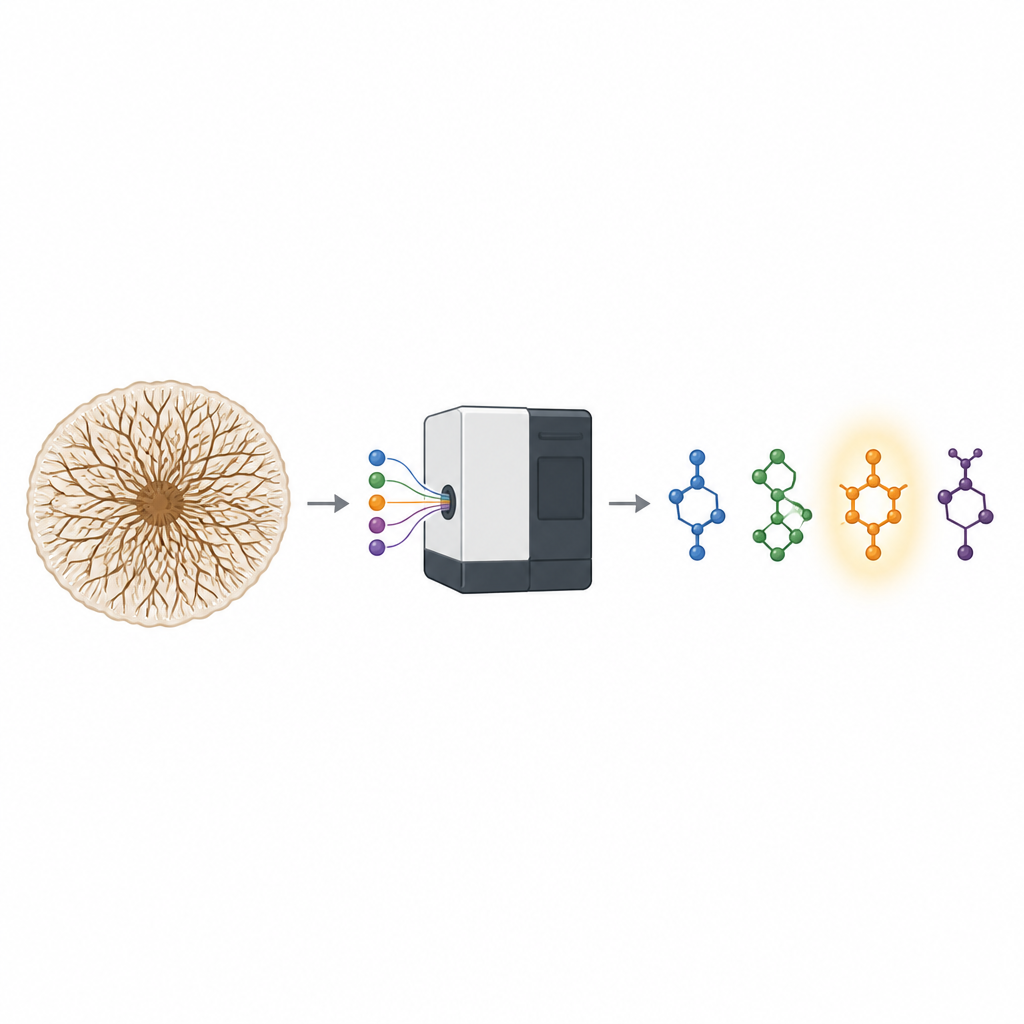
Four standout molecules
From these large-scale cultures, four main compounds were purified and structurally decoded using high resolution mass measurements and detailed nuclear magnetic resonance experiments. One, named tortoisellide A, is a polyketide with an unusual ring containing an oxygen bridge that flips between two forms, causing duplicated signals in the spectra. A second compound is a sulfur-containing variant of the known antibiotic grahamimycin A, in which a small sulfur-bearing side chain appears to blunt the original molecule’s potency. The third compound, cryptosphaerolide, is a complex terpenoid, and the fourth, isocochliodinol, is an indole-based pigment related to a family of fungal markers used to help identify certain groups of fungi.
How these molecules act on cells
When tested against a panel of microbes and mammalian cell lines, the four compounds showed very different behaviors. The sulfur-modified grahamimycin lost the broad antimicrobial effect of its parent, supporting the idea that the added group helps the fungus detoxify a powerful weapon it otherwise could not safely handle. Cryptosphaerolide showed selective activity against some bacteria and killed certain mammalian cells at low micromolar concentrations, consistent with earlier work linking it to a protein involved in cell survival. Isocochliodinol turned out to be the most potent against mammalian cells, with effects in the nanomolar range, and its activity pattern differed from that of its close cousin cochliodinol, underscoring how small structural changes can strongly alter biological impact.
Why these findings matter
Overall, the study shows that a single dung fungus can produce structurally diverse chemicals with very different effects on cells, expanding the known chemical space of its fungal family. Tortoisellide A and the sulfur-modified grahamimycin example hint at unusual ways fungi assemble and fine tune complex molecules, while the behavior of cryptosphaerolide and isocochliodinol highlights their potential as starting points for future drug discovery. For non-specialists, the key message is that even humble piles of tortoise dung can hide sophisticated chemistry, and that exploring such overlooked niches may uncover valuable new tools for medicine.
Citation: Charria-Girón, E., Liu, YY., Surup, F. et al. Structurally diverse secondary metabolites from the dung-inhabiting fungus Botryotrichum murorum. Sci Rep 16, 15180 (2026). https://doi.org/10.1038/s41598-026-52958-x
Keywords: coprophilous fungi, secondary metabolites, natural products, cytotoxic compounds, Botryotrichum murorum