Clear Sky Science · en
Line × tester analysis for yield and its components of some domestic okra (Abelmoschus esculentus L. Moench) lines
Why better okra matters for your table
Okra is a staple vegetable in many kitchens, valued for its tender green pods and rich supply of vitamins and minerals. Yet farmers often struggle to get high and reliable yields from local okra varieties. This study from Egypt takes a closer look at how to combine different okra lines to create hybrids that are more productive, earlier to flower, and better suited to farmers’ fields. The findings help point the way toward stronger okra plants that can support both local diets and crop incomes.
Mixing parents to build stronger plants
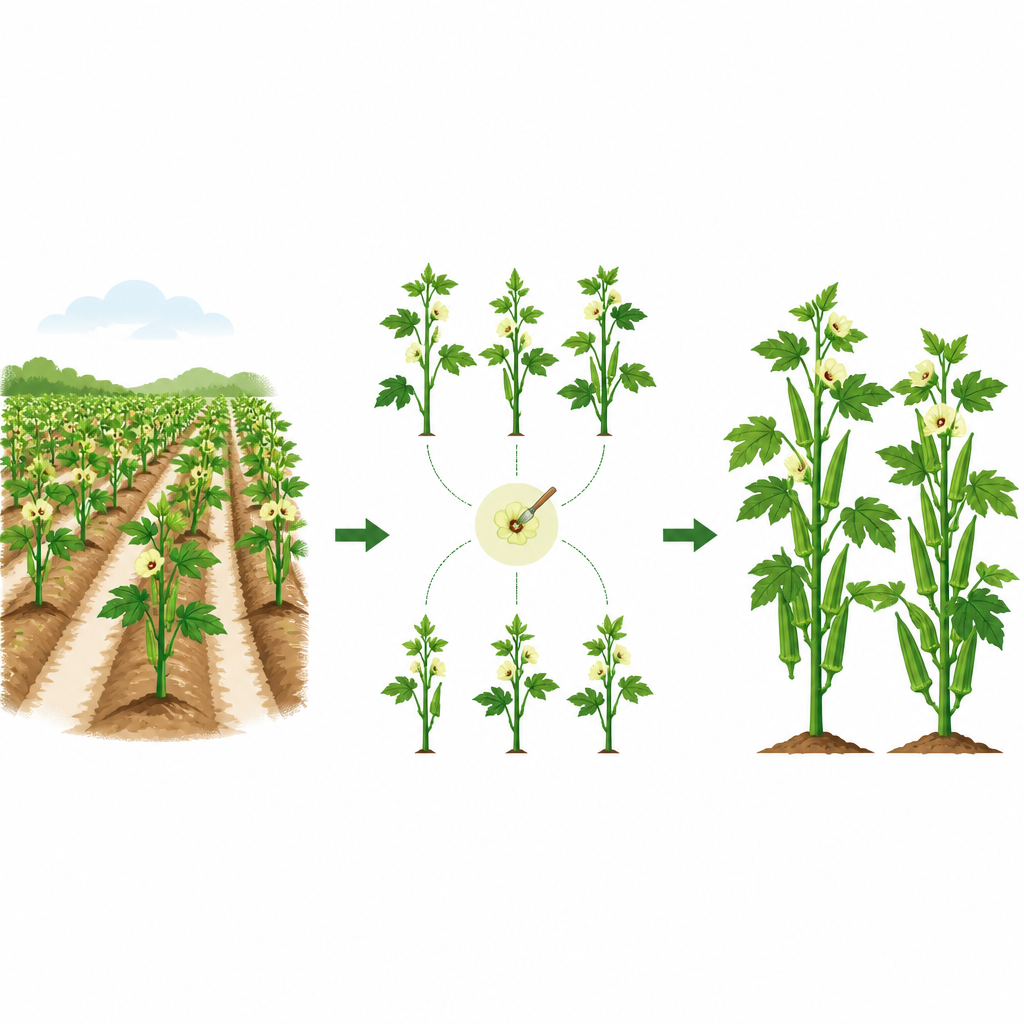
The researchers worked at El-Baramon Research Station over two growing seasons, using 12 types of domestic okra plants. Ten of these were used as “lines” and two as “testers,” which they crossed in a planned way to create 20 first‑generation hybrids. All parents and hybrids were grown side by side in replicated field plots so they could be fairly compared. The team measured nine traits that matter to farmers and consumers, including plant height, number of branches, days to flowering, pod size, pod weight, number of pods per plant, and total yield per unit of land.
Seeing big differences in growth and yield
The field results showed wide variation among both the parent plants and the hybrids. Some lines were short and early, others tall and late, and pod sizes also varied greatly. Many of the hybrids outperformed their parents for key traits. For example, hybrids such as L4×T1, L8×T1, L4×T2 and L8×T2 produced more pods per plant and higher total yields than either parent grown alone. One hybrid, L8×T2, gave about one quarter more pod yield per plant than the average of its parents and clearly stood out as a top yielder. These patterns confirm that crossing well chosen parents can unlock extra vigor in okra.
How the team read the genetics behind the gains
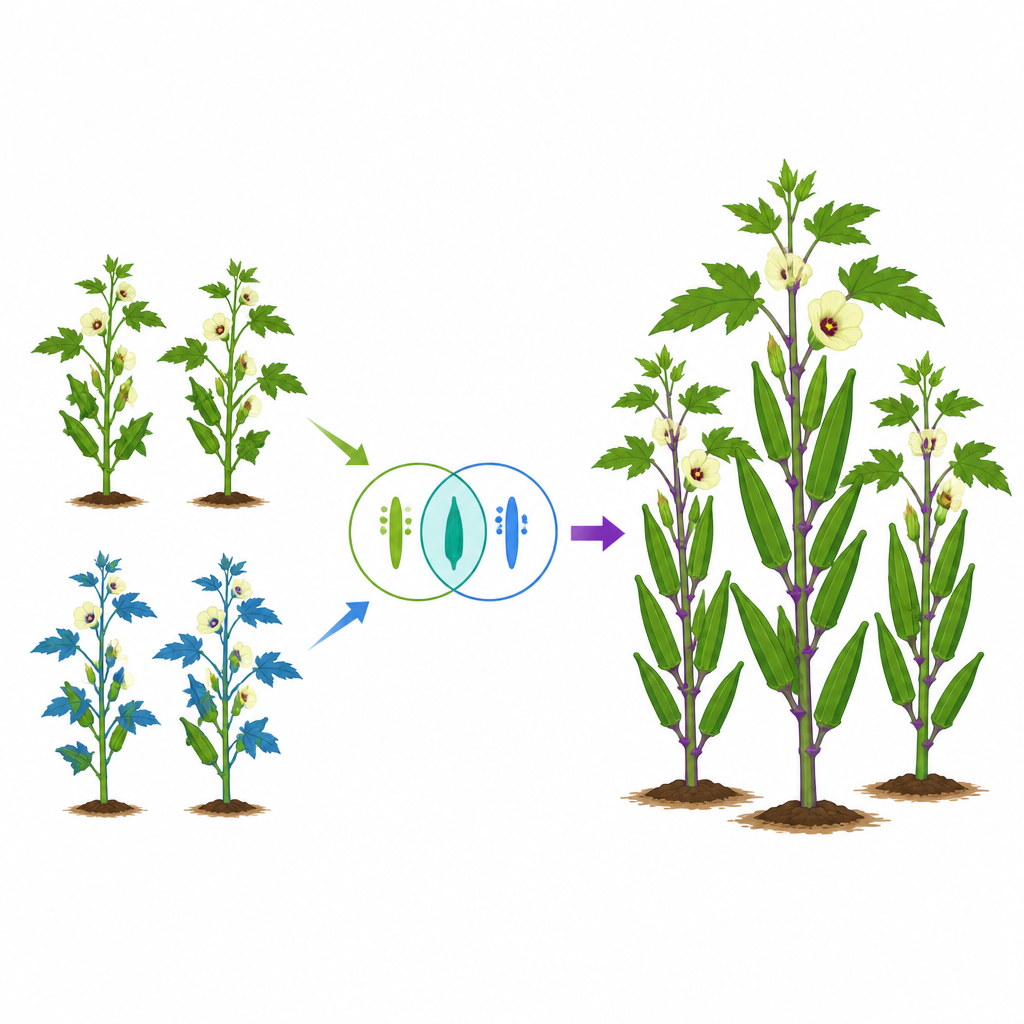
Beyond simple yield comparisons, the study used statistical tools common in plant breeding to understand why some crosses worked so well. The authors separated two kinds of genetic effects. One is general combining ability, which reflects how good a parent tends to be across many different crosses. The other is specific combining ability, which captures the unique boost seen in a particular pair of parents. Several lines, especially L4, L5, L8 and L10, had strong general combining ability for pod yield and total yield, marking them as particularly useful parents. At the same time, certain cross pairs like L9×T1, L3×T2, L4×T2, L2×T2 and L5×T1 showed very favorable specific combining ability, meaning that these particular combinations produced hybrids far better than expected from their parents alone.
Why hybrid vigor is key for okra
The genetic analysis showed that so‑called non‑additive effects, which include dominance and other interactions between genes, were more important than simple additive effects for all the traits studied. In practical terms, this means that the advantage of hybrids often comes from how the two parental genomes interact, rather than just adding up their individual strengths. Measures of heritability also suggested that much of the observed variation in yield and pod traits is tied to these complex effects and to the environment, rather than to straightforward inherited differences alone. This pattern favors breeding strategies that focus on creating and testing hybrids, rather than only selecting the best single inbred lines.
What this means for farmers and seed producers
For a non‑specialist, the main message is that domestic okra still holds plenty of untapped potential. By carefully choosing parent lines and crossing them in a structured way, breeders in this study identified several high‑performing hybrids and a set of strong parental lines that can be used to produce future hybrids. Because hybrid vigor appears to drive most of the yield gains, expanding hybrid okra seed production could help farmers harvest more pods from the same area of land. With further testing and adaptation, the highlighted hybrids and parents could support more productive okra crops, more stable supplies in markets, and better returns for growers.
Citation: Abed, M.Y., El-Shoura, A.M. Line × tester analysis for yield and its components of some domestic okra (Abelmoschus esculentus L. Moench) lines. Sci Rep 16, 15861 (2026). https://doi.org/10.1038/s41598-026-52940-7
Keywords: okra breeding, hybrid vigor, crop yield, genetic variation, vegetable genetics