Clear Sky Science · en
The importance of hair in human perception of electric fields – A double-blind repeated measures study
Why this study matters to everyday life
Most of us walk under power lines or sit near electrical devices without thinking about how our bodies sense the invisible fields around them. This study asks a surprisingly down-to-earth question: how much of that subtle awareness comes from our hair. By carefully testing volunteers in a controlled lab, the researchers show that both the presence and the condition of our hair strongly shape how well we can notice electric fields at all.
Hair as tiny feelers for invisible forces
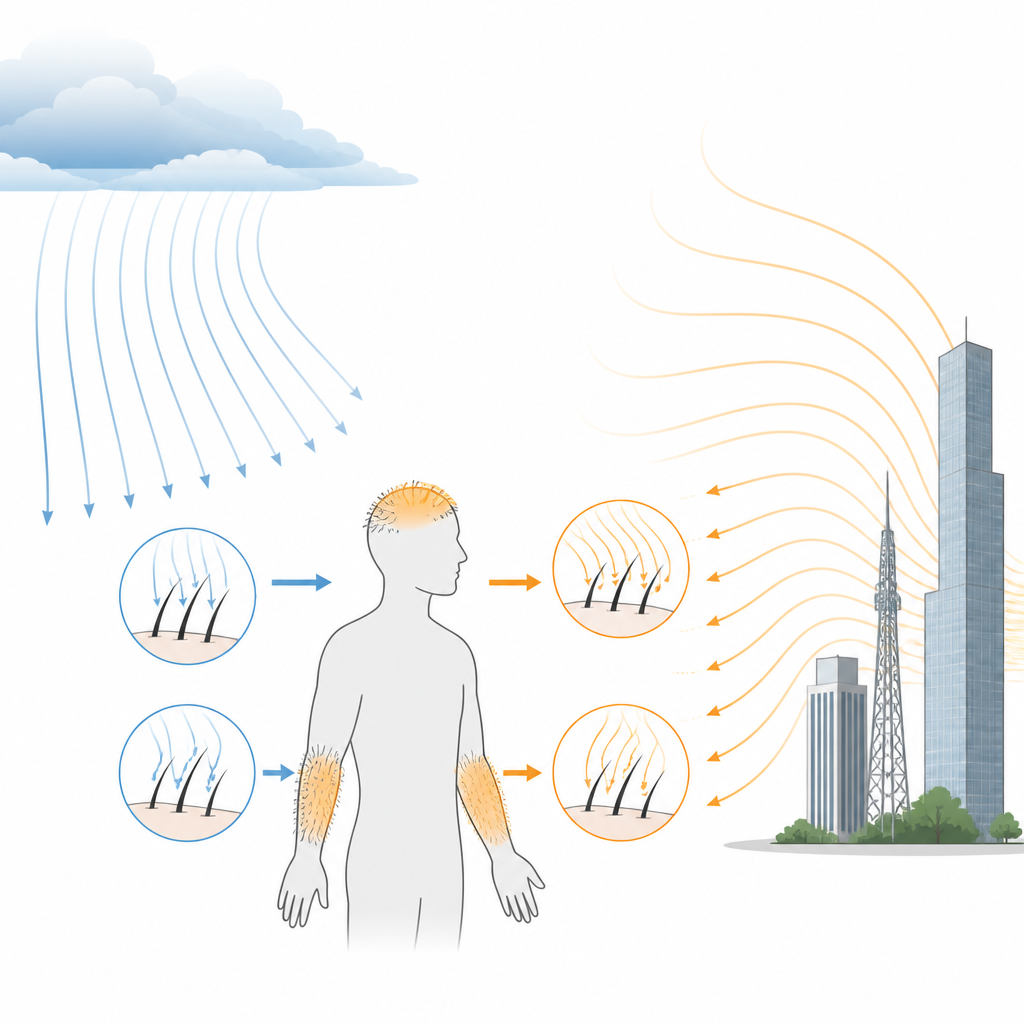
Electric fields are part of modern life, from high-voltage lines to future direct-current power grids, yet they barely penetrate the body and are thought to act mainly on the skin. Earlier work showed that people can consciously notice both steady and low-frequency electric fields, often describing a light tingling or vibration of body hair. This led to the idea that hair might work like a set of tiny feelers, especially on the head and arms, turning faint forces at the skin surface into sensations that the brain can detect.
How the experiment was set up
In this double-blind study, 30 healthy adults sat in a special exposure room where researchers could generate controlled electric fields. The team tested three situations: a steady field, a low-frequency alternating field similar to power-grid current, and a combination of both. On the first test day, volunteers kept their normal hair on head, arms, and face. A week later, they returned with these areas shaved smooth, while eyebrows and eyelashes remained. Across twelve short sessions per person, electric fields of different strengths or sham exposures were turned on in random order, and participants reported on each trial whether they sensed a field or not. The scientists then used signal detection methods to calculate how strong a field had to be before each person reliably noticed it.
What changed when hair and humidity were altered
The contrast between hairy and shaved conditions was striking. After hair removal, the number of people who could successfully detect a given field strength dropped sharply, and the field had to be stronger before it was noticed at all. This effect was clearest for steady fields and for mixed fields, where typical detection thresholds rose by about ten thousand volts per meter. The places on the body where people felt the fields also shifted. With full hair, nearly everyone reported sensations on the scalp and many on the arms. After shaving, mentions of scalp and arm sensations fell, while reports from still-hairy areas like eyebrows, ears, and eyelashes increased, suggesting that remaining fine hairs took over much of the sensing.
How hair quality and air moisture shape sensitivity
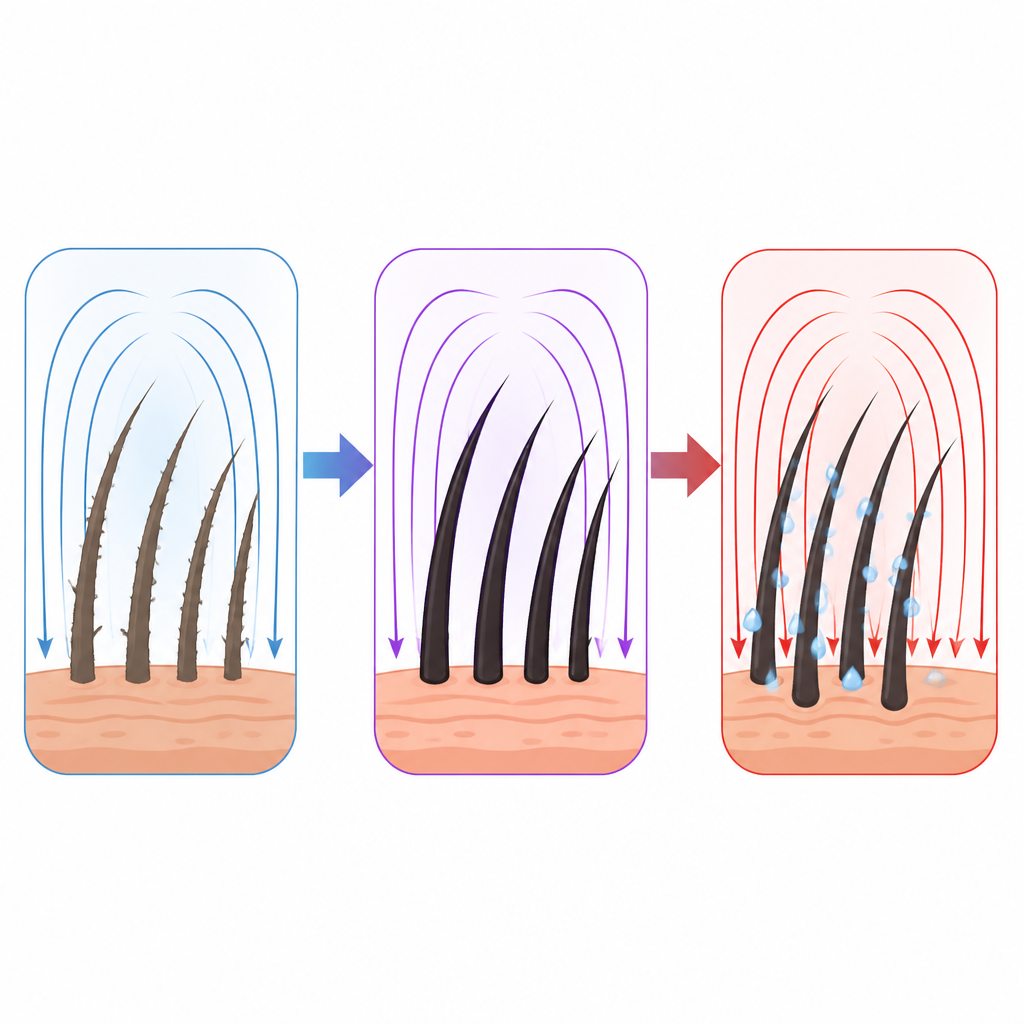
The study went further by measuring hair samples in the lab and varying the air’s moisture in the exposure room. When the air was more humid, participants became better at sensing steady fields, especially through scalp hair, but less sensitive to alternating fields. Drier air showed the opposite pattern for alternating fields, supporting earlier hints that moisture changes how electric charge moves along hairs. Independent measurements showed that scalp hair that held more external water was linked to better sensitivity to steady fields, while smoother arm hair was linked to better sensitivity to alternating fields. In female volunteers, applying mascara to eyelashes, which tends to smooth and weigh down the hairs, improved detection of alternating and mixed fields, pointing again to the importance of hair surface and movement.
What this means for our sense of electric fields
To a layperson, the take-home message is simple: human hair is not just decoration, it is an important part of how we feel electric fields that barely touch the body. Removing head and arm hair makes people much less able to notice these fields, while the wetness and texture of remaining hair can either sharpen or blunt that sensitivity. The results suggest that our awareness of electric fields depends on a partnership between tiny forces acting on hair and the skin’s normal touch sensors. Although the study does not address health risks, it helps explain why people differ so much in their ability to sense electric fields and points the way toward future research on the role of very fine facial and ear hairs in this little-known human sense.
Citation: Jankowiak, K., Kaifie, A., Krabbe, J. et al. The importance of hair in human perception of electric fields – A double-blind repeated measures study. Sci Rep 16, 14970 (2026). https://doi.org/10.1038/s41598-026-52898-6
Keywords: electric field perception, human hair, DC and AC fields, relative humidity, sensory thresholds