Clear Sky Science · en
Synergistic ANN-GA-CFD framework for high-performance Savonius wind turbine optimization with experimental validation
Urban wind made simple
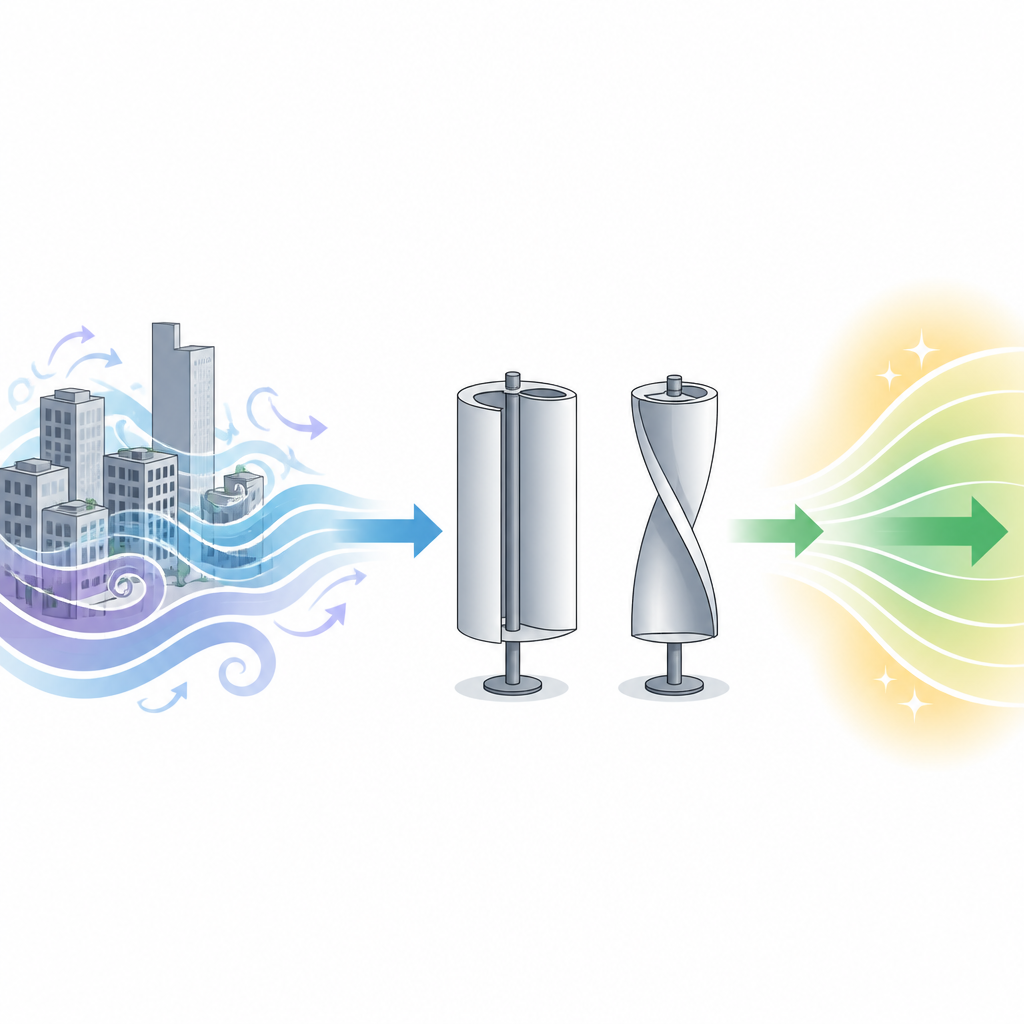
As cities search for cleaner energy, small rooftop wind turbines look attractive, but many designs struggle to turn gentle, shifting breezes into useful power. This study focuses on a simple, barrel-shaped device called a Savonius wind turbine and shows how smart computer tools can squeeze more electricity out of each gust, potentially making quiet, low-cost turbines more practical for homes and city blocks.
Why this type of wind turbine matters
The Savonius turbine is not the sleek three-bladed giant you see in wind farms. Instead, it is a short vertical cylinder made of two or more scooped blades, a bit like two half-drum shells facing opposite directions. Its strengths are simplicity, low cost, and the ability to catch wind from any direction, which is ideal for cluttered urban landscapes where air flows are turbulent and unpredictable. Its main weakness is low efficiency: it typically converts only a small fraction of the wind’s energy into useful rotation compared with other turbine types.
Using brains and evolution in a computer
To tackle this weakness, the researchers built a digital “wind tunnel” powered by a trio of methods. First, they gathered a large collection of results from earlier experiments and computer simulations of many Savonius designs, then filled in missing regions of that design space with new, detailed airflow simulations. Second, they trained artificial neural networks, a type of machine learning model, to learn how changes in blade size, shape, twist, spacing, and operating speed affect the turbine’s power output. Third, they linked these learned models to a genetic algorithm, a search method inspired by evolution, which breeds and mutates thousands of virtual designs to find combinations that spin the most efficiently.
Finding better shapes and how they work
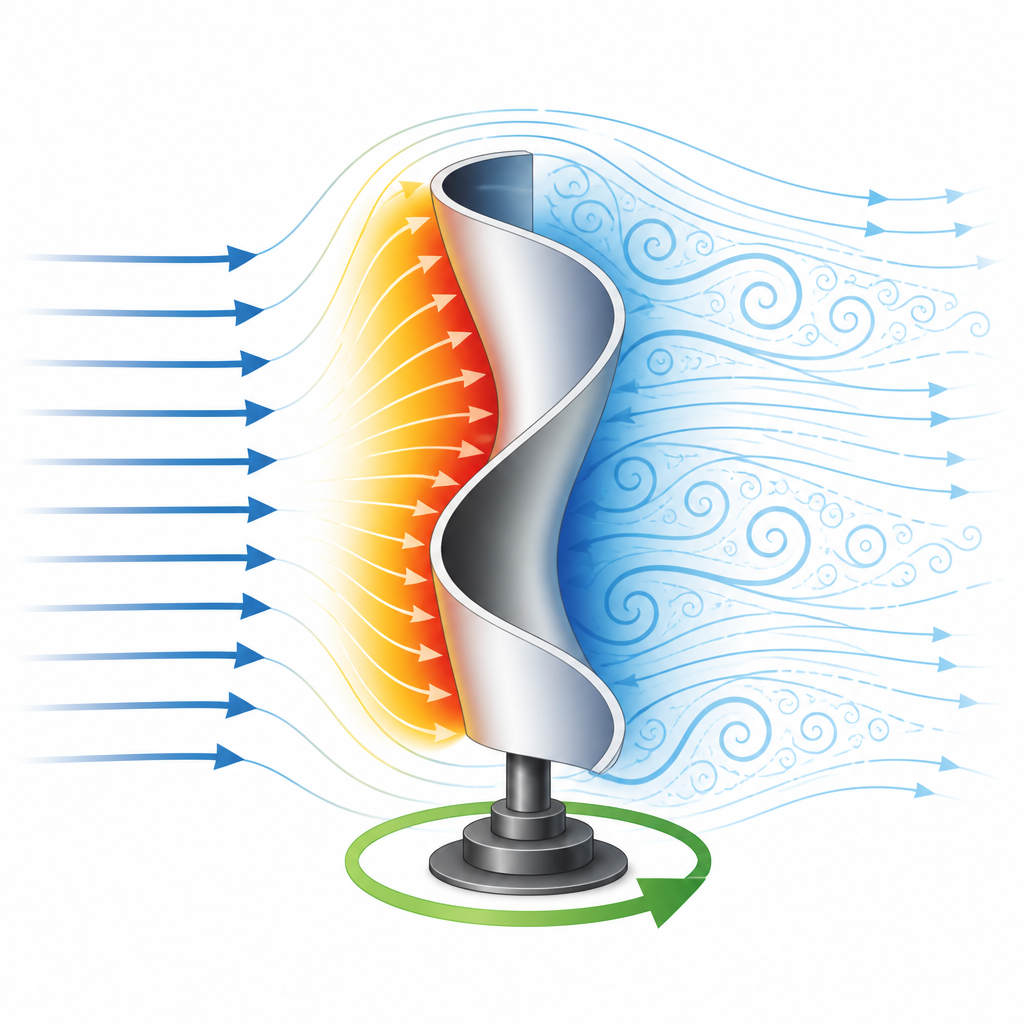
With this loop of learning, searching, and re-simulating, the team compared two families of turbines: ones with straight blades and ones with gently twisted blades that spiral along the height of the rotor. The optimized straight design showed a noticeable gain in power compared with a widely used reference design. The best twisted design performed even better, increasing the power output by roughly one-sixth over the same reference. The twisted shape smooths out the forces on the blades as they turn, reducing dead spots in rotation and keeping the turbine producing useful torque throughout a full revolution, especially at higher wind speeds.
Which knobs matter most
Because the neural network model runs extremely fast, the researchers could virtually test billions of combinations of design and operating conditions. They used this to perform a global sensitivity analysis, which ranks how strongly each factor influences performance. The results show that how fast the rotor spins relative to the wind speed is the single most important lever, followed by the overall wind speed itself. Blade count, rotor proportions, and twist angle also matter, but to a lesser degree. This means that smart control of rotation, such as adjusting the electrical load on the generator as the wind changes, can be just as important as carefully sculpting the blades.
Putting the designs to the test
To check whether their computer-guided designs hold up in the real world, the team 3D-printed prototypes of both the optimized straight and twisted turbines and tested them in a wind tunnel under several flow conditions. The measured power outputs closely matched the predictions from the neural network models, staying within a few percent across the tested range. This agreement suggests that the combined approach of data gathering, machine learning, evolutionary search, and targeted airflow simulation can reliably guide better designs without the need to build and test every variation physically.
What this means for future small wind power
For a non-specialist, the key takeaway is that simple vertical wind turbines can be made noticeably more effective when guided by modern data-driven tools. While the gains do not turn a Savonius device into a powerhouse rivaling large wind-farm machines, they make it more capable and predictable, especially in the messy winds around buildings. The same framework can be extended to other compact wind systems, helping engineers design quieter, more efficient devices that fit into everyday environments and contribute modest but reliable amounts of clean energy.
Citation: Sehsah, H.M., Sakr, I.M., Abdelsalam, A.M. et al. Synergistic ANN-GA-CFD framework for high-performance Savonius wind turbine optimization with experimental validation. Sci Rep 16, 15711 (2026). https://doi.org/10.1038/s41598-026-52882-0
Keywords: Savonius wind turbine, vertical axis wind, machine learning design, renewable energy, urban wind power