Clear Sky Science · en
Fractional-order analysis of a fear-induced ecoepidemiological predator–prey model with optimal control and bifurcation dynamics
Why fear and memory matter in nature
In many wild ecosystems, animals face not only the risk of being eaten but also the constant stress of nearby predators and the spread of infectious disease. This study looks at how fear of predators and the “memory” of past events together shape the rise and fall of animal populations. Using advanced mathematics, the authors show that taking these effects into account can calm wild population swings and reduce the effort needed to control disease outbreaks.
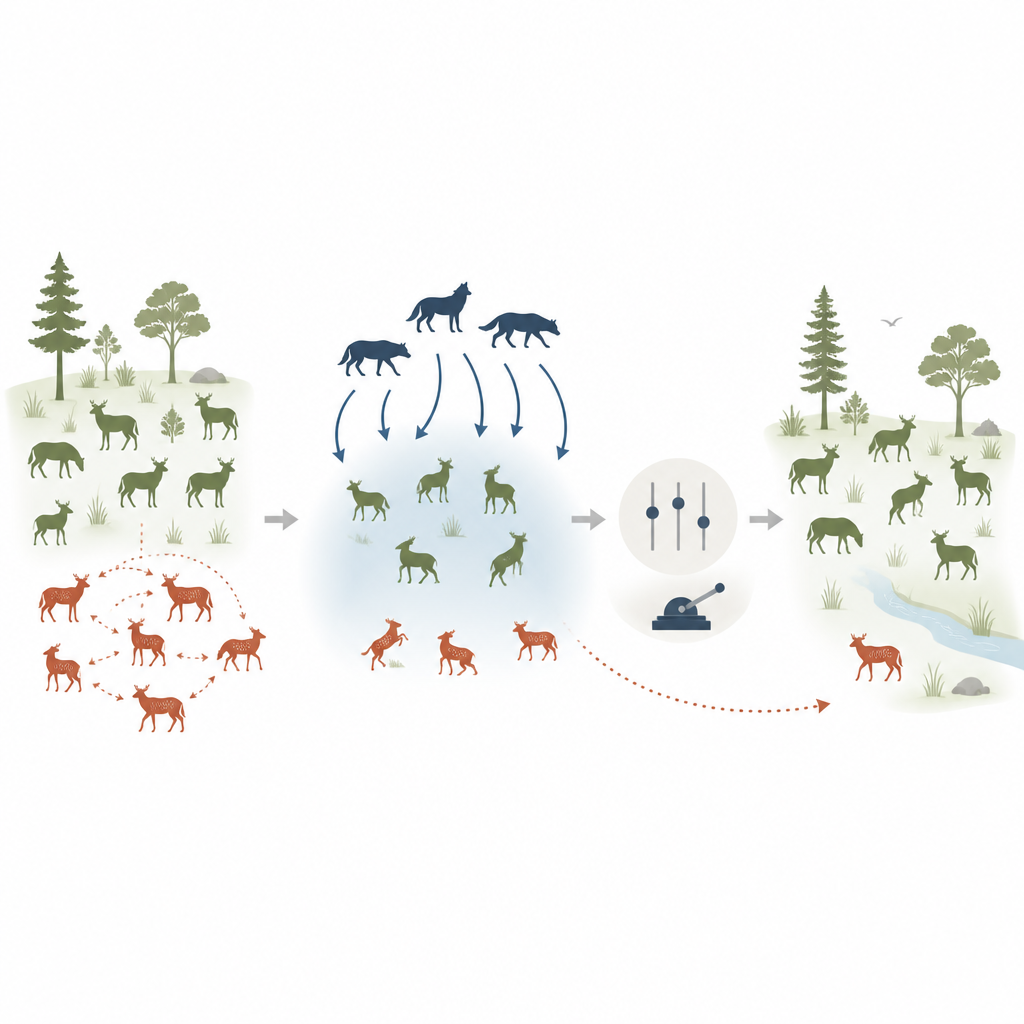
Predators, infection, and the hidden role of fear
The starting point is a food chain with three key players: healthy prey, infected prey, and predators. In many real systems, predators tend to target sick animals, and disease in the prey can spread through contact. Beyond actual attacks, however, the mere presence of predators can trigger fear, changing how prey behave. Frightened animals may eat less, reproduce less, or avoid open areas, which lowers birth rates and contact among individuals. The model captures all of these ideas by allowing prey growth to shrink when predators are common, while disease still passes within the prey population and predators continue to feed on both healthy and sick individuals.
Adding memory to population changes
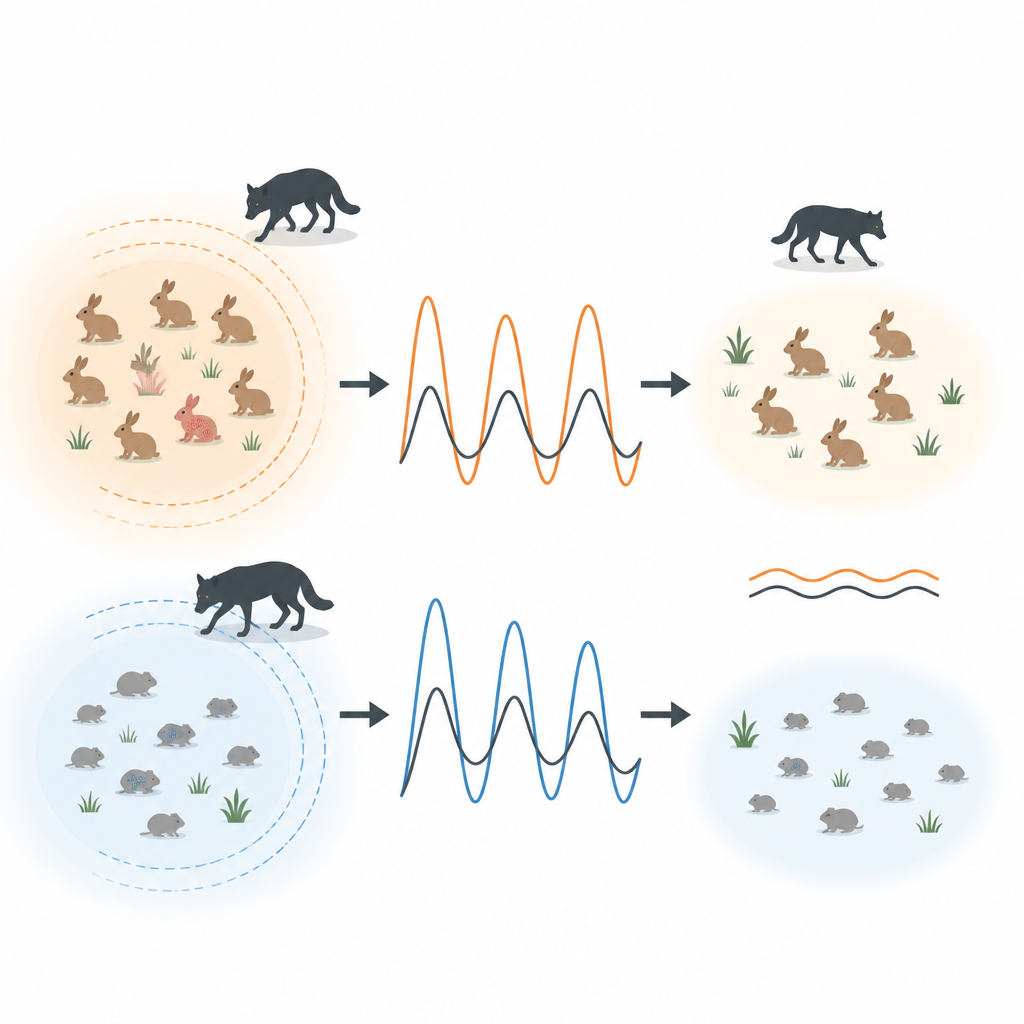
Classical population models assume that what happens at any moment depends only on current conditions. The authors instead use a fractional-order approach, which lets past states influence current changes. In practice, this means the system has memory: past population sizes and disease levels still matter, but their influence gradually fades. This framework is well suited to ecology, where factors like long-lived immunity, learned behavior, and slow environmental feedbacks create delayed responses. Mathematically, it alters the way growth, infection, and predation are combined, and it changes the rules for when a steady coexistence of species is stable or when it gives way to cycles and outbreaks.
When fear and memory steady the system
Using stability tools and numerical experiments, the authors show that fear and memory act together to restrain wild fluctuations. As the strength of fear increases, prey reproduce less, which lowers infection spread and reduces the food available for predators. This can prevent explosive cycles of booms and crashes, or even remove some coexistence states when fear is very strong. Meanwhile, decreasing the fractional order, which strengthens the role of memory, broadens the conditions under which populations settle to a steady state instead of oscillating. Simulations reveal smooth transitions: with no memory, the system can display large or even complex oscillations; with stronger memory, those oscillations shrink or vanish, leading to calmer dynamics.
Designing efficient ways to curb disease
The model is extended to include two kinds of human intervention: measures that reduce the chance of disease transmission, and measures that remove or treat infected prey. The authors frame this as an optimal control problem, which seeks strategies that keep infection low while minimizing the overall cost of action. They derive conditions that describe how to adjust control efforts over time, based on the evolving populations and a set of “shadow” variables that measure the future impact of present choices. Numerical tests show that when memory effects are included, infection peaks become smaller and the required interventions are milder and less expensive than in memory-free models.
What this means for managing wildlife disease
Overall, the study suggests that fear of predators and long-lasting ecological memory can stabilize predator–prey–disease systems and cut the cost of controlling infections. For wildlife managers and conservation planners, this means that natural behavioral responses and delayed ecological feedbacks may quietly support disease control efforts, if they are properly accounted for. While the work is theoretical, it offers a richer lens through which to think about real ecosystems, where stress, past disturbances, and carefully timed interventions together shape the health and stability of animal communities.
Citation: Alomari, F.A.H., Bahaa, G.M. Fractional-order analysis of a fear-induced ecoepidemiological predator–prey model with optimal control and bifurcation dynamics. Sci Rep 16, 16130 (2026). https://doi.org/10.1038/s41598-026-52826-8
Keywords: predator prey, ecoepidemiology, fractional calculus, optimal control, fear effect