Clear Sky Science · en
Interpretable and extrapolation-stable model for predicting nanofluid thermal conductivity
Why better cooling fluids matter
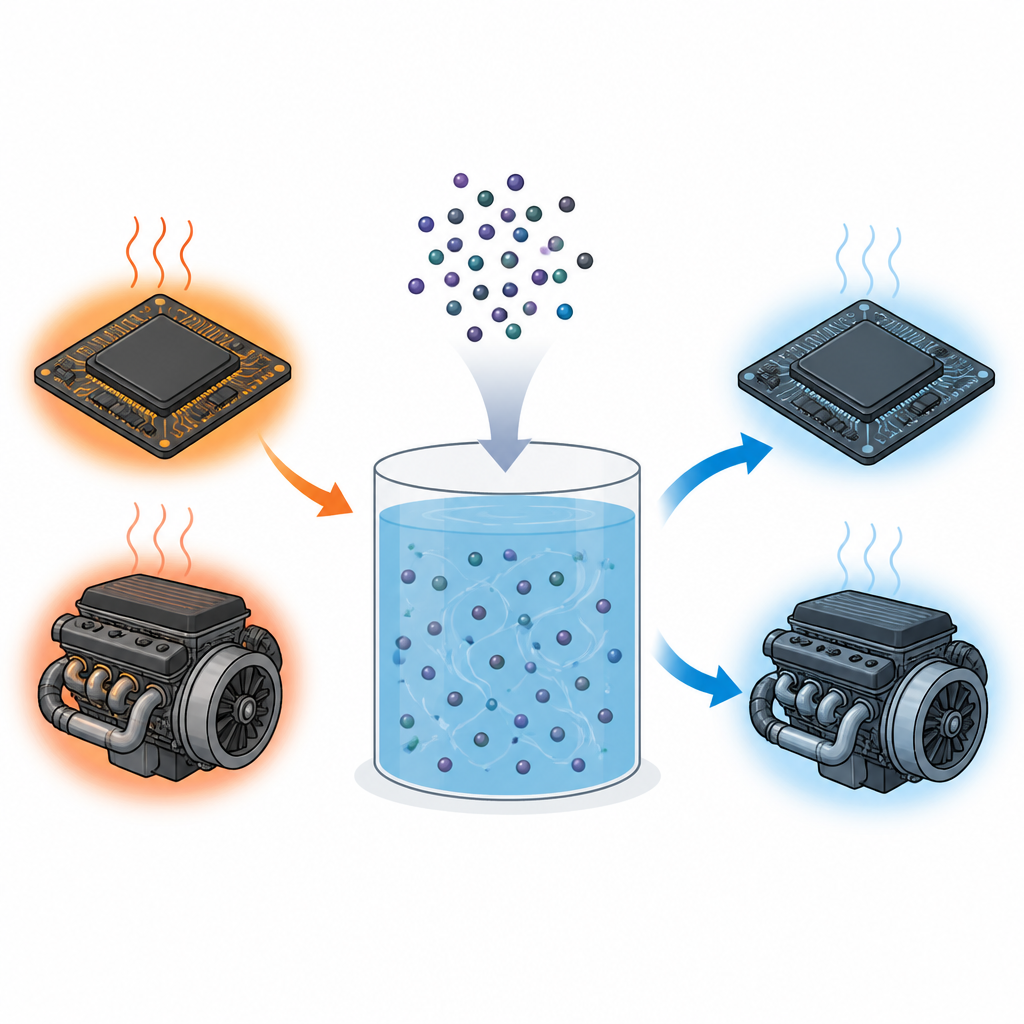
From smartphones and laptops to solar panels and electric cars, modern technology produces a lot of heat in very small spaces. Getting that heat out quickly is essential to keep devices safe, efficient, and long lasting. Engineers have discovered that adding tiny solid particles to ordinary liquids can boost their ability to carry heat, creating so called nanofluids. But predicting exactly how well a given nanofluid will conduct heat is tricky, especially when designers want models that are not only accurate but also easy to understand and trust.
What makes nanofluids special
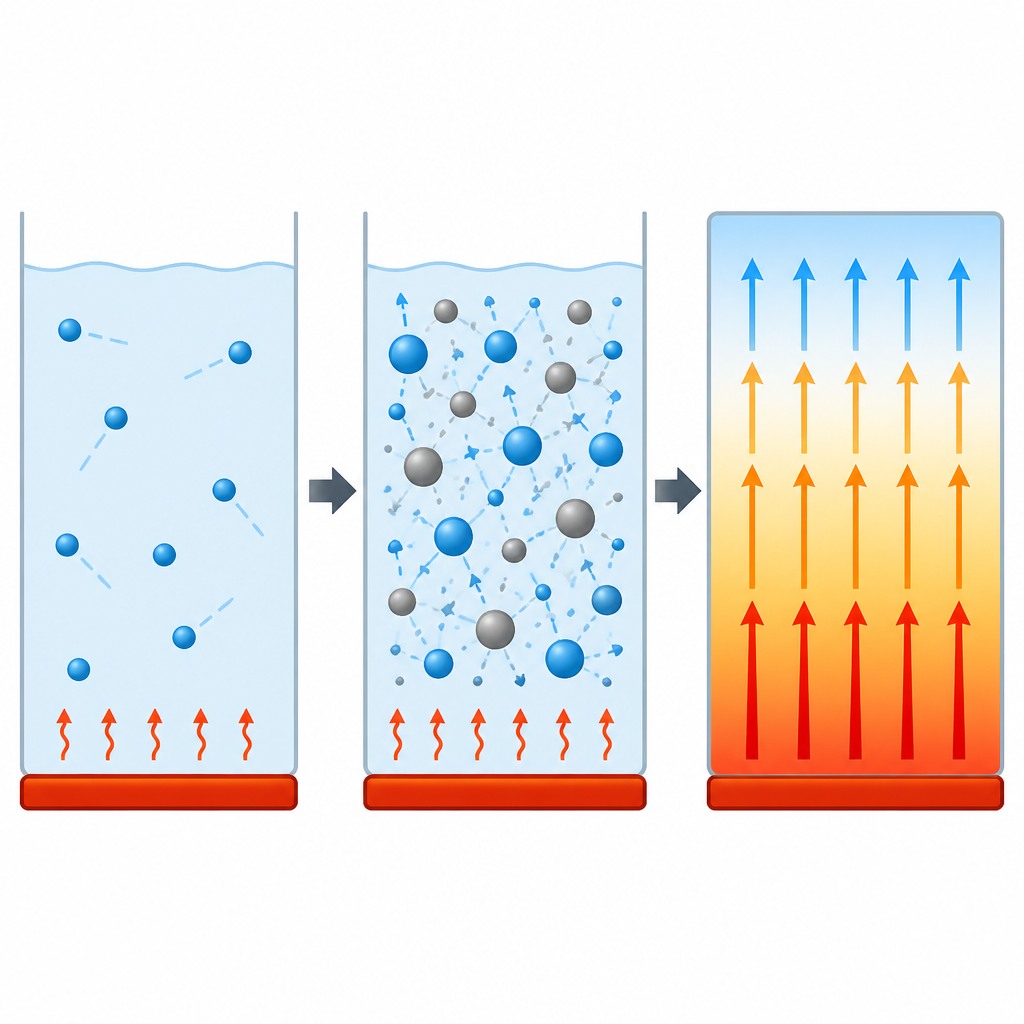
Nanofluids are made by dispersing particles only billionths of a meter in size into common liquids such as water, ethylene glycol, or transformer oil. Experiments show that their thermal conductivity, a measure of how well they move heat, depends on many intertwined factors. Temperature, how many particles are added, their size, and the type of base liquid all matter. Often, nanofluids conduct heat better than traditional formulas would suggest, hinting at subtle effects such as the jittery motion of particles and thin layers that form around them. Measuring all of this in the lab is slow and expensive, which is why researchers are turning to data driven models.
The problem with black boxes
Standard machine learning tools can fit the data very closely, uncovering hidden patterns between particle properties, fluid type, and temperature. Methods like neural networks, random forests, and boosting can reach impressive accuracy. However, they usually act as black boxes. They may give good numerical predictions but do not clearly show whether they respect basic physical behavior, such as the expectation that heat conduction should rise smoothly with temperature and particle loading. When engineers design critical cooling systems, they need models that not only fit past data but also behave sensibly when asked about new fluids and operating conditions.
A two step model that blends physics and learning
In this study the authors build a hybrid approach that combines a transparent statistical model with a more flexible machine learning stage. First, they reshape the raw data so that it focuses on how much the nanofluid improves conductivity compared with the plain base liquid. They also stabilize noisy measurements and use a separate algorithm to find and discard suspicious outliers. The first stage then uses smooth curves to capture broad trends: how conductivity gain varies with temperature, particle concentration, particle size, and an indicator of how conductive the base liquid is. This part is designed to follow known thermodynamic behavior and remains easy to inspect.
Letting data fine tune the details
Once the broad physical trends are fixed, a second stage machine learning model is trained only on the leftover errors. This learner is carefully kept simple and heavily regularized so that it cannot memorize each data point. Instead, it makes modest corrections in regions where the basic curves miss subtle effects, such as very high particle loadings or extremely small particle sizes. Tested against seven popular alternatives, this hybrid outperforms them all, achieving very low numerical error while still producing smooth, interpretable responses. Repeated cross checks and statistical tests show that the improvement is real and not a fluke of the dataset.
Trusting predictions for new fluids
A key challenge is whether a model trained on some base liquids can handle a new one. To test this, the authors repeatedly removed all data for one fluid, such as water, trained on the remaining fluids, and then asked the model to predict the missing case. The hybrid approach handled this demanding task far better than competing methods, especially for water, whose conductivity range differs markedly from oils and glycols. Even in this hardest test, its typical error stayed below the uncertainty of common laboratory instruments, suggesting that it captured genuine physical patterns rather than just memorizing the training set.
What this means for future cooling design
For engineers, this work offers a way to have both accuracy and insight when working with nanofluids. By separating broad, physics guided trends from local data driven corrections, the model provides reliable predictions of thermal conductivity while making clear how temperature, particle loading, and size shape the result. Its speed and stability make it suitable as a building block in design tools, optimization studies, and even real time control of cooling systems. More broadly, the study illustrates how blending physical reasoning with machine learning can help predict complex material properties in a form that scientists and engineers can understand and trust.
Citation: Zinhom, E., Radwan, S.S., Elmasry, A. et al. Interpretable and extrapolation-stable model for predicting nanofluid thermal conductivity. Sci Rep 16, 16134 (2026). https://doi.org/10.1038/s41598-026-52822-y
Keywords: nanofluid, thermal conductivity, machine learning, hybrid modeling, cooling fluids