Clear Sky Science · en
The effect of laser pulse on nonlinear thermoelasticity using an advanced analytical method
How laser heat reshapes solid materials
Lasers are now routine tools in electronics manufacturing, medical treatments, and precision machining, but a brief burst of light can send surprisingly complex waves of heat and stress racing through a solid. This article explores how a single laser pulse can warm, stretch, and stress a material in ways that depend sensitively on temperature, revealing patterns that matter for keeping devices and structures safe under extreme thermal conditions. 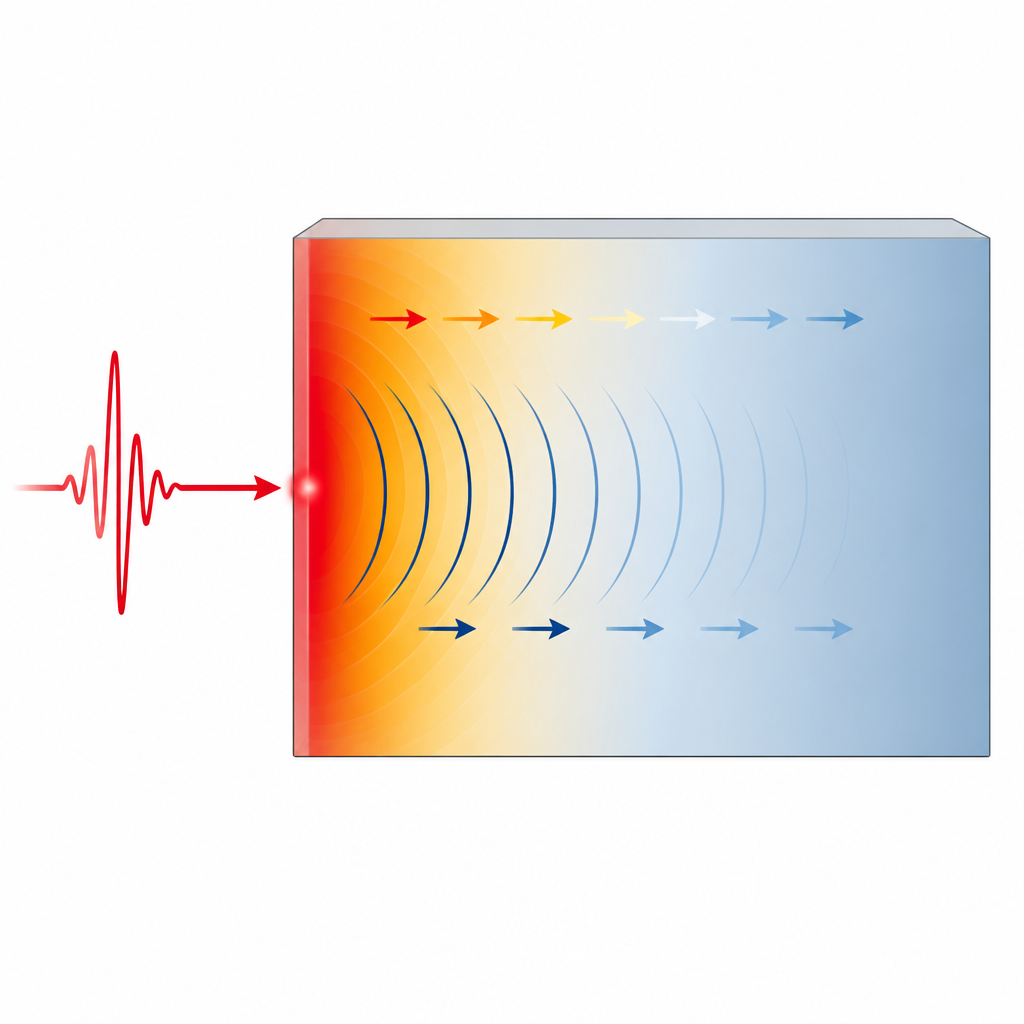
Why simple heat models fall short
Most familiar heat theories assume that warmth spreads instantly and smoothly, like ink diffusing in water. That picture works well for slow, gentle heating but breaks down when a powerful, short laser pulse hits a surface. In such fast events, heat behaves more like a wave with a finite speed than a slow seep. The authors base their work on the Green Naghdi Type II theory, a modern framework that treats heat as moving in undamped waves rather than fading away as it travels. This approach better reflects what happens in high tech settings such as microchips, laser surgery, and advanced aerospace components, where rapid temperature jumps are common and energy loss during the first moments is very small.
When material properties change with temperature
A key twist in this study is that the material is not assumed to stay the same as it heats up. In reality, quantities like stiffness, density, thermal expansion, and thermal conductivity all shift with temperature. As the laser warms the solid, these changes alter how heat and mechanical waves move, leading to a strongly nonlinear response. The authors show that this feedback can significantly boost local temperatures, slow or speed up wave fronts, and modify how stresses build up. Comparing models with and without temperature dependent properties, they find that treating properties as fixed can severely underestimate both temperature rise and deformation once the heating becomes moderate or intense, a critical point for predicting failure in hot environments.
Using advanced math to capture wave patterns
To unravel these intertwined thermal and mechanical effects, the researchers use an analytical technique called the Modified Extended Direct Algebraic method. Starting from the coupled equations that describe motion, heat flow, and the laser heat source, they simplify the problem by tracking waves that travel through the material at a constant speed. This reduces complex equations in space and time to a more manageable form. The MEDA method then provides families of exact wave solutions written in closed mathematical form, with adjustable constants that can represent different laser intensities, pulse durations, and material sensitivities. These solutions create a kind of catalog of possible behaviors, including sharply peaked pulses and localized dips in temperature and displacement that travel without changing shape.
What the wave shapes reveal
From these exact solutions, the authors identify several distinct wave patterns, often described as soliton like. Some appear as bright pulses where temperature and displacement surge above the background level, while others resemble dark pulses where they drop below it. The study presents graphical results for copper, showing how laser intensity, pulse length, and the strength of temperature sensitivity shape temperature profiles, displacements, and internal stresses over distance and time. 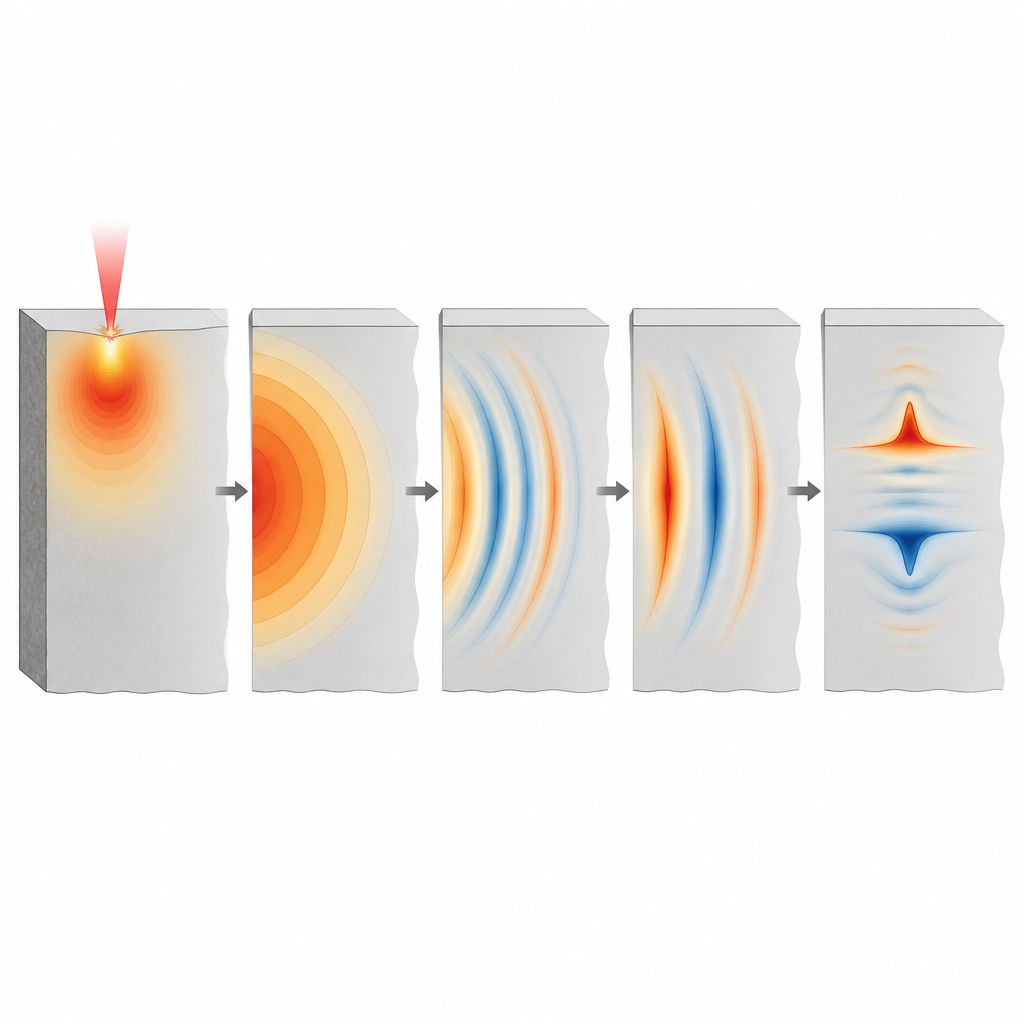
Why these findings matter
For a lay reader, the main message is that a laser pulse does far more than simply heat a material. It launches waves of temperature and motion whose behavior is tightly controlled by how the material softens or expands as it gets hot. By deriving exact wave patterns within a realistic heat wave model, this study provides a precise toolbox for predicting those responses. Such understanding can guide the design of safer microelectronic devices, more reliable laser based manufacturing processes, and robust protective structures exposed to sudden thermal shocks, helping engineers anticipate where and when damaging stresses are likely to arise.
Citation: Rabie, W.B., Ahmed, H.M., Ismail, M.F. et al. The effect of laser pulse on nonlinear thermoelasticity using an advanced analytical method. Sci Rep 16, 15488 (2026). https://doi.org/10.1038/s41598-026-52771-6
Keywords: laser pulse heating, thermoelastic waves, temperature dependent materials, non Fourier heat conduction, soliton solutions