Clear Sky Science · en
Integrated torrefaction-anaerobic digestion of bamboo waste for enhanced energy recovery: process optimization, product characterization, and techno-economic evaluation
Turning leftover bamboo into useful energy
Bamboo is one of the fastest growing plants on Earth, and industries that use it for furniture, flooring, and crafts create huge heaps of offcuts and shavings. Much of this material is wasted or burned in simple ways that lose most of its energy value. This study asks a practical question: can we turn bamboo leftovers into clean, usable fuels in a way that fits local economies, cuts climate pollution, and makes business sense?
From plant scraps to coal like fuel
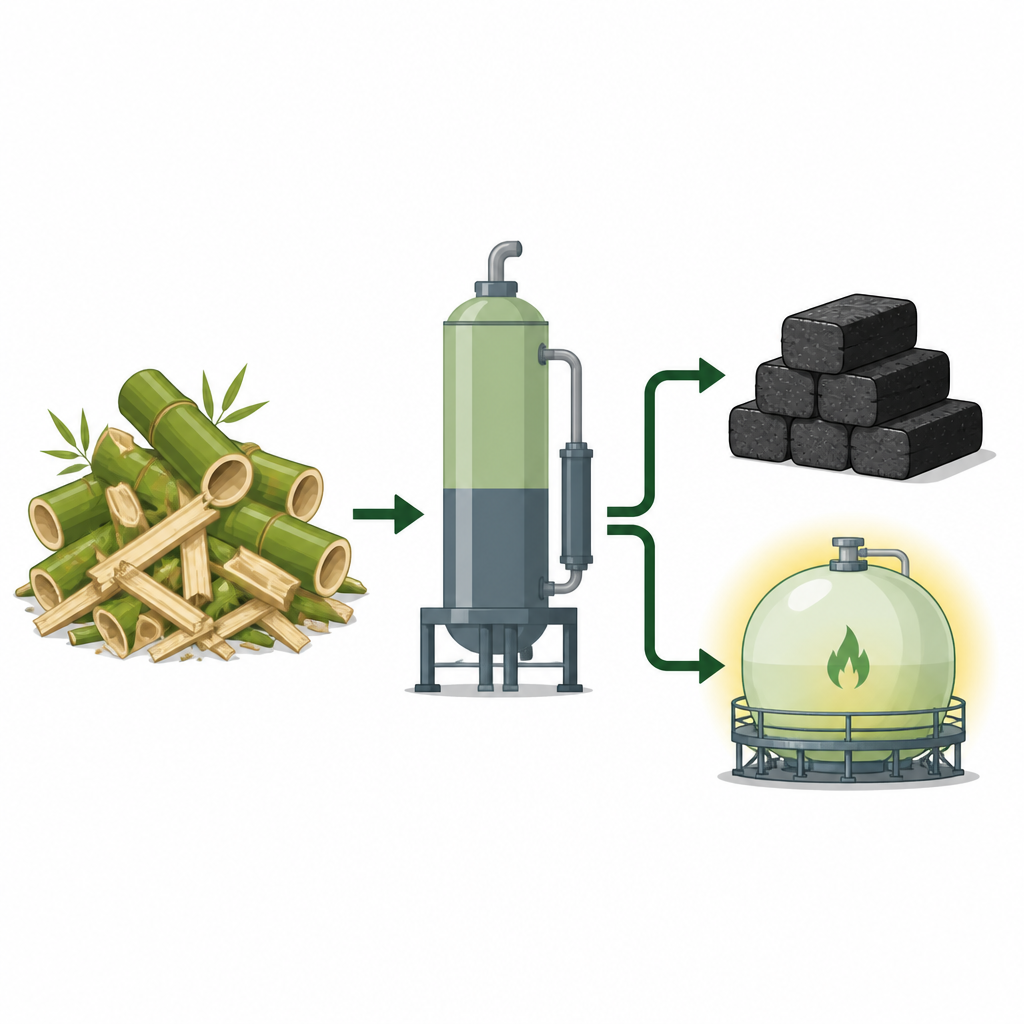
The researchers focused on a heat treatment called torrefaction, which gently "roasts" dried bamboo in the absence of air at around the temperature of a hot pizza oven. Under the best conditions they tested, the process concentrated the energy in the solid part of the bamboo, creating a dark, crumbly material known as bio coal. Compared with untreated bamboo, this bio coal contained much more carbon, much less moisture and volatile material, and burned with a higher energy content similar to low grade coal. Because bamboo naturally has low ash and low mineral content, the resulting fuel is cleaner and less likely to cause clogs and deposits in boilers than common crop residues such as rice husks and straw.
Making use of the overlooked liquid stream
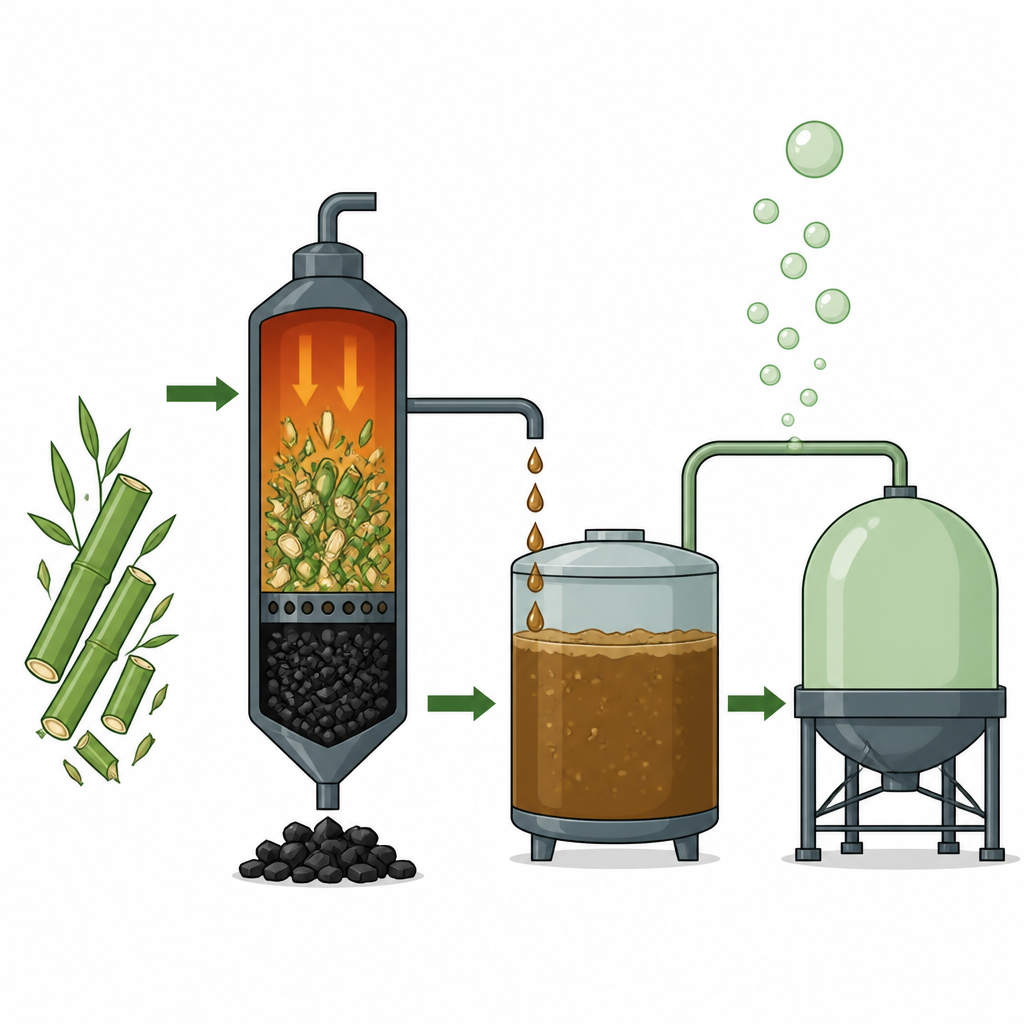
Heating bamboo does not just leave behind a solid fuel; it also drives out vapors that cool into a watery liquid called condensate. In many systems this liquid is treated as waste because it is acidic and complex. The team carefully measured what was in this bamboo derived condensate and found that it was rich in simple organic acids such as acetic and lactic acid, with relatively low levels of compounds that can harm microbes. They then fed this liquid to an anaerobic digester, a sealed tank where microbes break down organics without oxygen and release methane rich biogas. Under controlled conditions, the condensate produced a high methane yield, showing that this often ignored stream can serve as a second energy product rather than a disposal problem.
How the two step system boosts total energy
By combining torrefaction for the solid fraction and digestion for the liquid fraction, the study built a dual stream pathway that captures energy that would otherwise be lost. Detailed measurements of material flows and energy content showed that one ton of bamboo waste could deliver about 21 gigajoules of usable energy through both bio coal and biomethane. This is more than what the same integrated setup provides when fed with rice husk or rice straw under identical conditions, and it clearly outperforms using torrefaction, pyrolysis, or gasification alone. The work also showed that the trace minerals remaining in the bamboo bio coal are evenly spread and relatively low in troublesome elements, helping the fuel burn more uniformly and cleanly.
Testing whether the idea pays off
To see if this approach could work outside the lab, the authors designed a model facility in India that would handle fifty thousand tons of bamboo waste per year, a scale suited to bamboo rich regions. Using real experimental data for yields and energy content, they estimated the costs of equipment, operation, and labor, along with income from selling solid fuel, biomethane, and recovered heat. Their calculations suggest that such a plant could recover its investment in about six and a half years and earn a return that compares well with other renewable energy projects. The system also lends itself to decentralized setups, located close to where bamboo waste is generated, which helps cut transport needs and supply risks.
What this means for everyday life and climate
For non specialists, the takeaway is straightforward: if we handle bamboo leftovers wisely, they can become a steady source of cleaner energy instead of a disposal headache. The study shows that by pairing a roasting step that makes solid fuel with a digestion step that turns the leftover liquid into gas, almost the entire bamboo residue can be used. This makes better use of local resources, can support rural industries with extra income and energy, and fits with national and global goals to reduce greenhouse gas emissions and waste. While further work is needed on environmental impacts and large scale operation, the findings point toward practical bamboo based energy hubs that serve both people and the planet.
Citation: Kachroo, H., Doddapaneni, T.R.K.C., Kaushal, P. et al. Integrated torrefaction-anaerobic digestion of bamboo waste for enhanced energy recovery: process optimization, product characterization, and techno-economic evaluation. Sci Rep 16, 15878 (2026). https://doi.org/10.1038/s41598-026-52760-9
Keywords: bamboo bioenergy, bio coal, anaerobic digestion, circular bioeconomy, biomethane