Clear Sky Science · en
Myco-synthesized copper oxide nanoparticles as a sustainable bionanofungicide for managing Fusarium falciforme and enhancing potato productivity
Why this matters for everyday food
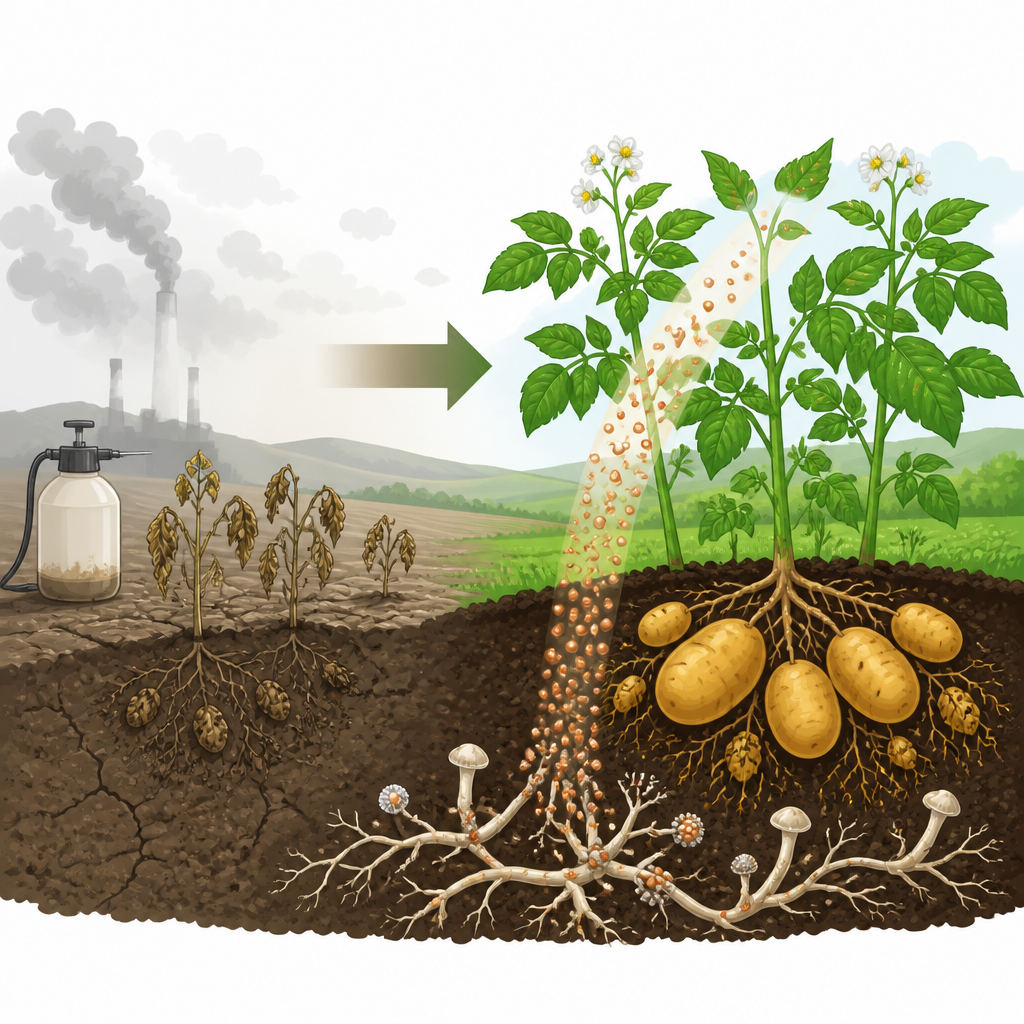
Potatoes are a key part of diets around the world, but hidden fungal infections in the soil and in storage can quietly destroy much of the harvest. Farmers often rely on chemical fungicides to keep these diseases at bay, but those chemicals can build up in the environment and lose power as fungi evolve resistance. This study explores a cleaner option that uses helpful fungi to make tiny copper particles which both protect potatoes from a serious disease and help the plants grow better.
A quiet threat beneath the soil
One of the most damaging potato diseases is dry rot, caused by a group of Fusarium fungi that attack plants in the field and tubers in storage. Infected potatoes can lose up to half their marketable yield and suffer changes in starch and sugar content that reduce quality. The researchers focused on Fusarium falciforme, a soil fungus that infects roots and tubers. Standard control relies on synthetic fungicides and copper salts, but these tools are increasingly limited by resistant strains and environmental concerns, raising demand for safer ways to protect this staple crop.
Turning friendly fungi into tiny copper factories
Instead of using harsh chemicals to make metal particles, the team collected common soil fungi from vegetable fields in Egypt and asked them to do the manufacturing. They grew these fungi in liquid culture, separated either the living filaments or the broth they had released molecules into, and then mixed this biological material with a copper salt solution. Over several days a dark solid formed, which detailed tests showed was copper oxide in the form of very small, mostly spherical particles around 11 nanometers across. Microscopy and surface charge measurements confirmed that the fungal molecules helped shape and stabilize these particles in water.
Putting the nano shield to the fungal test
The next step was to see whether these myco made copper particles could stop Fusarium falciforme. In petri dish tests, potato fungal colonies grew more slowly when the medium contained the nanoparticles, with growth reduced by about one third at the chosen dose. At the same copper level, a standard copper salt barely slowed the fungus, while a commercial fungicide had the strongest effect but raised worries about plant side effects. Based on a range of test doses, the researchers selected 200 milligrams per liter of nanoparticles as a sweet spot that curbed the fungus without harming plants.
Helping sick and healthy potato plants thrive
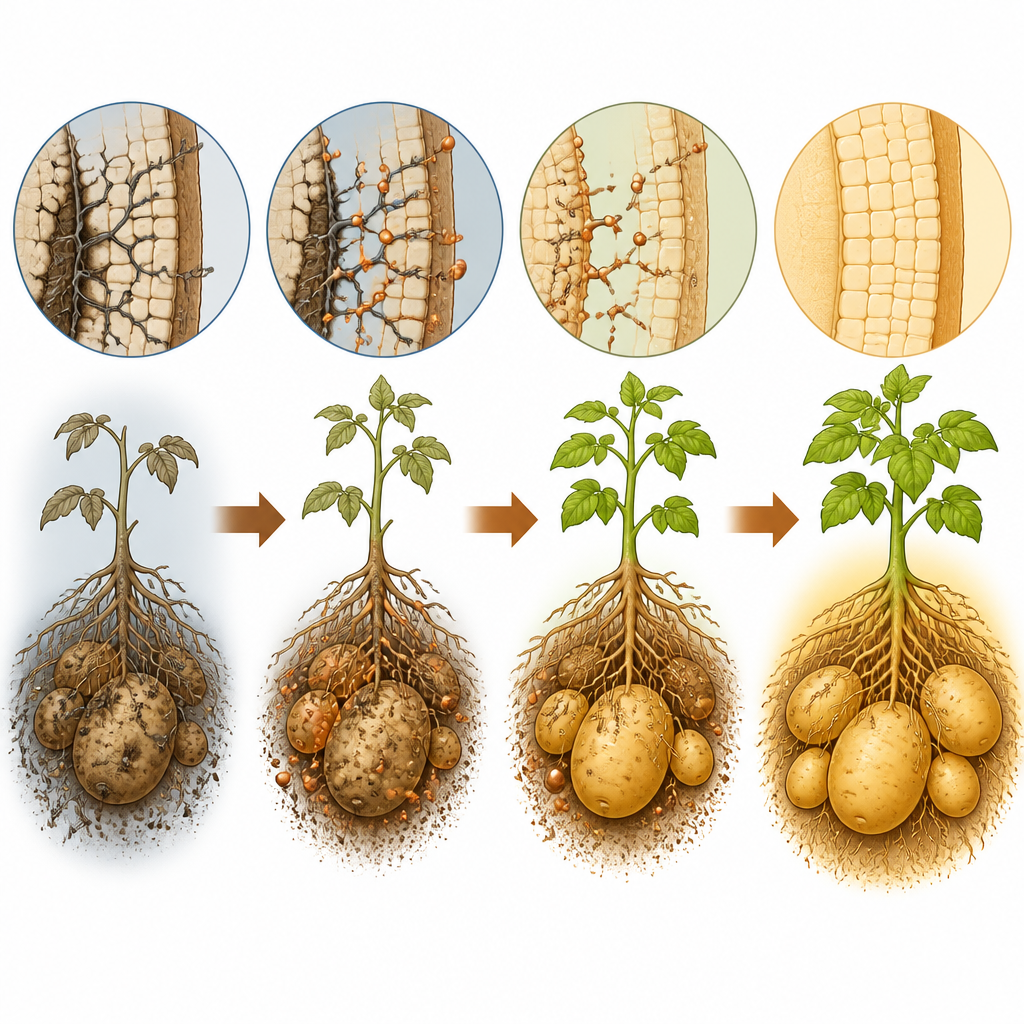
To see how this played out in a more realistic setting, the researchers grew potatoes in pots of soil either left clean or deliberately infested with Fusarium falciforme. Seed tubers and later the leaves received sprays of water, bulk copper salt, commercial fungicide, or the myco made nanoparticles. Infection alone shortened shoots, reduced leaf area, and cut tuber number and weight. Sprays of the copper nanoparticles helped infected plants recover much of their lost growth, improved chlorophyll levels in the leaves, and adjusted the mix of sugars, proteins, and natural antioxidant systems in a way that suggested lower stress. Importantly, in healthy plants without disease, the nanoparticles still boosted shoot growth and leaf area.
More potatoes from the same plant
Yield at harvest is the clearest measure for farmers. In clean soil, plants sprayed with the fungal made copper nanoparticles produced about 20 percent more tubers and 40 percent more fresh tuber weight than untreated plants. Under infection, the same treatment not only prevented losses but pushed yield above that of healthy controls. Bulk copper salt gave only modest gains, while the commercial fungicide increased tuber weight but sharply reduced tuber number in healthy plants, hinting at harm to normal tuber formation. The nano form, in contrast, acted like a combined gentle medicine and nutrient source.
What this means for the future of crop care
For non specialists, the key message is that tiny copper oxide particles grown by friendly soil fungi can both fight a damaging potato disease and help plants grow and yield more, while avoiding some of the drawbacks of standard chemicals. By working at very small scales, these particles deliver copper in a form that stresses the pathogen more than the plant and supports the plant's own defense and growth systems. The study suggests that such bio made nanoparticles could become part of a more sustainable toolkit for farmers, reducing dependence on traditional fungicides while helping secure a vital global food crop.
Citation: Ahmed, R.U., Abou-Zeid, A.M., Ahmed, A.I. et al. Myco-synthesized copper oxide nanoparticles as a sustainable bionanofungicide for managing Fusarium falciforme and enhancing potato productivity. Sci Rep 16, 16128 (2026). https://doi.org/10.1038/s41598-026-52727-w
Keywords: potato disease, copper nanoparticles, Fusarium dry rot, sustainable agriculture, biological control