Clear Sky Science · en
Evidence from multifeature whole-report in visual short-term memory suggests that not all misbinding is swapping
Why our memories mix things up
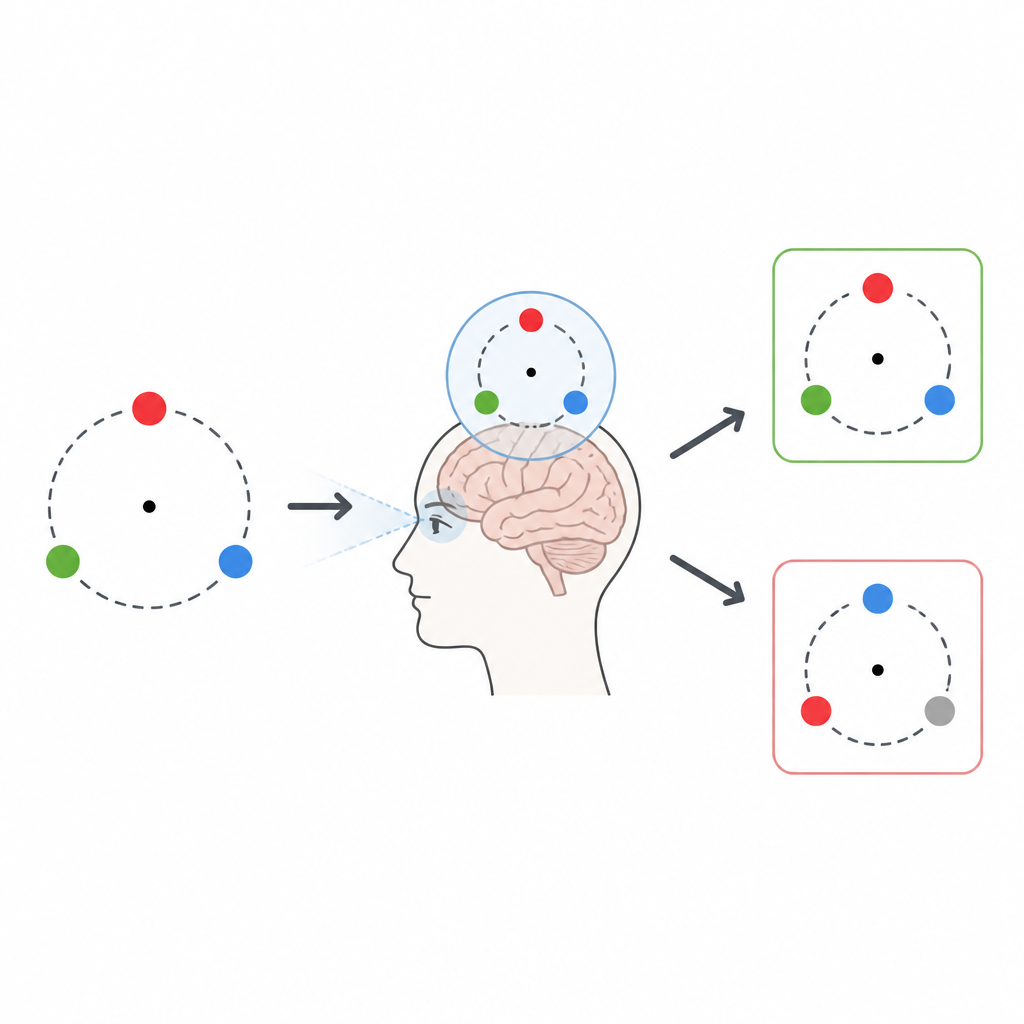
We all know the feeling of remembering the right details in the wrong place, like recalling a friend’s story but assigning it to the wrong person. This study looks at a similar problem in visual short term memory: how our minds keep track of what feature belongs to which object. By teasing apart different kinds of mix ups, the researchers show that not all memory mistakes are simple swaps, revealing a more nuanced picture of how our brains hold on to visual scenes.
How the study tested memory mix ups
The researchers asked volunteers to remember small displays of three colored dots placed around an invisible circle. After a brief pause, people had to reproduce both the color and the location of every dot, often without any hint about where to start. Sometimes they began by choosing a location and then a color for it, and sometimes they did the reverse. In one experiment, all three dots appeared at once; in another, they appeared one after another. This set up let the team inspect every reported color and position, not just one feature at a time, and see exactly how the remembered scene differed from the original.
Looking inside memory errors
Past research often used “cued recall,” where people were shown one part of an object (for example its location) and asked to report another part (its color). When they answered with a color belonging to a different dot, it was labeled a “misbinding” and treated as if two objects had swapped features. But this method could not reveal what happened to the unprobed dots or to the missing feature of the probed one. Was there a true swap between two objects, or did one feature simply vanish and get replaced by a guess or by a feature from another object? To answer this, the authors built a detailed statistical model that considers all three objects at once and all the ways a response could arise: as a correct report, a clean swap, or a partial mix up that includes forgetting.
Two kinds of mix ups in visual memory
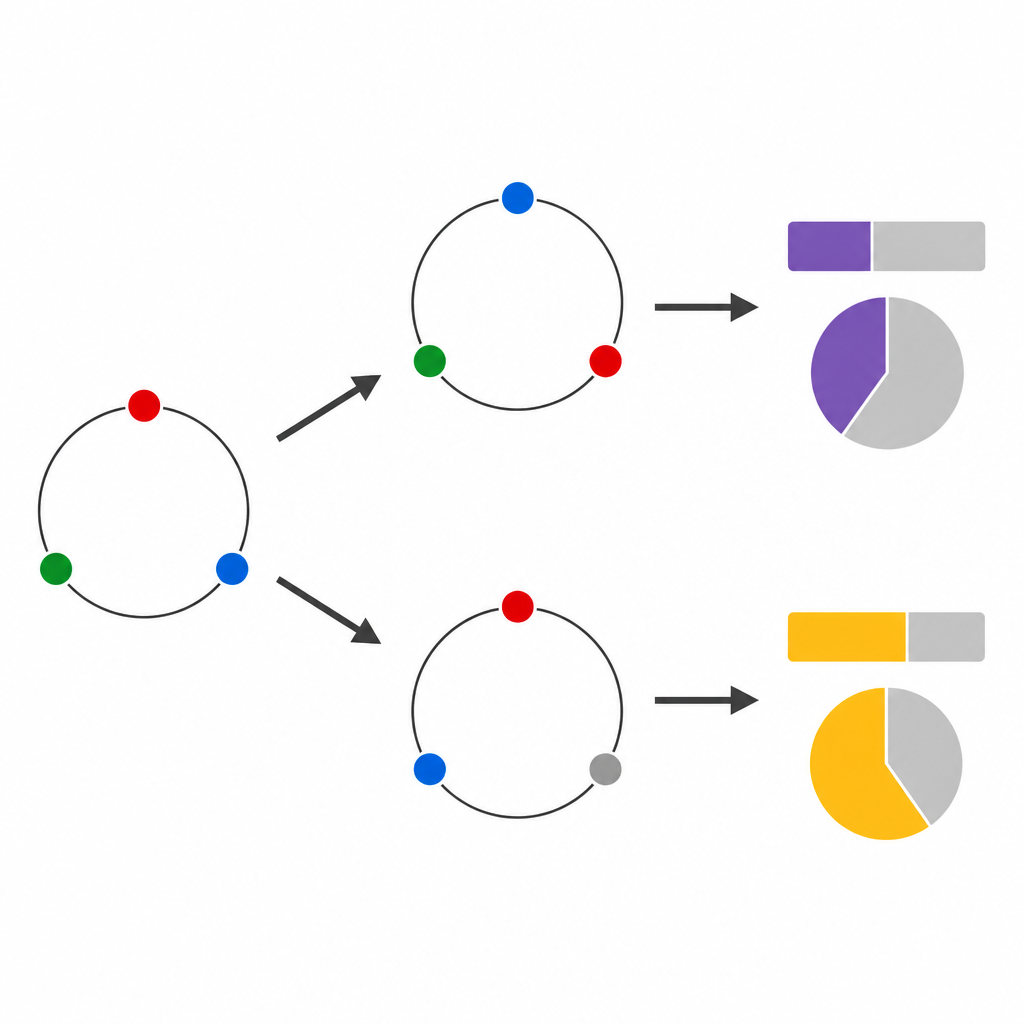
Using their “multifeature whole report” task and Bayesian model, the team found strong evidence that misbinding is not a single phenomenon. Some errors were symmetric swaps, where two objects really did trade a feature, such as two colors exchanging positions. Others were asymmetric misattributions: a feature from one object appeared in the wrong place, while the correct feature for that place was missing and effectively guessed. Across trials where any swap-like error occurred, almost half were of this asymmetric type. The pattern also depended on how people responded. When participants reported locations first and colors second, true swaps were more frequent; when they reported colors first, asymmetric mix ups that involved forgetting were more common. This points to a special role for spatial position in anchoring other features in memory.
Timing of what we see also matters
The way the dots were shown shaped the errors too. When all three dots appeared at the same time, people were more likely to make asymmetric misattributions that involved losing all features of one object. Presenting the dots one after another improved how precisely colors and locations were remembered overall, even though the mix of error types stayed broadly similar. The study also found that people who tended to guess entire objects more often also showed more swap-like errors, hinting that general memory weakness and binding mistakes may be linked. Standard cue based tests, which only look at one feature per trial, tended to overestimate how often pure swapping really happens.
What this means for everyday memory
To a lay observer, it might seem that when we misremember, we simply confuse items with each other. This work shows that our visual short term memory is more fragile and more intricate than a simple swap story suggests. Sometimes features are indeed exchanged, but just as often one feature is lost and a stand in is pulled from elsewhere in the scene or from guessing. Knowing that many errors reflect one sided mix ups, especially when items appear together or when we recall color before place, will help refine theories of how the brain binds features into objects and may guide future studies of memory problems in health and disease.
Citation: Tabi, Y.A., Husain, M. & Manohar, S. Evidence from multifeature whole-report in visual short-term memory suggests that not all misbinding is swapping. Sci Rep 16, 16012 (2026). https://doi.org/10.1038/s41598-026-52649-7
Keywords: visual short term memory, feature binding, memory errors, misbinding, cognitive neuroscience