Clear Sky Science · en
Study the removal of copper ions from wastewater using an array of horizontal rough vibrating zinc discs
Why cleaning copper from water matters
Heavy metals in wastewater do not break down and can build up in rivers, soil, and living things. Copper is widely used in electronics, plumbing, and industry, so it often ends up in factory effluents and even household water. Turning that pollution back into useful metal instead of throwing it away is attractive for both the environment and the economy. This study explores a practical way to strip copper from water using vibrating zinc discs, aiming to make treatment systems faster, more compact, and more energy efficient.
A simple metal swap to clean water
The process at the heart of this work is called cementation, a kind of metal swap. When copper rich water touches zinc metal, copper ions in the water are converted into solid copper that coats the zinc, while some zinc dissolves into the water. This reaction is controlled mainly by how quickly copper ions can reach the zinc surface through the surrounding liquid. The researchers focused on making that journey as fast as possible by improving how the water flows around the metal, rather than by using complicated chemicals or high voltages.
Vibrating discs that stir without blades
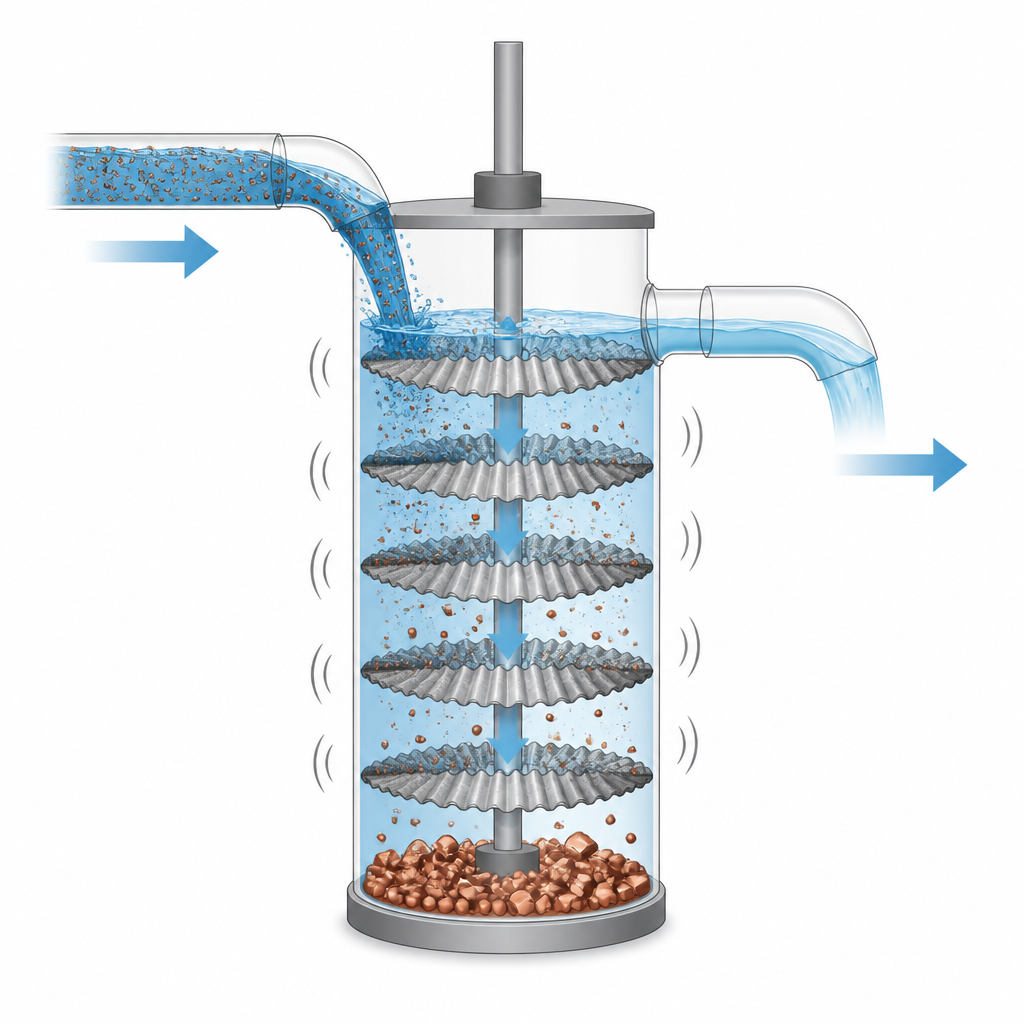
To do this, the team built a transparent cylinder holding a vertical stack of flat zinc discs that move up and down. They compared smooth discs with rough ones that have regular grooves, like a corrugated surface. By adjusting how fast the discs vibrated, how far they moved each cycle, how far apart the discs were spaced, and the temperature of the solution, they measured how quickly copper disappeared from the water. Careful sampling and chemical analysis over time showed that the removal followed a simple, predictable pattern in which the rate depended on how rapidly copper ions could be transported through a thin liquid layer next to the metal surface.
How roughness and motion boost copper removal
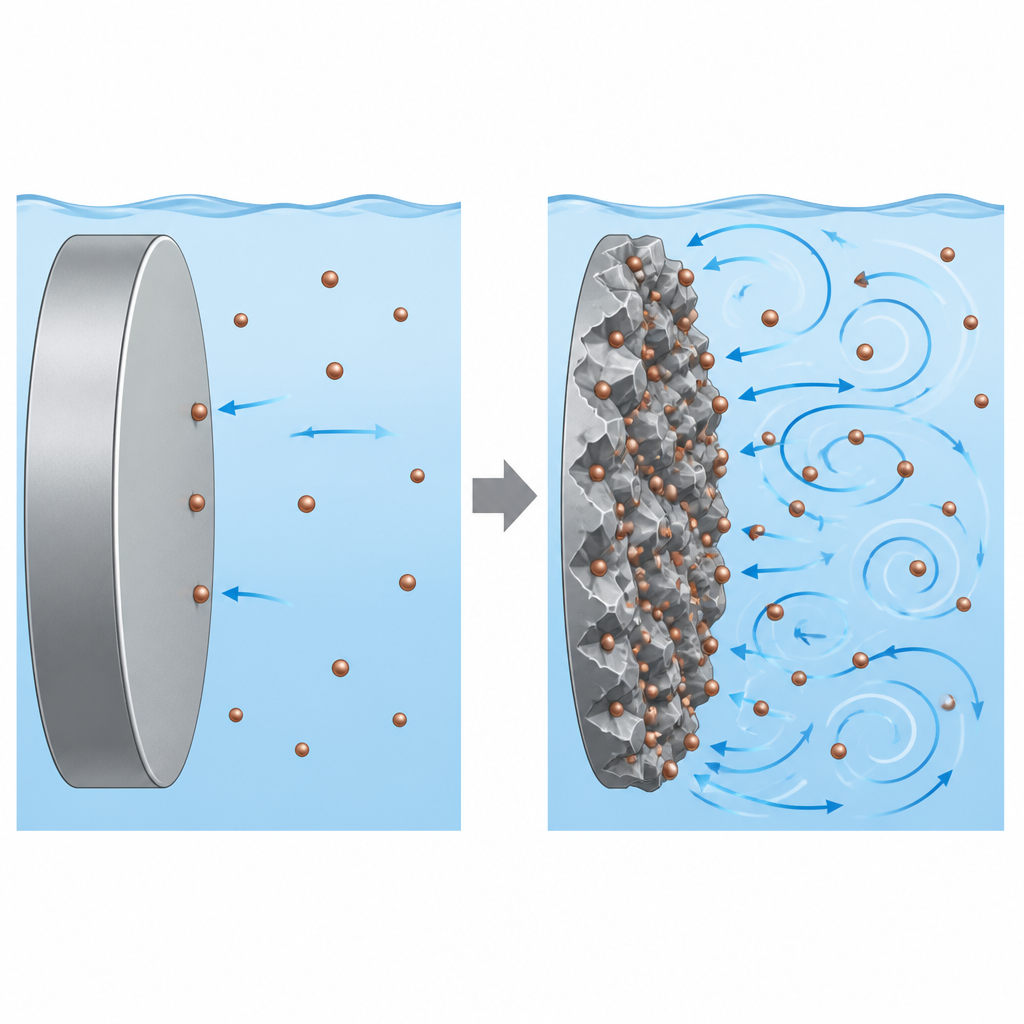
The experiments revealed several ways that motion and surface texture work together. Stronger vibration, larger movement of the discs, and higher starting copper levels all increased the rate at which copper deposited onto zinc. As the discs moved, they created circulating flows and swirling eddies, especially near the disc edges, that constantly swept fresh solution to the surface and thinned the stagnant layer that slows transport. Spacing the discs farther apart allowed these flows to develop more fully and prevented local copper depletion between discs. Adding controlled roughness to the zinc discs had an even stronger effect: the peaks and valleys on the surface created micro scale whirls and increased the actual contact area, leading to copper transfer rates nearly two to three times higher than with smooth discs, up to a point where making the surface rougher gave little extra gain.
Design rules for real world reactors
Beyond observing trends, the researchers translated their measurements into compact design rules expressed with dimensionless numbers that engineers commonly use. These rules link the copper transfer rate to the strength of the liquid motion, the properties of the solution, the distance between discs, and the height of the surface corrugations. They confirmed that the process behaves as a diffusion controlled system, with a low activation energy and a clear dependence on temperature mainly through changes in liquid thickness and ion mobility. When compared with earlier cementation devices using other zinc shapes or rotating parts, the vibrating rough discs delivered higher transfer rates per unit volume while using motion that can be easier and cheaper to supply.
From lab column to cleaner industry water
In practical terms, this work shows that stacks of vibrating, grooved zinc discs can strip copper from wastewater quickly while turning it back into metal that can be reused. The study highlights how controlling simple physical features such as vibration strength, disc spacing, and surface roughness can make a big difference to performance. Because the authors provide clear design correlations, their results can help scale up from small laboratory setups to industrial units that occupy little floor space yet handle large flows. This approach offers a route to cleaner discharges, recovery of valuable copper, and better use of energy in treatment plants.
Citation: Tafeh, S.E., Nosier, S.A., Sedahmed, G.H. et al. Study the removal of copper ions from wastewater using an array of horizontal rough vibrating zinc discs. Sci Rep 16, 15712 (2026). https://doi.org/10.1038/s41598-026-52620-6
Keywords: copper removal, wastewater treatment, zinc cementation, surface roughness, mass transfer