Clear Sky Science · en
Objective-function-guided automated VMAT planning reduces OAR dose, low-dose exposure, and inter-planner variability in breast radiotherapy
Safer radiation for breast cancer treatment
Women treated with radiation for breast cancer want the tumor controlled while the rest of the body stays as safe as possible. This study explores whether computer-guided planning can shape radiation more carefully around the breast, lowering exposure to the heart, lungs, and the other breast without sacrificing cancer control. The work matters because even small dose reductions to healthy organs may translate into fewer long-term side effects years after treatment.
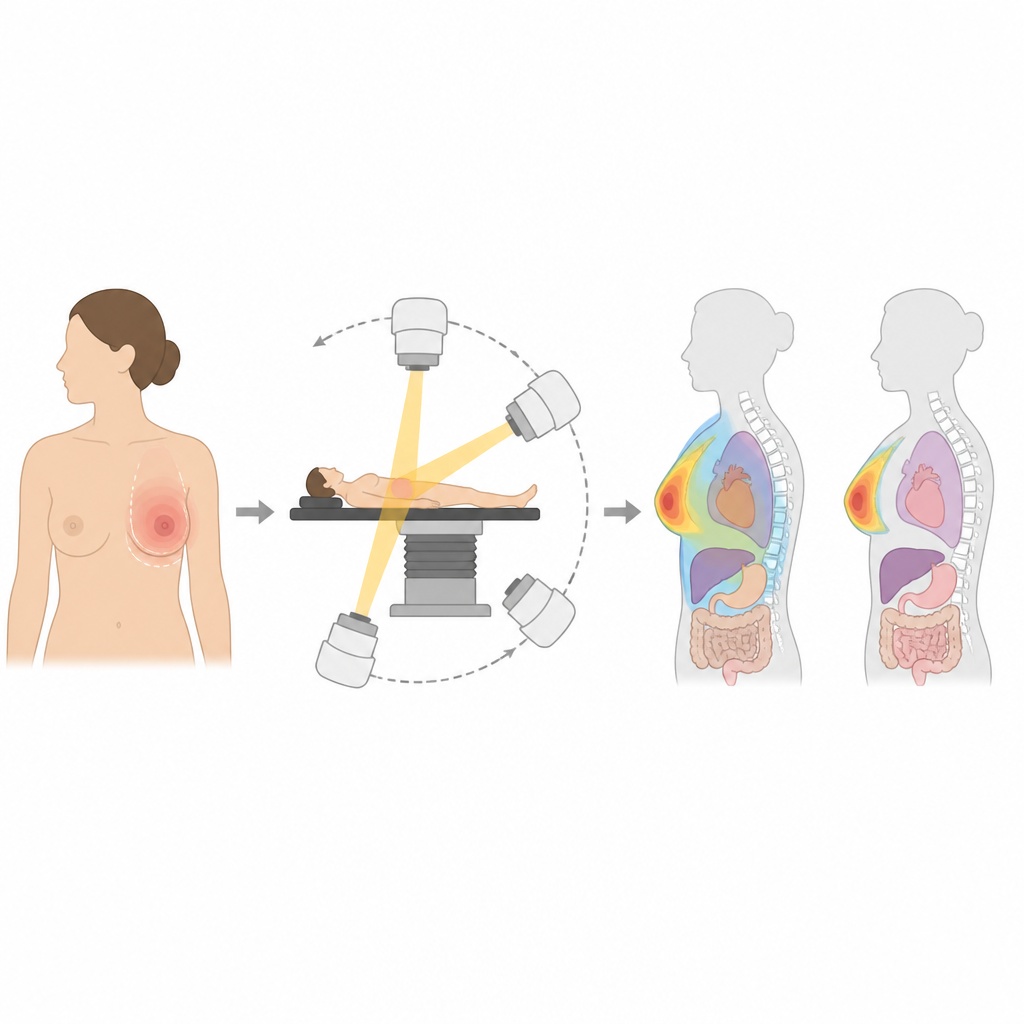
Old and new ways to aim the radiation
For many years, most women received breast radiation with two simple beams that skim along the chest. This tried-and-true method is reliable and uses relatively little radiation scatter, but it can be less flexible when the anatomy is complex. Newer machines can rotate around the patient and continuously adjust the beam while moving, a method called arc therapy. These modern plans often protect some organs better and shorten treatment time, but they can also bathe a larger portion of the body in low doses of radiation, which may slightly raise the risk of second cancers.
Letting software fine tune every plan
Human planners usually follow internal rules when designing arc therapy plans. Once basic dose limits are met, they stop adjusting, which may leave room for further improvement. In this study, the researchers built a Python script that talks directly to a commercial planning system. Instead of relying on a planner’s experience alone, the program watches a mathematical score that balances how well the breast is treated against how much radiation nearby organs receive. It then automatically tightens or relaxes limits on those organs in small steps, reruns the optimization several times, and stops only when further sparing would start to harm coverage of the breast.
Testing the method in real patient cases
The team first explored how this score behaves using ten test patients to find a sweet spot where organs can be spared without underdosing the breast. They then applied the automated procedure to 20 women previously treated with standard arc therapy. Every automated plan used the same beam setup and prescription dose as the original clinical plan, allowing a fair head-to-head comparison. The key question was whether the computer-guided plans could lower doses to the heart, lungs, and opposite breast while keeping the cancer target just as well covered.
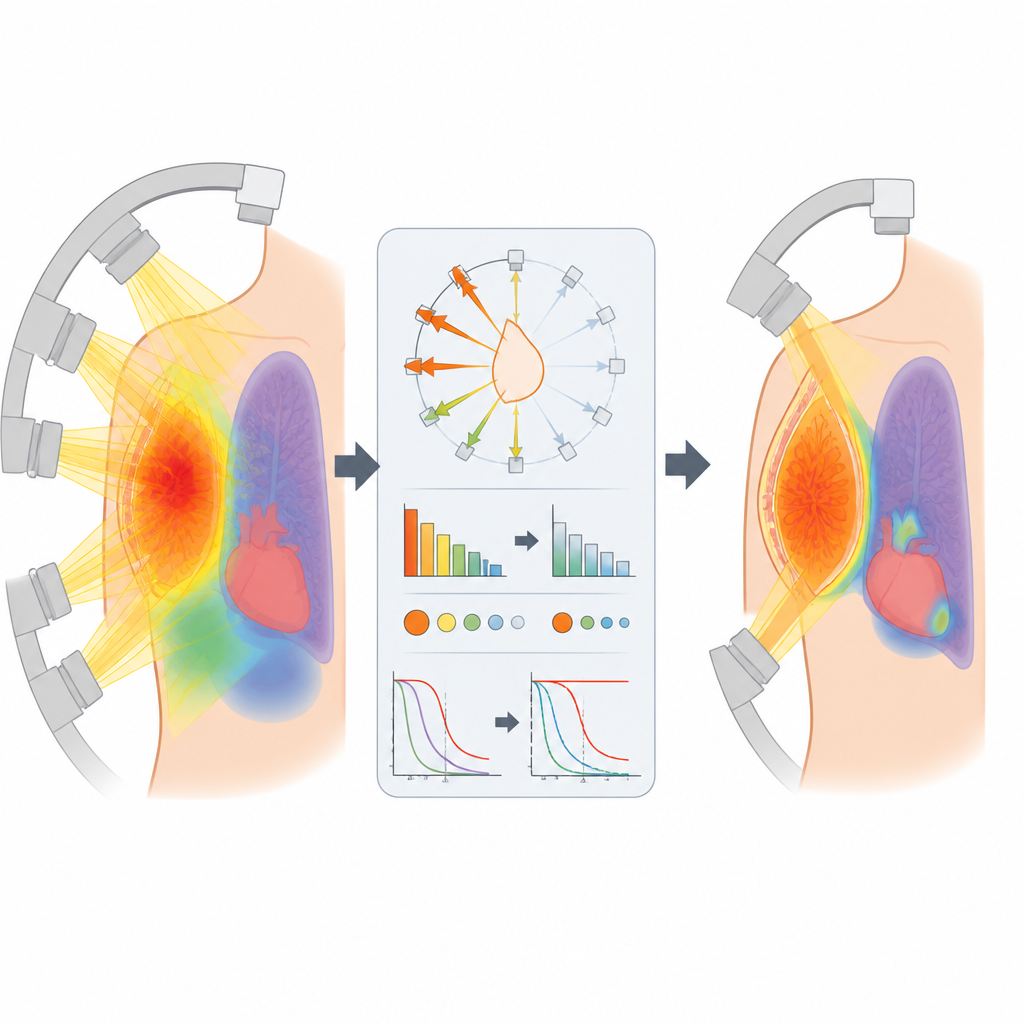
What changed for the heart, lungs, and other breast
The automated plans consistently cut radiation to healthy tissues. On average, the heart dose dropped by about one quarter to one third, and low-dose exposure to both lungs and the opposite breast shrank sharply, especially in the very low-dose range that is thought to be linked with second cancer risk. At the same time, coverage of the breast stayed essentially the same, and the pattern of dose inside the target remained uniform. The algorithm achieved this by favoring beam directions that run tangentially along the chest and “push” dose out of the body rather than through it. Interestingly, the total amount of machine output needed to deliver these plans also fell by about 17 percent, suggesting simpler deliveries with less stray radiation.
Limits, special cases, and consistency
Across patients with different breast sizes, the dose savings were remarkably consistent, and the spread in results from person to person narrowed, indicating less dependence on the individual planner. The method also showed resilience when the tuning parameter was varied moderately, meaning that it does not rely on very delicate settings. However, an extra test case with a sunken chest shape revealed a trade off: heart and lung doses improved, but the opposite breast received more radiation. This example underlines that unusual anatomies still need expert review and possibly extra planning rules tailored to those situations.
What this means for future breast radiation
In everyday terms, the study shows that letting the computer systematically push the plan to its safe limits can make breast radiation gentler on the heart and lungs while still hitting the breast as intended. The approach does not replace human judgement but offers a reliable starting point that reduces guesswork and variation between planners. Over time, such standardized high quality plans could both improve patient safety and provide cleaner data to train future artificial intelligence tools that design cancer treatments.
Citation: Rennau, H., Hildebrandt, G. Objective-function-guided automated VMAT planning reduces OAR dose, low-dose exposure, and inter-planner variability in breast radiotherapy. Sci Rep 16, 15875 (2026). https://doi.org/10.1038/s41598-026-52616-2
Keywords: breast radiotherapy, VMAT planning, automated optimization, organ at risk sparing, radiation dose reduction