Clear Sky Science · en
Investigating magnetic and optical properties and morphology of a nanocomposite of intercalated layered material and polymer compounds
Why this new coating material matters
From smartphone screens to solar cells and corrosion resistant paints, many modern technologies rely on thin coatings that control how light and magnetism behave at a surface. This study explores a new way to build such coatings by blending a layered magnetic crystal with everyday style polymers and silica nanoparticles, creating a nanocomposite whose magnetic and light absorbing properties can be tuned for future protective and optoelectronic uses.
Building a hybrid from hard layers and soft chains
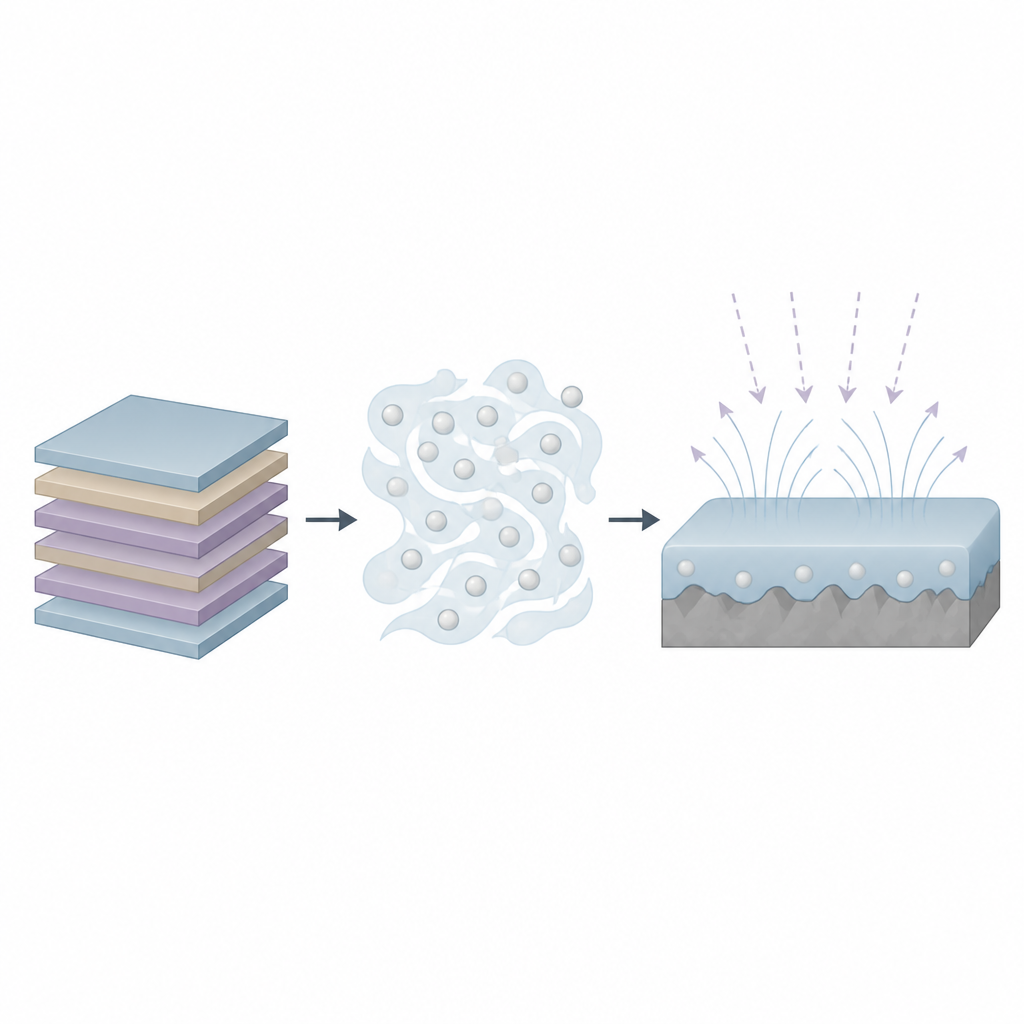
At the heart of the work is a crystal called iron phosphorus trisulfide, which naturally forms in stacked sheets that carry magnetic and electronic activity. The researchers first slipped an organic molecule between these sheets to expand the spacing and make the layers more accessible. They then mixed this modified crystal in different ratios with two common types of polymer and with tiny grains of silica, forming three related nanocomposites. The goal was to see how this blend of rigid layers, flexible chains, and insulating particles reshapes the overall behavior of the material.
Peering inside the structure
To understand what they had made, the team used several imaging and analysis tools. X ray diffraction showed that almost the entire material behaves like a glassy solid rather than an ordered crystal, with only about one and a half percent retaining crystalline structure from the original layered compound. Electron microscopes revealed that the particles form rounded clusters only a few billionths of a meter across, with the polymer spreading irregularly over the layered crystal and silica. Infrared spectroscopy further confirmed that chemical groups on the polymers and silica interact closely with iron sites and other atoms in the layered sheets, indicating that the components are not just mixed but are bonded at their interfaces.
Tuning magnetism by dilution and pairing
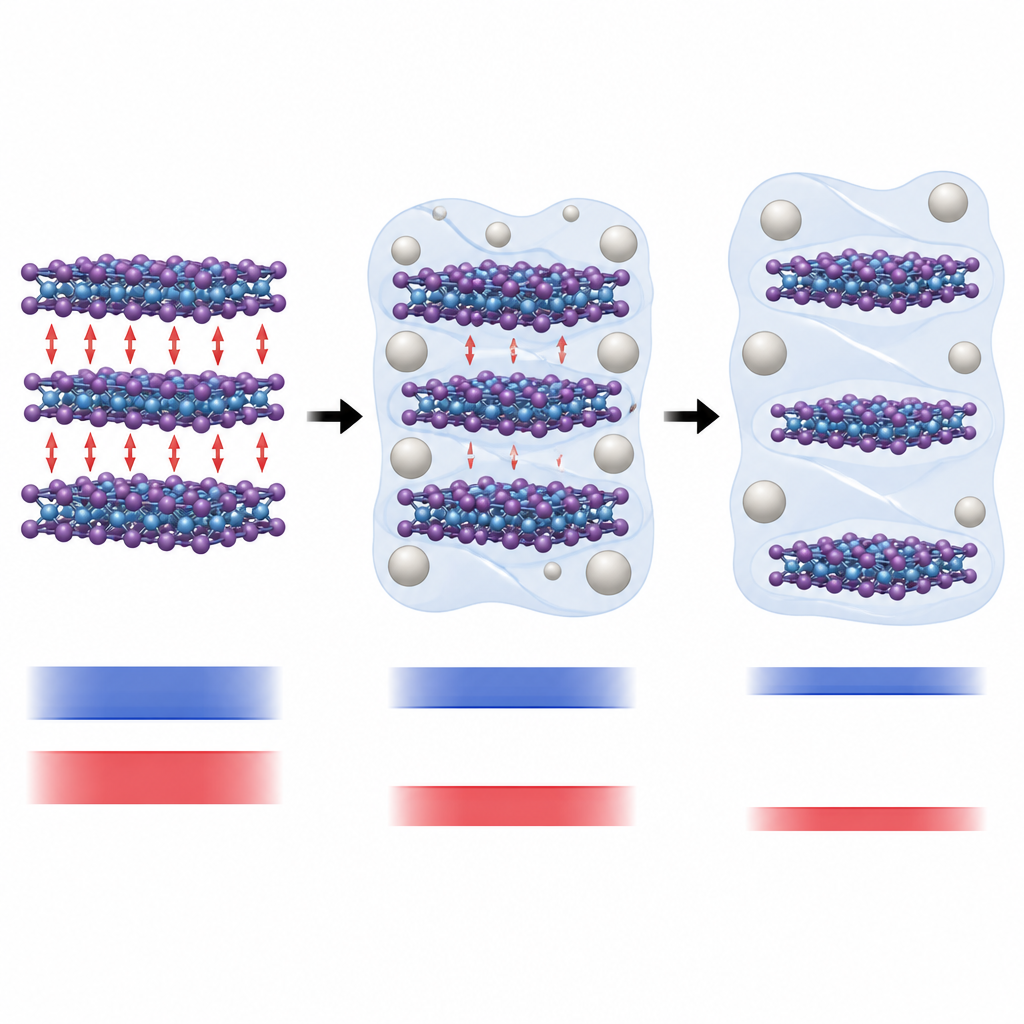
One of the key questions was how the blend would affect magnetism. The starting layered crystal shows paramagnetic behavior, meaning it is weakly attracted to an external magnetic field. When the researchers measured the nanocomposites, they found that the magnetic response had flipped sign to become weakly repelled by the field, a feature known as diamagnetism. Detailed measurements of the magnetization curves showed a sharp drop in the ability of the material to hold magnetic alignment once the field is removed. This shift is explained by two linked effects: the polymers and silica, which do not carry unpaired electrons, dilute the magnetic ions, and their bonding to iron centers encourages electrons to pair up, both of which reduce the overall magnetic response.
Widening the window for light
The team also examined how the nanocomposites interact with ultraviolet light. By measuring how strongly the films absorb different wavelengths, they estimated an energy threshold called the band gap, which marks the jump electrons must make to conduct electricity. In the original layered crystal this band gap is relatively small, but in the new composites it nearly doubles, reaching values that place the material among good electrical insulators. The researchers attribute this widening to distortions of the layered structure, the disorder introduced by polymer chains, and the blocking effect of silica particles, all of which make it harder for electrons to move freely through the material.
What the findings mean for future coatings
In everyday terms, the study shows that combining a magnetic layered crystal with tailored polymers and silica nanoparticles can switch its magnetic behavior off while turning it into a better electrical and optical insulator. The resulting films are mostly amorphous, have weak magnetism, and strongly resist the flow of charge and ultraviolet light, making them attractive candidates for advanced protective coatings. Such coatings could help shield metals from corrosion, filter harmful UV light, or serve as stable insulating layers in electronic and sensing devices where controlled surface interactions are vital.
Citation: El-Meligi, A.A., Ahmed, E.H., Abdel-karim, A.M. et al. Investigating magnetic and optical properties and morphology of a nanocomposite of intercalated layered material and polymer compounds. Sci Rep 16, 15486 (2026). https://doi.org/10.1038/s41598-026-52585-6
Keywords: nanocomposite coatings, magnetic properties, optical band gap, polymer materials, silica nanoparticles