Clear Sky Science · en
A stochastic model for dynamic reconfiguration of multi-microgrid networks under demand and supply uncertainties
Keeping the Lights On in a Uncertain Energy World
As more homes get their electricity from solar panels and wind turbines, keeping power reliable becomes harder. Sun and wind do not always show up on schedule, and demand for electricity changes hour by hour. This study explores how groups of small local power systems, called neighborhood-scale grids, can team up and constantly reshuffle who powers which homes so that households enjoy steady service without having to change their routines.
Small Local Grids Working Together
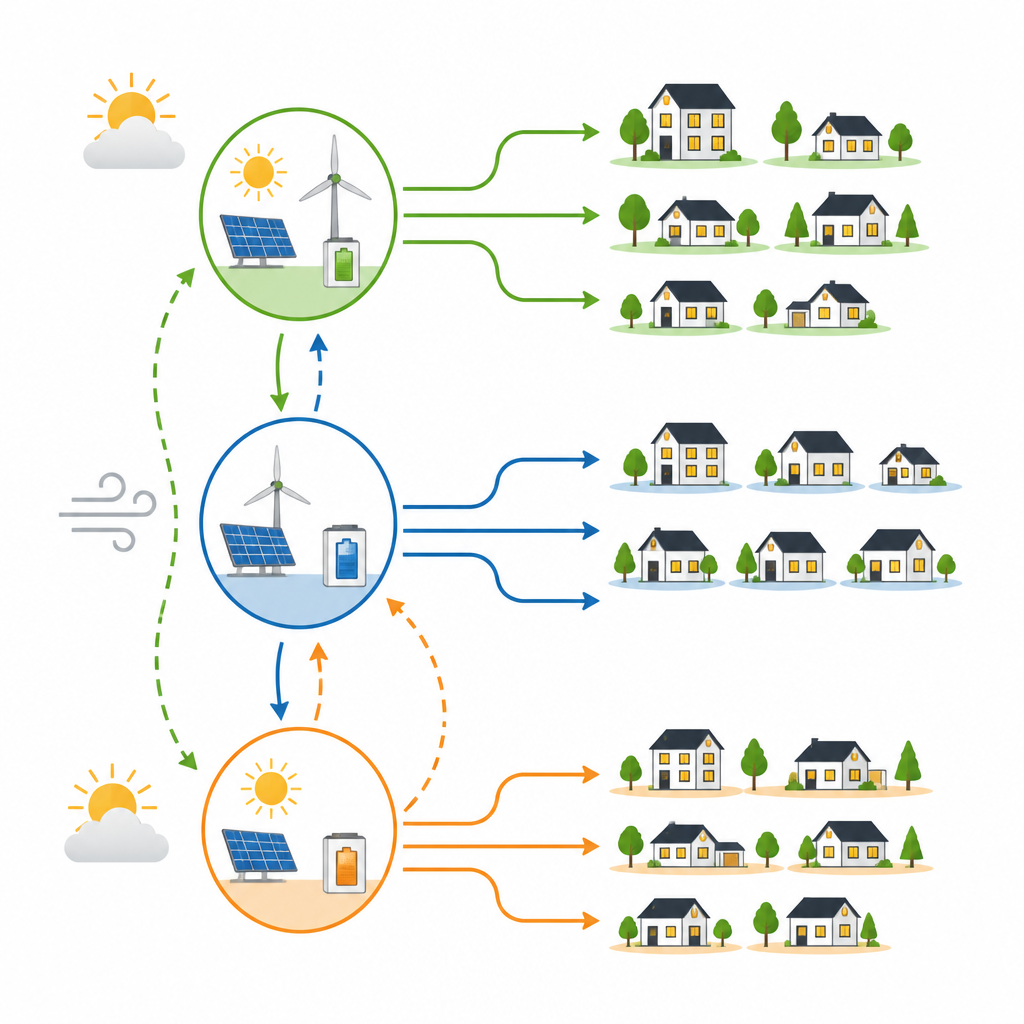
Instead of one big power plant feeding a whole region, the paper looks at three local grids, each with its own mix of wind, solar, and diesel backup, serving 15 nearby homes. In a simple layout, each home would stay tied to a single local grid. The authors instead imagine a web of connections where any home can be temporarily supplied by any of the three grids. If one grid has extra wind or sun at a given hour, it can share that surplus with neighbors whose own grid is short on power. By constantly rearranging which homes connect to which grid, the system aims to keep the combined demand on each grid as smooth and even as possible.
Planning for Hourly Ups and Downs
Real households do not all cook dinner, charge devices, or run air conditioners at the same time every day, and clouds or calm weather can slash renewable output without warning. To capture this, the researchers built a detailed computer model that plays through hundreds of different “what if” days. These scenarios are based on nearly two years of hourly data for both home demand and renewable production. For each of 600 possible days, the model decides, hour by hour, which grid should feed each home, always making sure every home is supplied and that no grid is asked to deliver more than it can safely produce.
How the Smart Rewiring Works
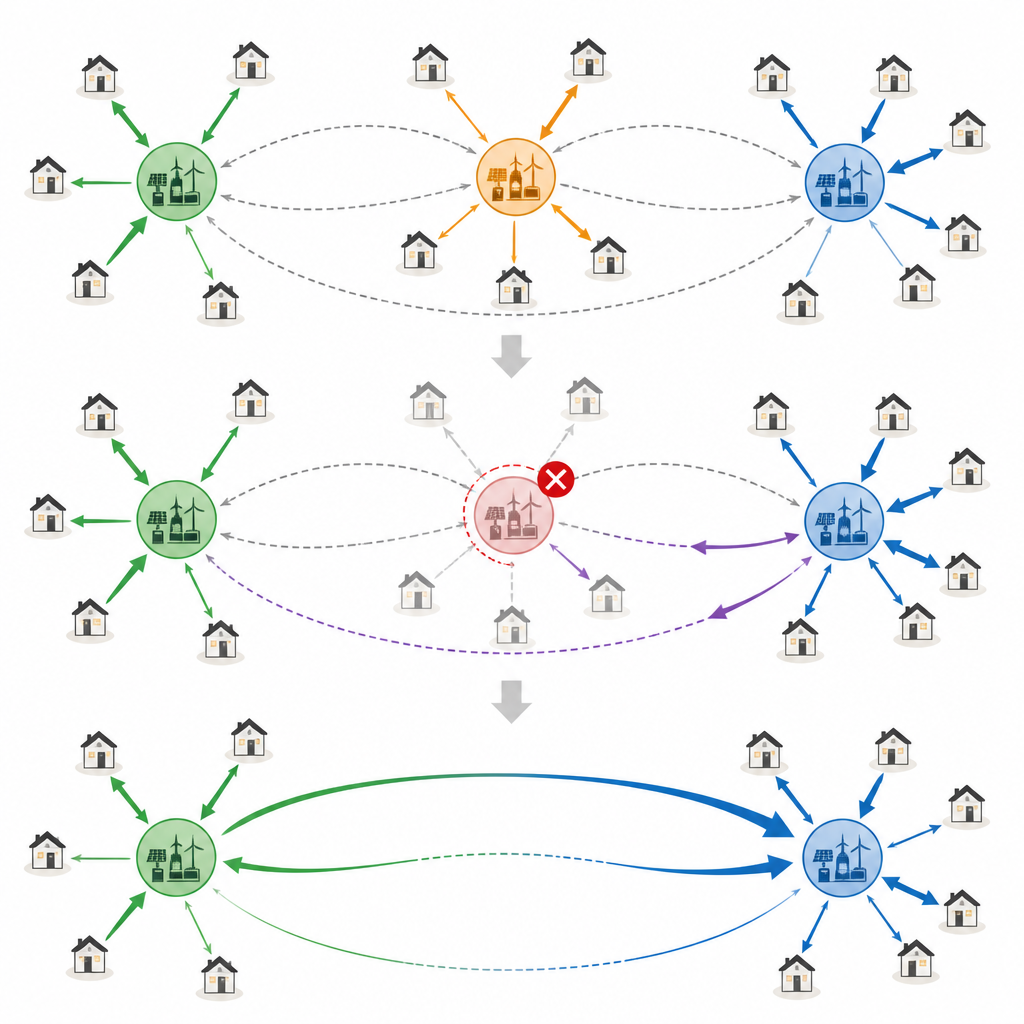
The heart of the study is a mathematical engine that weighs two competing goals: make each grid’s workload as steady as possible over the day and keep energy losses in the wires low. Longer routes between grids and homes waste more power as heat, so the model favors short, electrically “close” paths whenever it can. Homes are treated as smart junctions that can pass power onward to neighbors, forming a flexible web rather than a rigid tree. The engine searches among countless on–off combinations of possible lines, choosing the pattern that gives the fairest, flattest use of all three grids while respecting physical limits and the constantly changing supply and demand in each scenario.
Testing Outages and Tough Conditions
The authors then stress-test the system by pretending that one grid, and then two grids, are taken out of service. In every case, the remaining grids and lines are rearranged so that all 15 homes continue to receive power every hour of the day, with no forced cutbacks. When only one grid is left, that single system carries a heavier and more efficient average load, but its behavior becomes much more erratic from one scenario to another. With all three grids active, each grid runs at a lower average load but with far more stable performance, meaning its daily pattern is predictable even when the weather and demand wiggle around.
What This Means for Future Neighborhood Power
For everyday users, the main message is that linking small local grids into a web and allowing their connections to change over time can make power both cleaner and more dependable. The study shows that such a mesh of neighborhood grids can ride out equipment failures and swings in sun and wind without blackouts, as long as the system is allowed to reroute power intelligently. The price of turning off extra grids is higher risk and more volatile behavior, even if it looks efficient on paper. In plain terms, a network of cooperating small grids can act like a shared safety net, smoothing out the bumps of our changing energy system while quietly keeping the lights on.
Citation: Yahia, Z., Gheith, M. A stochastic model for dynamic reconfiguration of multi-microgrid networks under demand and supply uncertainties. Sci Rep 16, 15489 (2026). https://doi.org/10.1038/s41598-026-52537-0
Keywords: microgrid, renewable energy, smart grid, energy resilience, demand uncertainty