Clear Sky Science · en
Assessment of a modified Coronavirus Disease Optimization Algorithm for Parameter Estimation of Proton Exchange Membrane Fuel Cells
Smarter power for a cleaner future
As the world looks for cleaner ways to power cars, homes, and gadgets, fuel cells stand out because they turn hydrogen into electricity with little noise and almost no local pollution. But getting the most from these devices means knowing a handful of hidden settings inside each fuel cell. This study introduces a new smart search method that can uncover those hidden settings more accurately and quickly, helping engineers design more efficient systems and paving the way for better digital twins and control of fuel-cell powered vehicles.
Why fuel cells need careful tuning
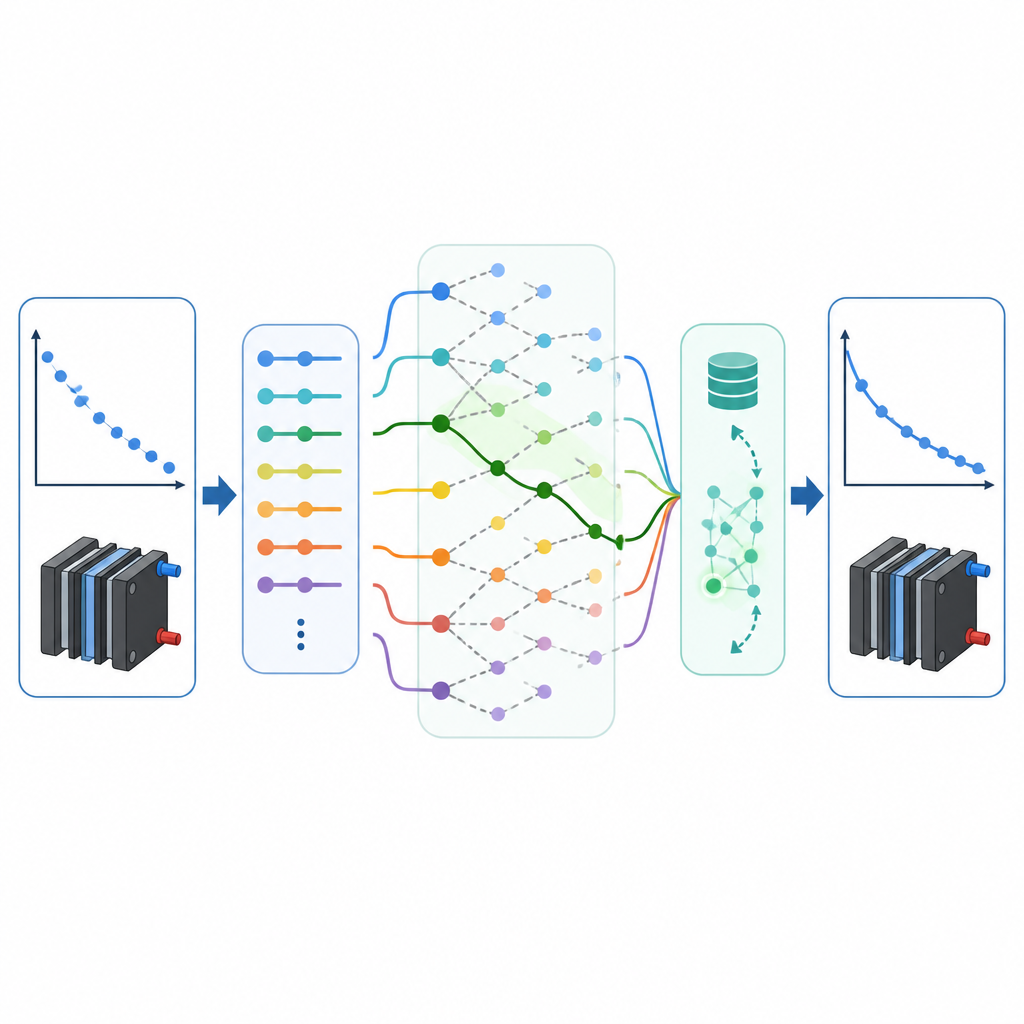
Proton exchange membrane fuel cells, or PEM fuel cells, are promising for everything from stationary power plants to laptops and electric cars. Inside each cell, chemical reactions, heat, water, and electricity interact in complex ways. Manufacturers rarely publish all the detailed parameters that describe this behavior, such as how fast reactions start, how much voltage is lost in the membrane, or how gases spread through the cell. Yet these numbers are vital to predict how a cell will perform under different loads and temperatures, to detect faults early, and to design controllers that keep the system efficient and safe. Finding them means adjusting a model again and again until its voltage-current curve matches real measurements as closely as possible.
Nature inspired search for better answers
Because the search space for these hidden settings is large and twisting, researchers often rely on metaheuristic algorithms, which mimic natural processes like animal swarms, predator hunting, or physical phenomena such as ice formation. Over the past few years, many such methods have been tested on fuel cell models, including differential evolution variants, walrus and rabbit inspired optimizers, ant colony schemes, and even reinforcement learning. These approaches aim to minimize the gap between measured and simulated voltages, usually expressed as the sum of squared errors. While several can reach good solutions, they often struggle to balance wide exploration of possibilities with focused improvement, risking slow progress or getting stuck in local dead ends.
A memory based twist on a virus inspired method
The authors build on a recent algorithm called the Coronavirus Disease Optimization Algorithm, which imitates how a virus enters cells, replicates, and mutates. In its original form, this method explores well but tends to wander without strong guidance from the best solutions found so far. The new version, called memory based COVIDOA, adds two ideas. First, it keeps a memory of elite candidates and lets them guide the rest of the population, gradually shifting from broad exploration early on to fine tuning around the strongest solutions later. Second, it introduces a random exploration strategy that can shake the system out of traps when all candidates start to look too similar. Together, these changes are designed to improve both speed and accuracy while preserving diversity in the search.
How well the new method performs
Before tackling fuel cells, the team tested the memory based algorithm on a standard set of 12 tough mathematical challenges, comparing it with the original COVIDOA and four other popular optimizers. Across most of these tests, the new method delivered lower objective values, smaller variation between runs, and faster convergence. Statistical checks confirmed that these improvements were not due to chance. The researchers then applied the method to a real PEM fuel cell stack known as NedStack PS6, where six key parameters of a widely used semi empirical model had to be identified within realistic bounds. The goal was to match a measured voltage-current curve by minimizing the sum of squared errors between predicted and observed voltages over 30 independent runs for each algorithm.

Results for real fuel cell data
On the NedStack PS6 data, the memory based method achieved the lowest error value, slightly better than the best competing approaches, and did so with less spread between runs. Its fitted parameters produced voltage predictions that closely tracked the measured values across a wide range of currents. Graphs of convergence showed that, while other algorithms could eventually approach good solutions, the new method typically settled into a high quality region earlier, which is important for real time or embedded applications with limited computing power. Boxplots and robustness curves reinforced this picture, revealing both higher reliability and more consistent behavior from run to run compared with the other swarm and virus inspired methods.
What this means for clean energy systems
In simple terms, the study shows that a smarter, memory aided version of a virus inspired search strategy can pin down the hidden settings of a fuel cell model more accurately and more reliably than several established competitors. With better models in hand, engineers can build digital twins that mirror real fuel cells in software, allowing them to test new control strategies, predict performance, and spot problems without risking hardware. While this work focused on a specific fuel cell stack, the approach is general and can be applied to other clean energy devices and complex systems where important parameters are hard to measure directly.
Citation: Ismaeel, A.A.K., El-Rifaie, A.M., Hashim, F.A. et al. Assessment of a modified Coronavirus Disease Optimization Algorithm for Parameter Estimation of Proton Exchange Membrane Fuel Cells. Sci Rep 16, 15988 (2026). https://doi.org/10.1038/s41598-026-52533-4
Keywords: proton exchange membrane fuel cell, parameter estimation, metaheuristic optimization, digital twin, clean energy systems