Clear Sky Science · en
Scaling laws for rockfall impact fragmentation emerging from diverse lithologies
Why falling rocks matter for everyone
In many mountain regions, rockfalls are part of everyday life. They can close roads and railways, threaten villages, and quietly grind down cliffs over thousands of years. Yet what happens in the split second when a big rock smashes into a slope is still hard to predict. This study digs into that moment of impact and break up, showing that the way rocks shatter follows simple patterns that hold across very different types of stone. These insights can help engineers design better protections and help geoscientists understand how landscapes evolve.
From single block to spreading debris
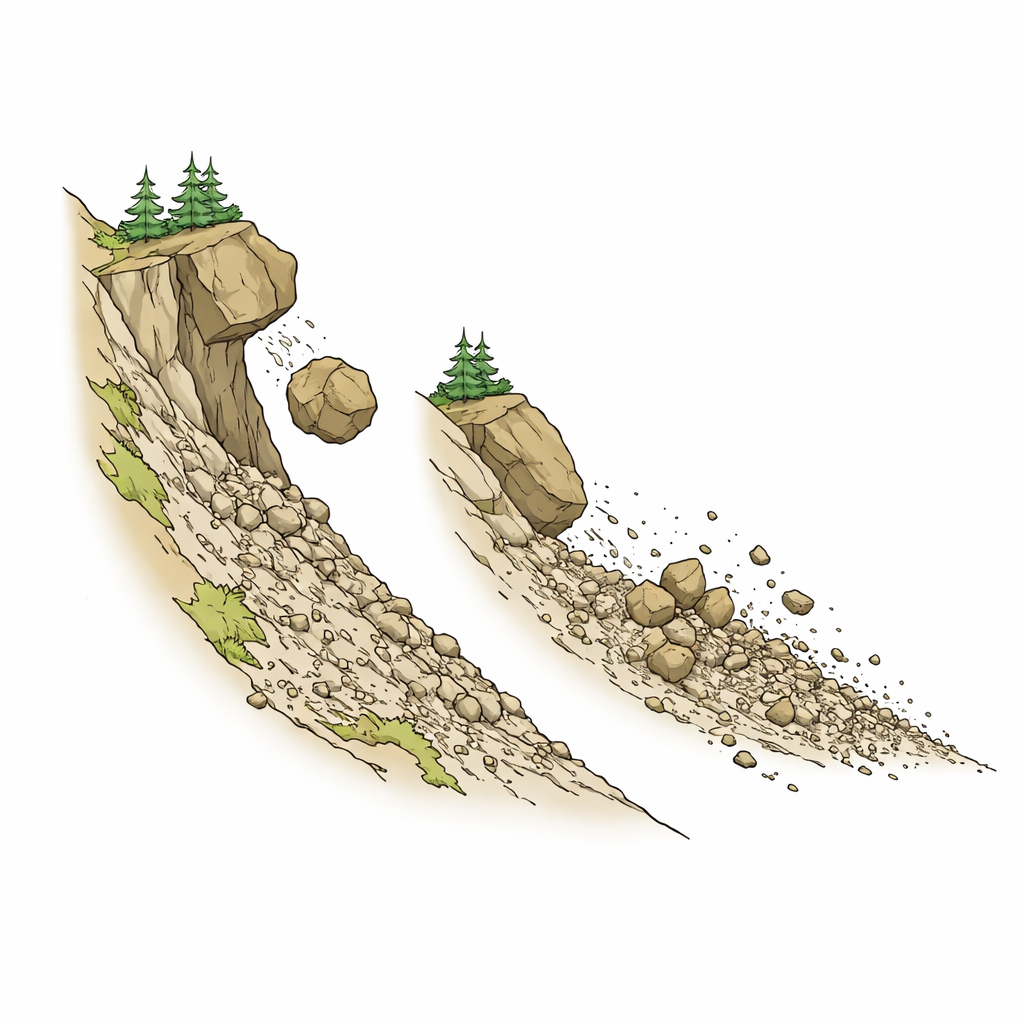
When a large block detaches from a cliff and hurtles downslope, its final impact can leave a very different footprint than a single boulder sliding to a stop. On collision, more than half of the original mass can fragment into a cloud of smaller pieces that travel farther and behave differently. The authors start from detailed observations of three rockfall events in Catalonia, Spain, covering weak sandstones, strong sandstones, and massive limestones. These natural events provide precise measurements of block sizes before and after impact, fall heights, and run out distances. Together they form a kind of open air laboratory where real rockfalls can be checked against computer models.
A digital crash test for rocks
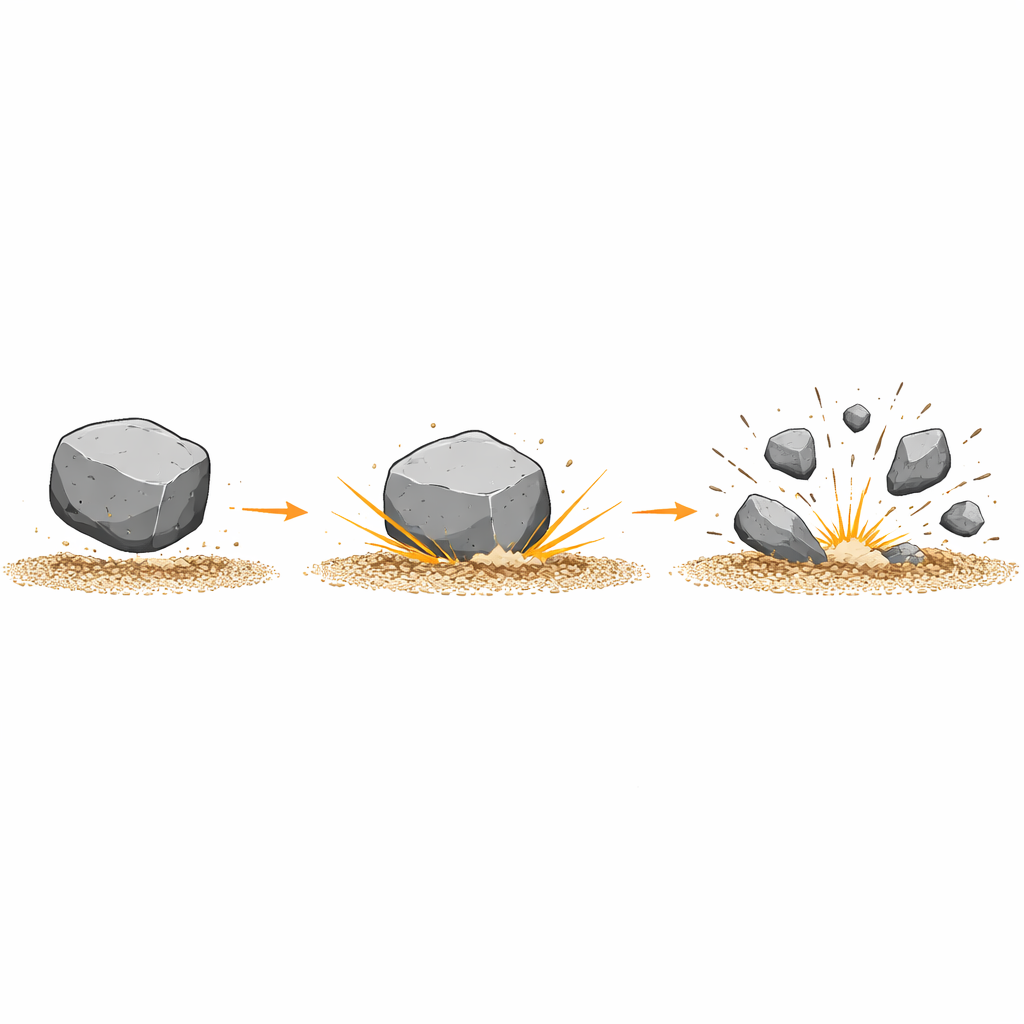
To peer inside the impact, the team builds a numerical model that treats each rock block as a collection of many small, interlocking pieces. Using a method called the discrete element approach, the computer follows how every piece moves, collides, and sometimes breaks. Breakage occurs when the energy delivered to a piece passes a threshold set by laboratory drop weight tests on real samples of each rock type. When this happens, the model instantly replaces the piece with a swarm of smaller fragments whose sizes follow rules tuned to the lab data. By repeating these digital crash tests for different block sizes and fall heights, the researchers can track how the mix of fragment sizes changes with impact energy.
A common pattern in how rocks shatter
Despite the large differences between weak and strong rocks, the simulations and field data show a surprisingly unified story. The team measures a relative breakage index that compares how far the fragment size distribution has moved from the original blocks toward a highly crushed end state. When they express impact intensity through a simple length ratio, given by fall height divided by block size, the results from all three rock types can be rescaled to lie on a single curve. This curve shows fast growth of breakage at low impact energies and a plateau where extra energy produces only modest extra damage. The statistics of the fragment sizes themselves match a Weibull distribution, a bell shaped law commonly used to describe how brittle materials fail. In other words, rockfalls do not break in a random way, but follow a repeatable statistical signature set by the distribution of tiny flaws inside the rock.
From shattered blocks to safer slopes
Because the model links impact energy, rock type, and fragment sizes in a compact formula, it can be used as a predictive tool. Instead of assuming that a single big block hits a road or protective gallery, engineers can now estimate how many fragments of different sizes will arrive, and how the initial energy is shared between surviving blocks and fine debris. This helps in choosing barrier meshes, sizing protective roofs, and mapping zones of higher impact energy downstream. For geoscientists, the same framework connects the mechanics of individual impacts with the long term supply of sediment to valley floors and rivers, influencing how talus slopes build up and how quickly cliffs retreat.
What the study means in plain terms
The key message is that when big rocks fall and smash, their break up is not purely chaotic. By combining field observations, lab tests, and detailed simulations, this work shows that rockfall fragmentation follows simple scaling laws that barely care about the specific rock type. In practice, that means we can estimate how a falling block of a given size and drop height is likely to shatter, and how much energy will be carried by the resulting cloud of fragments. Such knowledge does not remove the danger of rockfalls, but it offers a clearer, physics based way to design protections and to read the scars they leave on mountain landscapes.
Citation: Vergara, Á., Palma, S. & Fuentes, R. Scaling laws for rockfall impact fragmentation emerging from diverse lithologies. Sci Rep 16, 14735 (2026). https://doi.org/10.1038/s41598-026-52503-w
Keywords: rockfall, fragmentation, landslide hazards, mountain slopes, Weibull statistics