Clear Sky Science · en
Large and ultra-flat optical traps for uniform quantum gases
Why this matters for future space labs
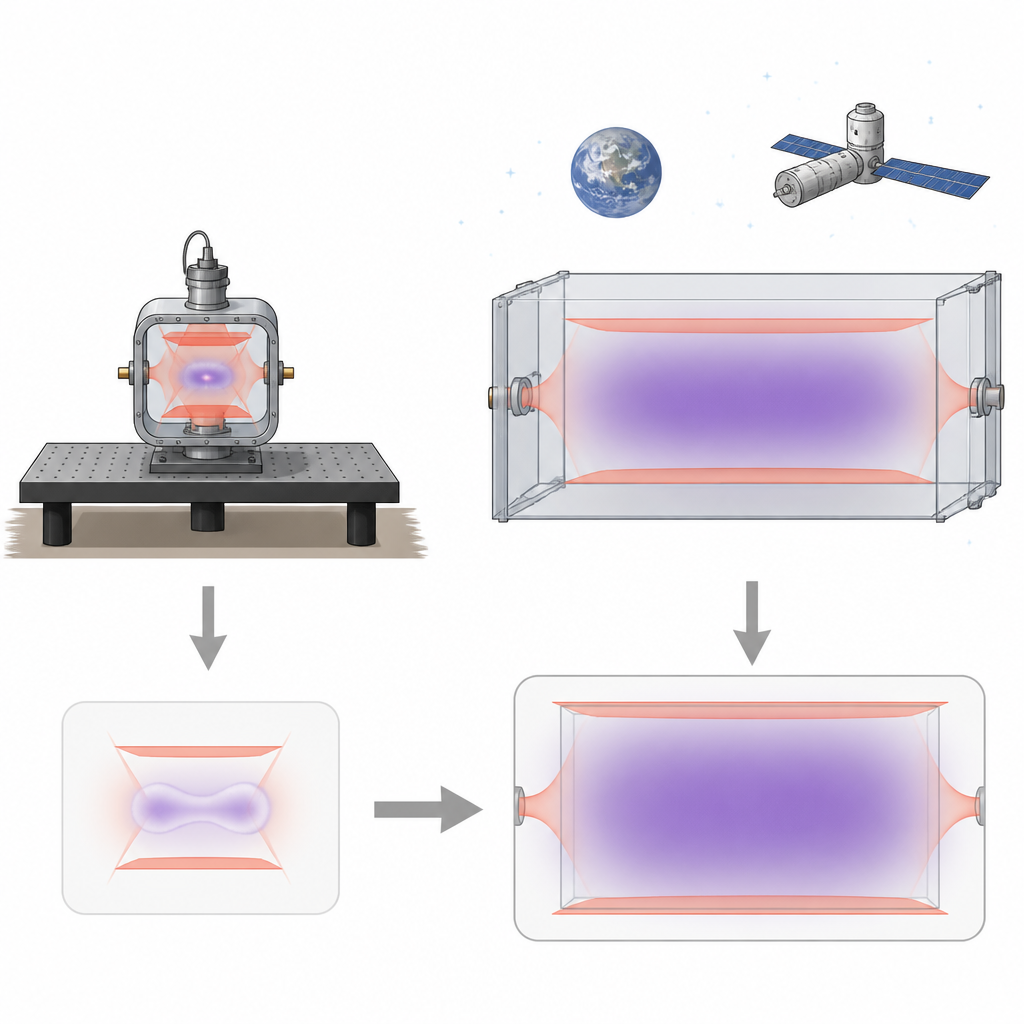
Imagine a cloud of atoms chilled to a hair above absolute zero, all spread out with nearly the same density, like a perfectly uniform fog. Physicists use such clouds to test the rules of quantum mechanics and to mimic materials found in stars, planets, and advanced technologies. This paper shows how to build much larger and more even "quantum boxes" than before, in a compact setup that can work not just on Earth but also in space laboratories, where weightlessness removes many limits.
Building a bigger, smoother quantum box
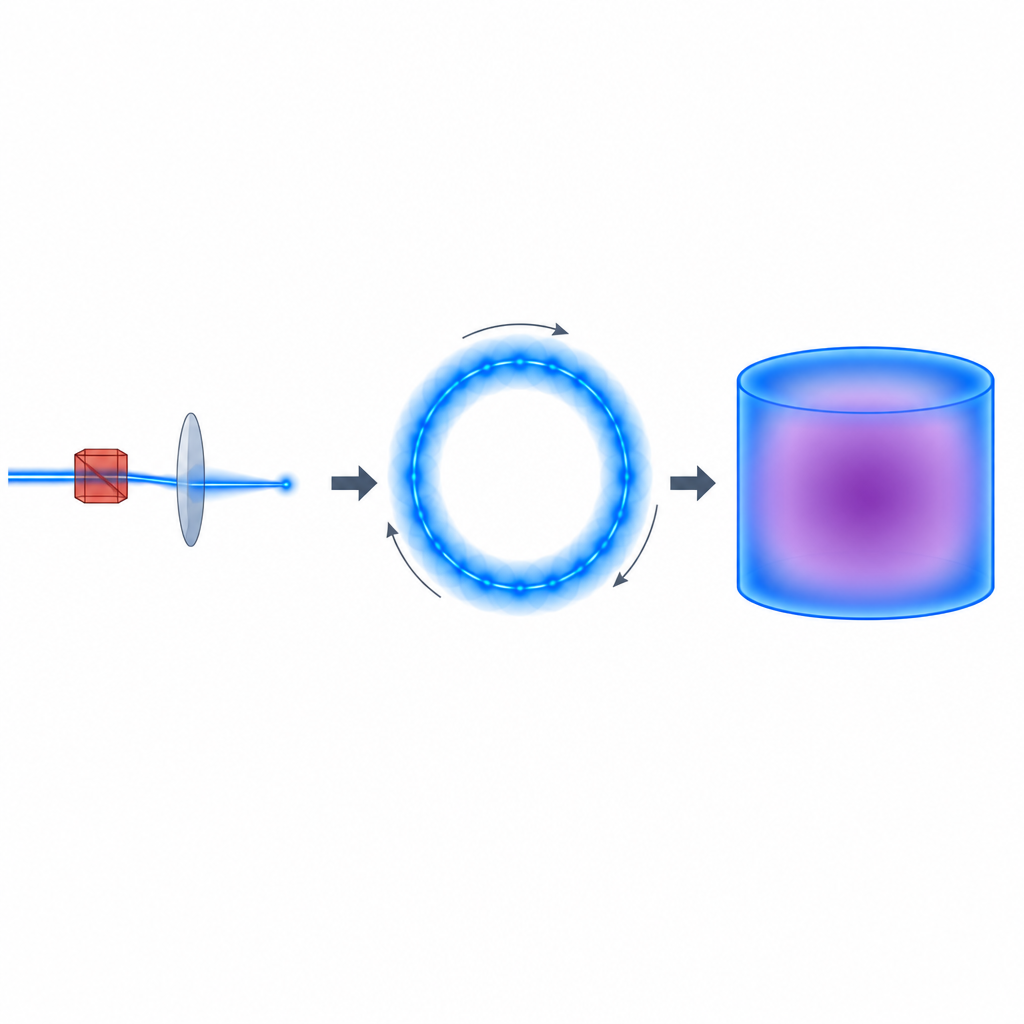
To trap atoms without touching them, researchers shine laser light so that atoms are pushed away from bright regions and collect in darker ones. The team designed a device that steers a laser beam very quickly in two directions, using sound waves in a crystal to nudge the light. By sweeping the beam around in carefully chosen patterns and averaging its effect over time, they "paint" box-shaped walls of light around a dark central volume where atoms can float freely. This painted box is far larger than typical traps, with a usable area about an order of magnitude bigger in each direction than most earlier systems.
Made for the challenges of space
On Earth, gravity pulls cold atoms downward, so scientists must use magnetic or electric fields to hold them up. These methods often warp the trap and limit its size, especially when mixing different atomic species. In microgravity environments like the International Space Station, the pull of gravity is effectively removed, allowing much simpler traps. The authors engineered a compact, rugged module that includes the light-steering hardware, lenses, and monitoring sensors, all tested against launch-like vibrations. It operates with modest laser power at a wavelength suited to common atoms such as rubidium and potassium, and it can generate a wide variety of shapes, from simple boxes and rings to arrays of multiple traps.
Ultra-flat floors and razor-sharp walls
A good quantum box needs an almost perfectly level "floor" so atoms feel the same conditions everywhere, and sharp "walls" so the edges are well defined. The researchers carefully measured stray light in the center of their traps and found it to be extremely low, meaning atoms there would barely be disturbed by the trapping light. They also showed that the trap edges are extraordinarily steep, following a power-law shape with an exponent as high as 152, which makes the trap behave very much like an ideal box rather than a soft bowl. Simulations indicate that heating from scattered light and from the rapid painting motion stays small enough for atoms to remain ultracold over hundreds of seconds.
Testing the quantum gas inside the box
To see how atoms would behave in such traps, the team performed detailed computer simulations of ultracold gases at zero temperature. They modeled how a cloud of interacting atoms fills the painted box and compared it with a non-interacting cloud in the same light pattern. In both small and millimeter-scale traps, the atoms settled into a very flat, box-like density profile, confirming that the steep walls and flat bottom work together to create a nearly uniform gas. The simulations also revealed how fast the laser beam must paint the trap so that atoms only feel the time-averaged shape and are not stirred by the moving light.
What this unlocks for quantum research
The study concludes that this compact painted-light setup can host very large, almost perfectly uniform quantum gases, especially in microgravity. Such gases are powerful testbeds for studying phase transitions, turbulence, mixtures of different atoms, and exotic few-body states in ways that closely match simple theoretical models. By making large, clean quantum boxes feasible on orbiting platforms, the work paves the way for more precise quantum sensors, new tests of fundamental physics, and deeper explorations of how matter behaves at the coldest temperatures nature allows.
Citation: Frye-Arndt, K., Glaysher, M., Rhyno, B. et al. Large and ultra-flat optical traps for uniform quantum gases. Sci Rep 16, 15171 (2026). https://doi.org/10.1038/s41598-026-52493-9
Keywords: ultracold atoms, optical box traps, microgravity, Bose Einstein condensate, quantum gases