Clear Sky Science · en
Carbon enriched mixed metal oxides as novel nanocomposites for efficient brilliant green decontamination
Why cleaning up colorful water matters
Brightly colored industrial dyes make our clothes, paper, and plastics look appealing, but once these chemicals escape into rivers and lakes they can threaten fish, plants, and people. One such colorant, a vivid substance known as brilliant green, is especially worrisome because it can damage living cells, linger in the environment, and resist natural breakdown. This study explores a new class of tiny mixed-metal and carbon particles that can pull brilliant green out of water efficiently and be reused many times, offering a practical route to cleaner wastewater from dye-using industries. 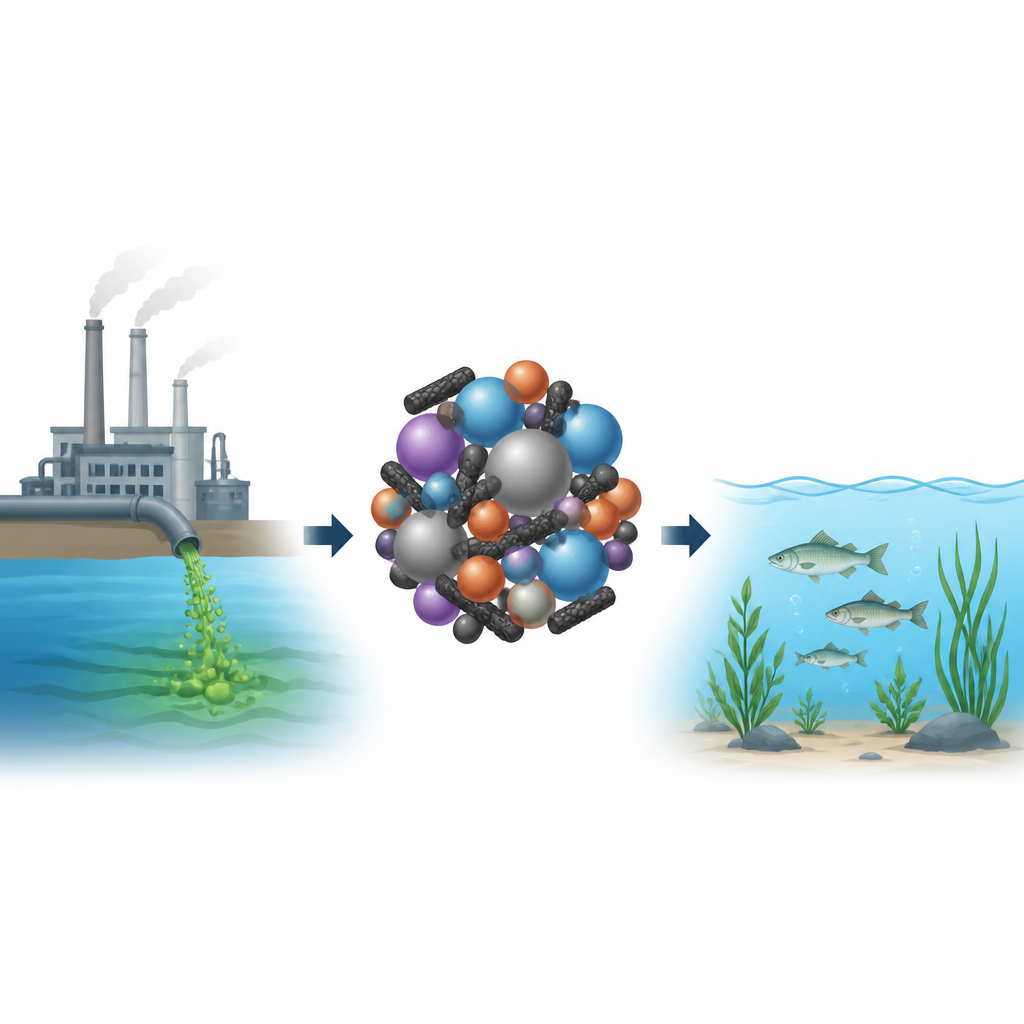
Color in, life out
Many factories that dye textiles, print paper, or produce plastics discharge water loaded with synthetic colors. These dyes are engineered to shrug off sunlight, heat, and microbes, which helps products stay bright but also means the chemicals persist once they reach streams and reservoirs. They block light from penetrating the water, disrupting photosynthesis in aquatic plants and reducing oxygen for fish and other organisms. Some dyes and their breakdown products can harm human organs or trigger genetic damage after long-term exposure. Brilliant green, a strongly colored, positively charged dye, is one such compound, making its removal a priority for modern water treatment.
Why tiny mixed particles are promising
Engineers have tried many ways to strip dyes from water, including filtration, chemical clumping, light-driven breakdown, and microbial cleanup. Each has drawbacks such as high cost, sludge generation, slow operation, or sensitivity to operating conditions. A simpler strategy is adsorption, where a solid with many active sites acts like a sponge for dye molecules. The authors focused on building advanced adsorbents from metal oxides combined with carbon. By blending several metal oxides containing strontium, lead, and magnesium with carbon into one nanoscale material, they aimed to create a rough, porous surface rich in different sites where dye molecules could stick, while still being strong enough to survive repeated use.
Cooking up the adsorbent
To build these materials, the team used a solution-based recipe called the Pechini method. Metal salts and an organic acid were mixed with a polymer-forming liquid, creating a uniform gel where the metal atoms were evenly dispersed. Heating this gel at 600 or 800 degrees Celsius burned away much of the organic matter and left behind two related products, called MSP600 and MSP800. Measurements showed that MSP600 formed mostly small, nearly spherical nanoparticles, while MSP800 contained larger, more irregular particles. Both materials combined multiple metal oxide phases with a modest amount of carbon, but MSP600 had a higher surface area and more small pores, giving dye molecules more places to land. 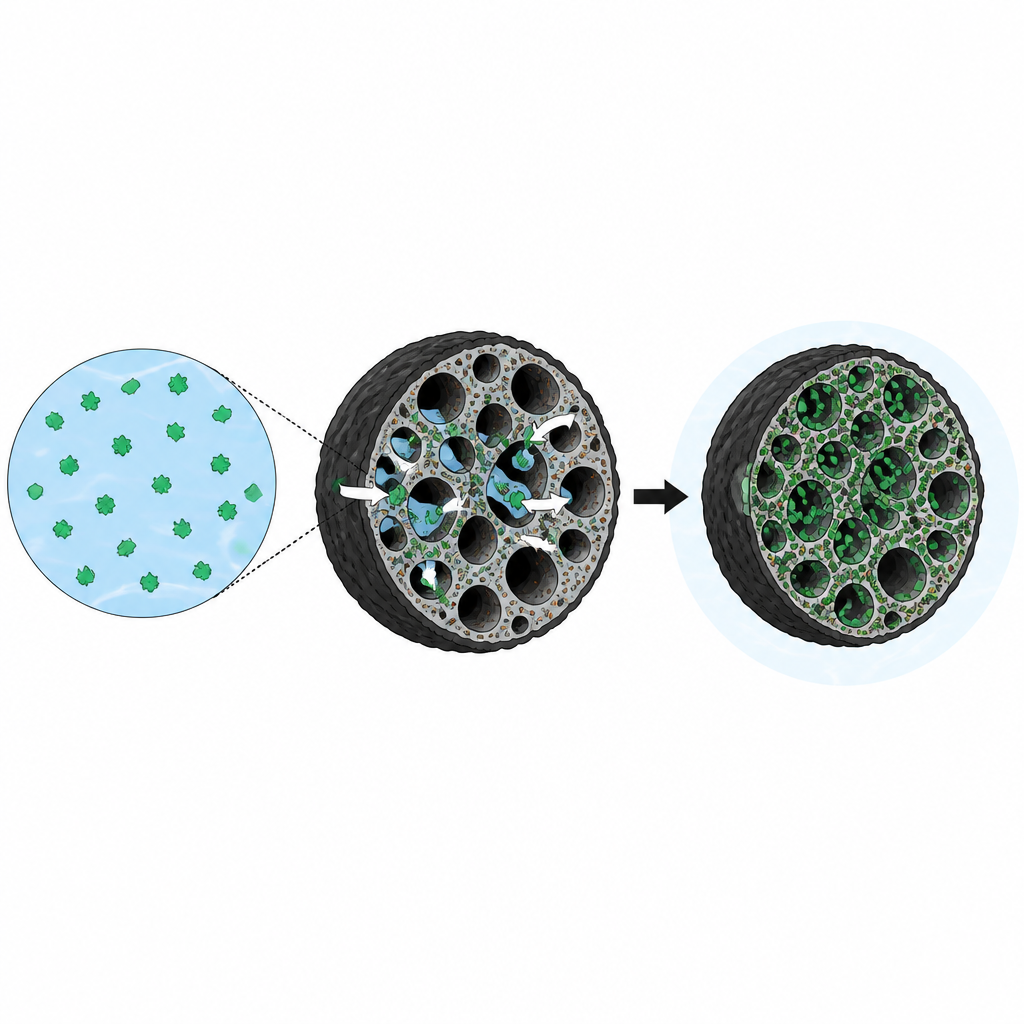
How the new particles trap dye
When the particles were stirred into dye-containing water, pH played a key role. Under acidic conditions, the particle surfaces carried a positive charge and repel the positively charged brilliant green molecules, leading to poor removal. Under mildly basic conditions, however, the particle surfaces became negative, attracting the dye electrostatically. Additional interactions, including hydrogen bonding and stacking between the dye’s aromatic rings and carbon-rich regions, helped lock the molecules in place. Tests showed that MSP600 could remove nearly all of the dye from moderately concentrated solutions within about an hour, while MSP800 also performed well but more slowly and with slightly lower capacity, in line with its lower surface area.
Performance, energy, and reuse
The researchers carefully analyzed how fast and how strongly the dyes attached to the particles. Their data revealed that dye uptake is mainly controlled by how quickly molecules move from the water to the particle surface, and that they form a single layer on fairly uniform sites. The process releases heat and is classified as physical rather than chemical binding, which helps when it is time to regenerate the material. By rinsing used particles with a strong acid solution, the team could free almost all of the trapped dye and restore most of the adsorption capacity. Even after five adsorption and cleaning cycles, both MSP600 and MSP800 maintained high removal efficiencies, with no sign that their metal components were dissolving into the water.
What this means for cleaner water
In practical terms, the new MSP600 and MSP800 materials outperformed many previously reported dye adsorbents, holding more brilliant green per gram while remaining stable and reusable. For non-specialists, the takeaway is that nanoscale design can turn simple metal and carbon ingredients into powerful, recyclable sponges for toxic dyes. If scaled up and integrated into treatment plants, such mixed metal oxide–carbon particles could help industries strip stubborn colors from their wastewater before discharge, reducing health risks and making our rivers and lakes clearer and safer.
Citation: Abdelrahman, E.A., Alashqar, S. Carbon enriched mixed metal oxides as novel nanocomposites for efficient brilliant green decontamination. Sci Rep 16, 15035 (2026). https://doi.org/10.1038/s41598-026-52486-8
Keywords: wastewater treatment, dye removal, brilliant green, nanocomposites, adsorption