Clear Sky Science · en
Comparative insecticidal efficacy and biochemical impact of nano-encapsulated citronella and geranium essential oils against Spodoptera littoralis (Lepidoptera: Noctuidae)
Why plant scents matter for farmers
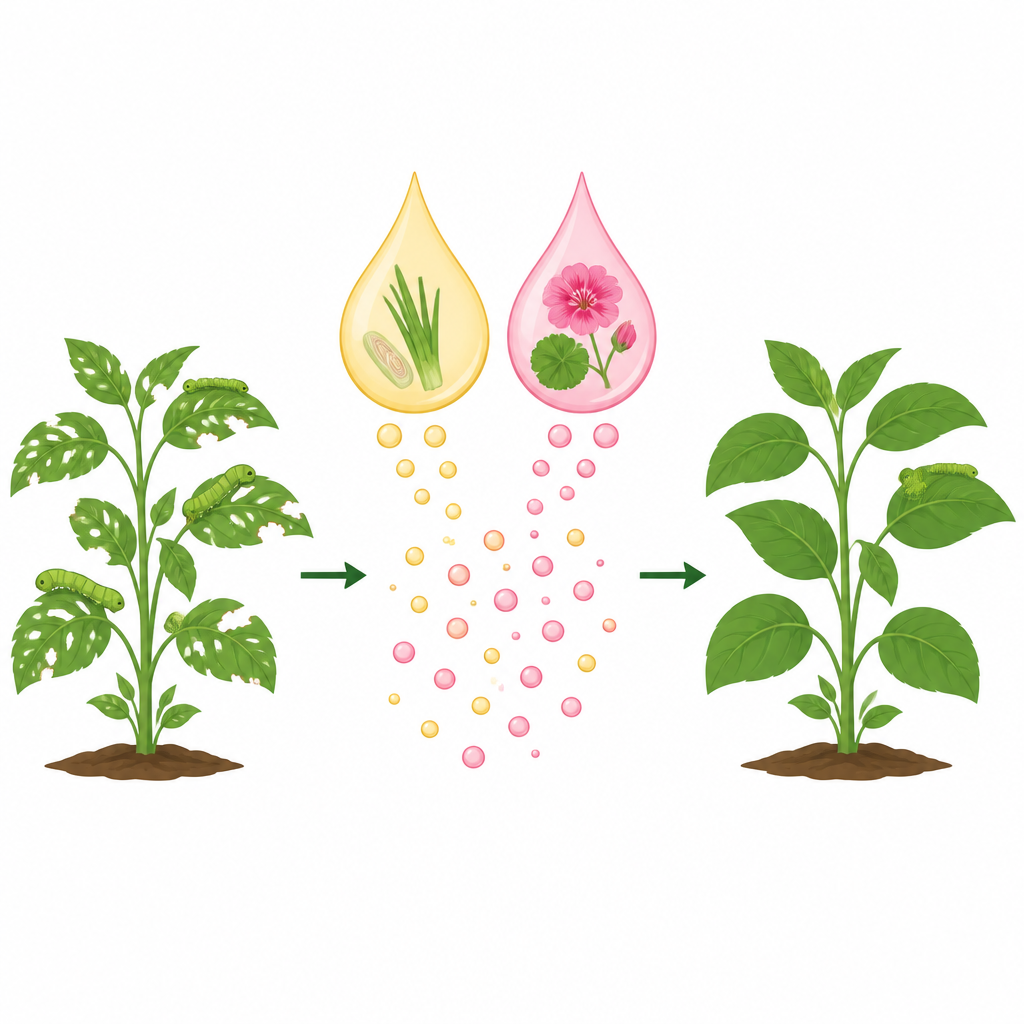
Many people know citronella and geranium oils as pleasant natural scents or mosquito repellents, but this study shows that these familiar plant oils could also help farmers protect crops from one of their most damaging caterpillar pests, the cotton leafworm. By packaging the oils into tiny, long lasting droplets, the researchers turned common fragrances into powerful, more sustainable tools for pest control.
Tiny droplets with a big job
The team focused on two essential oils, from citronella grass and geranium, and compared their usual “bulk” liquid form with new nano formulations. In these nano versions, the oil is trapped inside very small spheres, only about 20 to 60 billionths of a meter wide, made using a common, water friendly material called PEG. Under an electron microscope, these droplets appeared smooth and round, and testing showed that almost all of the oil was successfully packed inside. This design helps protect the fragile oils from air, light, and evaporation, and helps them spread more evenly in water.
Putting caterpillars to the test
To see how well the oils worked, the researchers fed treated leaves to fourth stage cotton leafworm larvae in the lab. They used several concentrations and tracked how many caterpillars died over a week. Both oils were poisonous to the insects, but the nano citronella stood out: it was about ten times more potent than regular citronella oil, killing more larvae at much lower doses. Nano geranium also worked better than its bulk form, though the improvement was more modest. When the scientists used doses that kill about half the larvae, they also found that surviving insects exposed to nano citronella took longer to grow and turned into smaller pupae, signs that their development had been seriously disturbed.
How the oils disrupt the insect body
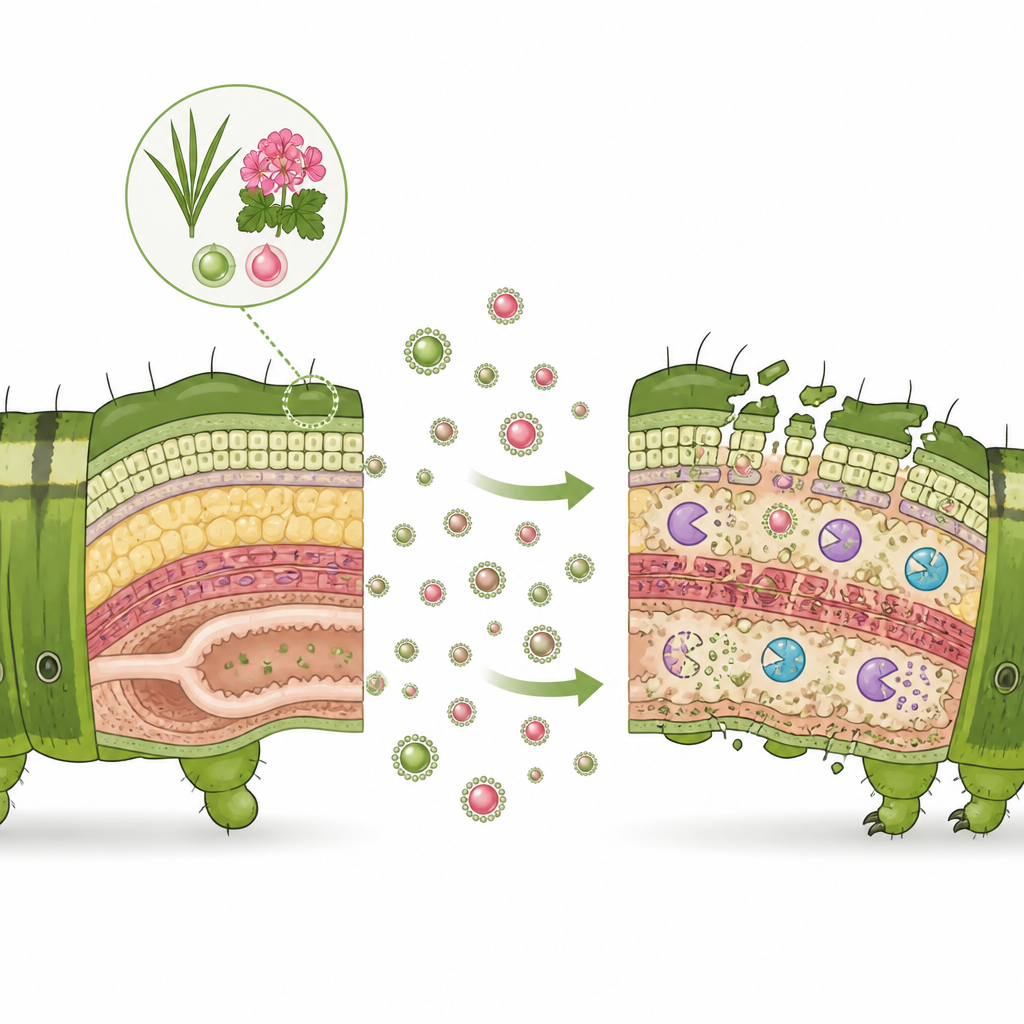
Beyond counting dead caterpillars, the study looked inside the insects by measuring key enzymes and proteins in their bodies. These molecules are like tiny machines that build the outer shell, digest food, and keep cells running. Treatments with the oils, especially the nano forms, changed the activity of enzymes involved in breaking down the insect’s shell material and in processing sugars from food. Total protein levels in the larvae also shifted, often dropping in the nano treated groups, which points to stress, tissue damage, and problems with normal growth. The scientists also observed misshapen pupae and adults, linking these internal biochemical upsets to visible defects in molting and metamorphosis.
Zooming in at the molecular level
To better understand one possible target inside the insect, the researchers used computer simulations to see how geraniol, a major component of these oils, might attach to a model enzyme that breaks down chitin, the tough material in the insect shell. Their virtual “movie” showed that geraniol fit snugly into the enzyme’s active pocket and stayed there stably, held in place by many close range contacts. The calculated binding energy suggested a strong interaction, supporting the idea that this plant compound could interfere with shell remodeling and molting. Although the model enzyme comes from bacteria, its key features are similar to those in insect enzymes, making this a useful first look at how essential oil ingredients might work at the atomic scale.
What this means for greener pest control
Overall, the study suggests that wrapping citronella and geranium oils into nano sized droplets can make them more stable and much more effective against cotton leafworm. Nano citronella, in particular, delivers strong killing power at lower doses while also slowing growth and weakening survivors by disturbing their internal chemistry. These results point toward essential oil nano formulations as promising tools for integrated pest management, where farmers combine several methods to keep pests in check while reducing reliance on conventional chemical insecticides.
Citation: Abd-Elatef, E.A., Mohammed, A., Osman, S.M. et al. Comparative insecticidal efficacy and biochemical impact of nano-encapsulated citronella and geranium essential oils against Spodoptera littoralis (Lepidoptera: Noctuidae). Sci Rep 16, 15475 (2026). https://doi.org/10.1038/s41598-026-52470-2
Keywords: cotton leafworm, citronella oil, geranium oil, nanoemulsion, biopesticide