Clear Sky Science · en
Linear stability and dispersive soliton propagation in nonlinear media subject to parabolic phase modulation
Why light pulses need careful guidance
Every email, video call, and streamed movie depends on tiny flashes of light racing through glass fibers. Ideally, each flash, or pulse, would travel for thousands of kilometers without losing its shape, so information arrives cleanly. In reality, the glass itself tends to smear and distort these pulses. This paper explores how specially designed fibers and mathematical tools can help keep light pulses sharply focused and stable, even when the physics becomes more complicated than standard textbook models.
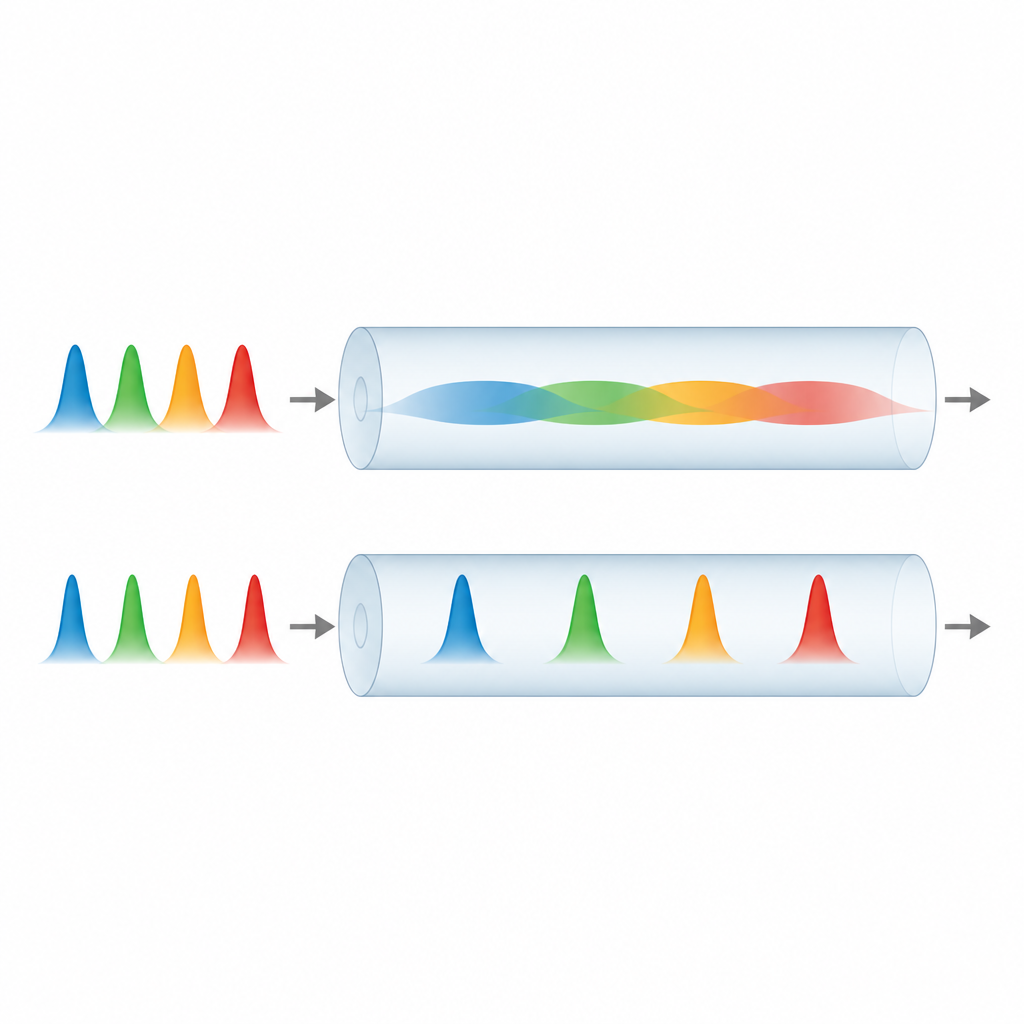
Shaped glass and stubborn light pulses
In modern fiber networks, light pulses behave like miniature waves that want to spread out as they travel. At the same time, the glass responds to intense light by slightly changing how fast it lets that light pass. When these two tendencies balance, a pulse can travel long distances without changing its shape. Such a self-preserving pulse is called a soliton. The authors study a version of this balance that includes extra real-world effects: higher levels of dispersion that act like stronger smearing, and a more complex response of the glass that grows faster than commonly assumed when the light gets very bright.
Richer kinds of waves in advanced fibers
To understand what kinds of pulses can exist in such fibers, the researchers use an algebraic method that turns a difficult wave equation into a simpler set of relations. This approach lets them write down exact mathematical expressions for several types of waves. They find bright solitons, which look like isolated peaks of light; dark solitons, which are stable dips riding on a continuous background of light; waves that grow or decay smoothly; sharp, spike-like repeating patterns; and more intricate repeating structures described by elliptic functions. Each pattern comes with clear rules about which fiber properties and light strengths are needed to make it possible in practice.
How the balance of effects shapes each pulse
The study shows how different knobs in fiber design control the shape of these waves. A higher level of fourth-order dispersion, a refined measure of how the glass spreads different colors of light, tends to broaden bright solitons and lower their peak height. The usual nonlinear response of the glass controls how tall and energetic the pulse can be, while the added higher-intensity response adjusts the pulse shape at very high powers. Smaller effects, such as self-steepening and cross-coupling between parts of the pulse, add subtle asymmetries and fine details. Together, these ingredients explain why bright and dark solitons, as well as repeating wave trains, can all arise in carefully engineered fibers.
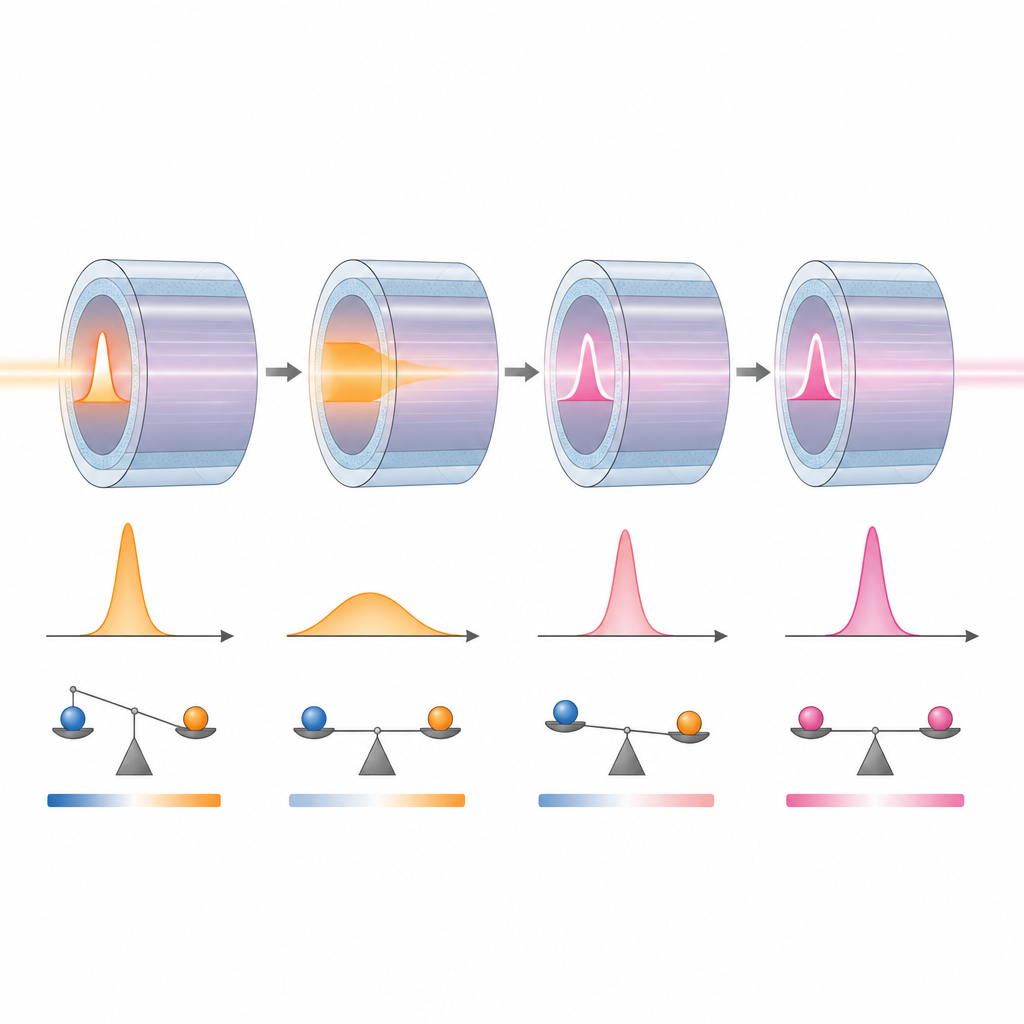
Testing whether pulses can survive disturbances
Real communication lines are never perfectly quiet; small distortions constantly tug at each pulse. The authors test the resilience of their waves by adding tiny disturbances in their equations and tracking whether they grow or fade. This analysis produces a rule that links the size of a disturbance to how quickly it moves along the fiber. If the disturbance falls below a certain threshold, the pulse remains stable; above that threshold, the disturbance grows and breaks the pulse apart, a process known as modulational instability. Computer simulations of full pulse propagation back up these predictions, confirming when bright and dark solitons stay intact and when they fail.
What this means for future light-based technologies
In plain terms, the study maps out which kinds of self-preserving light pulses can exist in advanced optical fibers, how their shapes depend on fiber design, and under what conditions they stay stable. By treating several higher-order effects in a single, unified framework, the work offers designers of high-speed communication systems and ultrafast lasers concrete guidelines for choosing dispersion and nonlinearity in glass structures. This knowledge can help keep information-carrying pulses crisp and reliable over long distances, while also supporting new wave patterns for specialized photonic devices.
Citation: Morgan, M., Ahmed, H.M., Sayed, M. et al. Linear stability and dispersive soliton propagation in nonlinear media subject to parabolic phase modulation. Sci Rep 16, 15347 (2026). https://doi.org/10.1038/s41598-026-52445-3
Keywords: optical solitons, fiber optics, nonlinear waves, pulse stability, dispersion engineering