Clear Sky Science · en
Energy-efficiency optimization and comparison for IRS-assisted bidirectional relay and direct transmissions
Smarter Signals for Future Wireless
Our phones, sensors, and smart devices are putting heavy pressure on wireless networks, which must deliver fast and reliable connections while using as little energy as possible. This study explores new ways to steer radio waves in the air so that two users can talk to each other more efficiently, helping future beyond 5G and 6G systems support more devices without wasting power.
Bouncing Signals off a Smart Wall
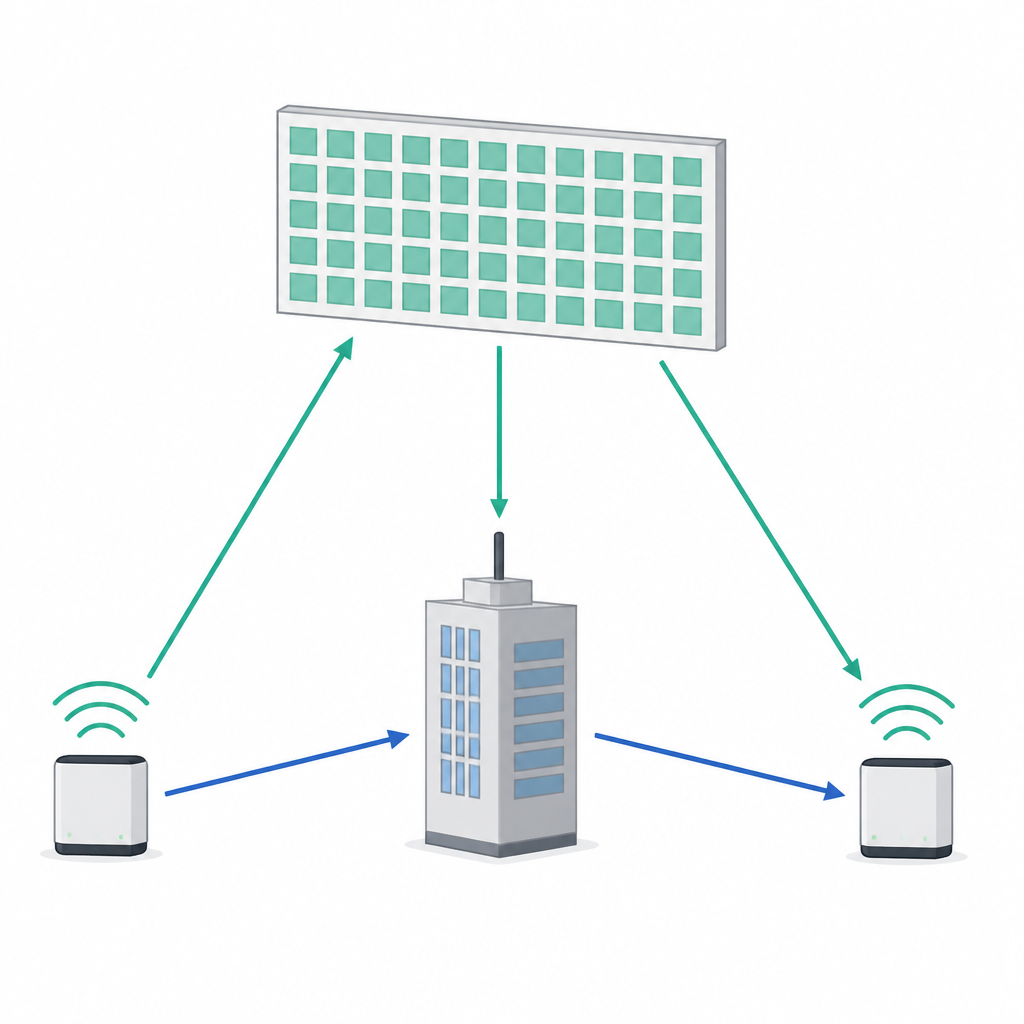
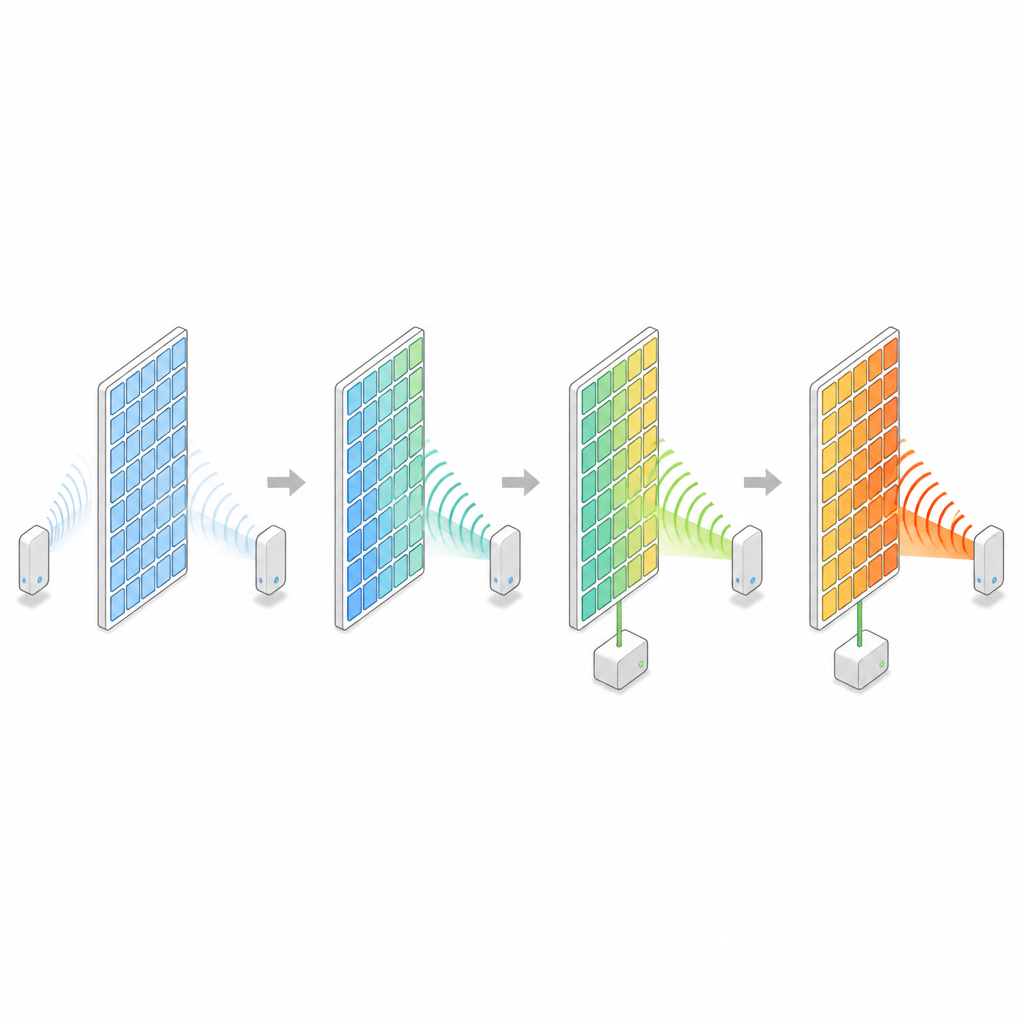
A key idea in this work is the intelligent reflecting surface, a flat panel made of many tiny elements that can bounce incoming radio waves in chosen directions. Unlike a traditional relay station that actively receives and retransmits signals, this smart wall is mostly passive, adjusting only how it reflects signals. By carefully tuning the reflection of each tiny element, the panel can boost the strength of the signal where it is needed, much like tilting a mirror to direct light onto a target. This offers a way to improve coverage and data rates while adding only a small amount of extra power consumption to the network.
Two Ways to Talk in Both Directions
The researchers focus on a setting where two users exchange data in both directions. They study two main designs. In the first, called bidirectional relay transmission, the users communicate through a relay node placed between them, with help from the reflecting surface. In the second, called bidirectional direct transmission, the users talk directly to each other, again with the surface assisting by guiding the signal. Both designs use two time slots for the exchange, but in one case the relay amplifies and forwards the mixed signals, while in the other case the users communicate without a relay. The question is which setup uses energy more efficiently under realistic conditions.
Tuning Power and Reflections Together
To compare the two designs fairly, the authors consider the full energy budget, including the transmit power of all nodes and the circuit power used by the electronics and the reflecting surface. They define energy efficiency as the total data rate achieved per unit of total power consumed. Instead of treating the relay power and reflecting surface control separately, they jointly adjust both. Using advanced mathematical tools, they design an algorithm that searches over the allowed power levels and the phase settings of every reflecting element to find combinations that give the highest data per watt. This process is carried out for both the relay-based and direct links so that each one is pushed close to its best possible performance.
When the Relay Gains the Edge
Once the best settings are found, the study compares the two designs across a wide range of transmit power levels and channel conditions using computer simulations. The results show that at very low total transmit power, the direct link with the reflecting surface tends to be more energy efficient, partly because the relay adds extra circuit power. However, once the total transmit power exceeds about -5 dBm, the relay-assisted link consistently provides higher data per watt. In this regime, the benefit of the relay in strengthening the two-way connection outweighs its extra hardware cost, and the reflecting surface helps both designs, with more elements bringing higher efficiency for the same power budget.
Why This Matters for Everyday Users
For non-specialists, the main takeaway is that future wireless systems can save energy by using smart reflecting panels that reshape how signals travel, and by carefully sharing power among users, relays, and these panels. The study shows that a relay plus a reflecting surface can be the better choice once the network is operating above a modest power level, while a simpler direct connection may be preferable at very low power. These insights can guide network planners in choosing architectures that keep devices connected while limiting energy use, supporting greener and more capable communication systems.
Citation: Cai, C., Zhang, J., Zhong, F. et al. Energy-efficiency optimization and comparison for IRS-assisted bidirectional relay and direct transmissions. Sci Rep 16, 16429 (2026). https://doi.org/10.1038/s41598-026-52438-2
Keywords: intelligent reflecting surface, energy efficiency, bidirectional relay, wireless communication, 6G networks